
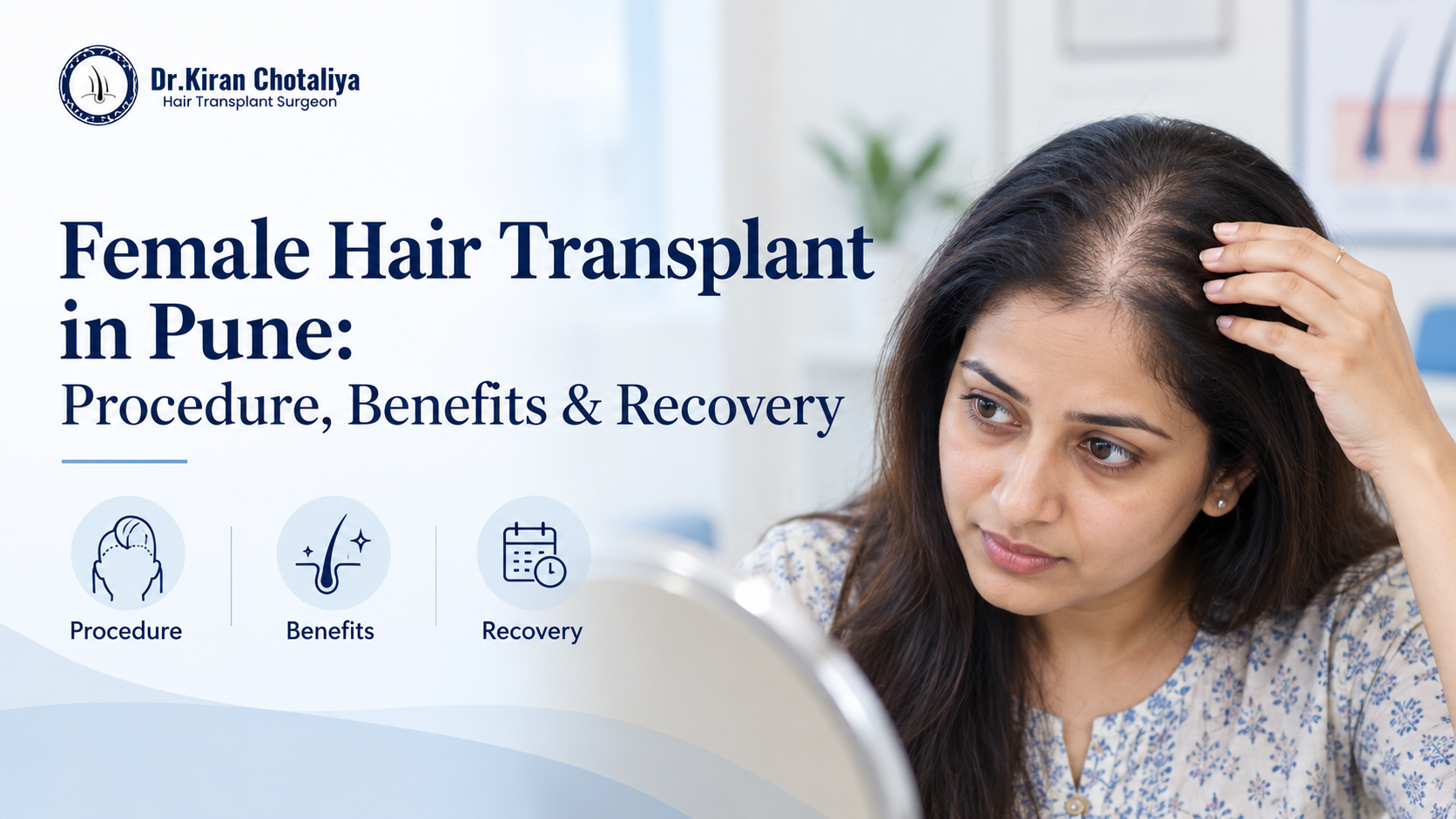
Hair thinning in women can affect confidence, styling choices, and everyday comfort. Unlike male pattern baldness, female hair loss often appears as diffuse thinning, a widening part line, reduced volume, or thinning around the crown. If you are considering a Female Hair Transplant in Pune, a consultation with Dr Kiran Chotaliya can help you understand the cause of hair loss and whether restoration treatment is suitable for you.
Dr Kiran Chotaliya provides personalised assessment and treatment planning for women experiencing hair thinning, receding hairlines, and reduced scalp coverage. Explore Female Hair Transplant in Pune and book a consultation to discuss your individual goals.
Understanding Female Hair Loss
Female hair loss can occur due to genetics, hormonal changes, thyroid concerns, iron or vitamin deficiencies, stress, PCOS, childbirth, and certain medical conditions. It may present as overall thinning, a widening parting, reduced hair volume, or thinning at the crown.
Because female hair loss patterns can differ from male patterns, a detailed evaluation is important. A consultation helps assess the scalp, donor area, medical history, and underlying factors before recommending treatment.
What Is a Female Hair Transplant?
A female hair transplant is a surgical hair restoration procedure in which healthy hair follicles are moved from a donor area—usually the back or sides of the scalp—to areas affected by thinning. The goal is to improve hair density, restore a natural hairline, and create a fuller appearance.
At Dr Kiran Chotaliya’s clinic, treatment planning may include FUE (Follicular Unit Extraction), Sapphire FUE, BIG FUE, and other suitable approaches based on the patient’s hair loss pattern, donor strength, and restoration goals. The process includes consultation, hairline design, donor extraction, recipient-site creation, implantation, and post-procedure care.
Who May Be Suitable?
A female hair transplant may be suitable for women who:
-
Have female pattern hair loss with a stable donor area.
-
Experience thinning at the crown, temples, or part line.

-
Have healthy donor hair at the back of the scalp.
-
Have realistic expectations about density and coverage.
-
Are medically stable and able to follow pre- and post-treatment instructions.
Not every woman with hair loss is an immediate candidate for surgery. It is important to address underlying concerns such as iron deficiency, thyroid imbalance, vitamin D deficiency, and hormonal issues before planning transplantation.
Consultation and Treatment Planning
A consultation is the first step towards informed hair restoration. During the appointment, the doctor evaluates the hair loss pattern, scalp condition, donor area, and individual expectations before creating a personalised plan.
The treatment journey may include:
-
Consultation and scalp evaluation.
-
Assessment of underlying medical or nutritional factors.
-
Hairline planning based on facial proportions and restoration goals.
-
Donor-area assessment and graft extraction.
-
Recipient-site creation and graft implantation.
-
Post-procedure care and follow-up planning.
Before proceeding, ask about the recommended technique, estimated graft requirement, expected timeline, risks, limitations, and complete treatment cost.
Hair Transplant Techniques for Women
Different techniques may be considered depending on the extent of hair loss and donor availability.
-
FUE: Individual follicles are extracted and implanted, generally with minimal visible scarring and a relatively quick recovery.
-
Sapphire FUE: Uses specialised blades to create recipient channels, with a focus on precision and natural-looking placement.
-
BIG FUE: May be considered in selected cases where scalp donor hair is limited and body hair grafts are being evaluated.
-
FUT: Involves removing a small strip of donor tissue and may be considered in specific cases.
The most suitable option depends on your hair loss pattern, donor area, desired density, and medical assessment.
Female Hair Transplant Cost in Pune
The cost of a female hair transplant in Pune depends on the extent of hair loss, the number of grafts required, the technique used, donor-area quality, and the individual treatment plan.
Before booking, request an itemised estimate and clarify whether the cost includes consultation, procedure charges, medicines, aftercare, and follow-up visits. This helps you compare options transparently.
Recovery and Aftercare
Following the prescribed aftercare routine is important for protecting transplanted grafts and supporting healing. Patients are generally advised not to touch, rub, or scratch the treated area, to follow the recommended hair-wash routine, avoid direct sun exposure and strenuous activity initially, sleep with the head slightly elevated, and take prescribed medicines as advised.
Hair growth takes time. Initial growth may begin in a few months, while fuller results typically become visible over the following months as the transplanted hair matures.
Why Choose Dr Kiran Chotaliya?
Dr Kiran Chotaliya is a dermatologist and hair transplant surgeon in Pune who focuses on personalised female hair restoration planning. His approach includes detailed evaluation, soft and natural hairline design, FUE-based techniques, and guidance on realistic expectations.
If you are searching for a female hair transplant surgeon in Pune or a hair transplant clinic in Pune, begin with a consultation that explains your options clearly and helps you make an informed decision.
Book a Consultation
Considering a Female Hair Transplant in Pune? Visit Female Hair Transplant in Pune with Dr Kiran Chotaliya to learn more about hair loss assessment, treatment options, suitability, costs, and aftercare. A consultation can help you take an informed step towards restoring hair density and confidence.
 umar.medigrow
 aggiecarpetcleaning