
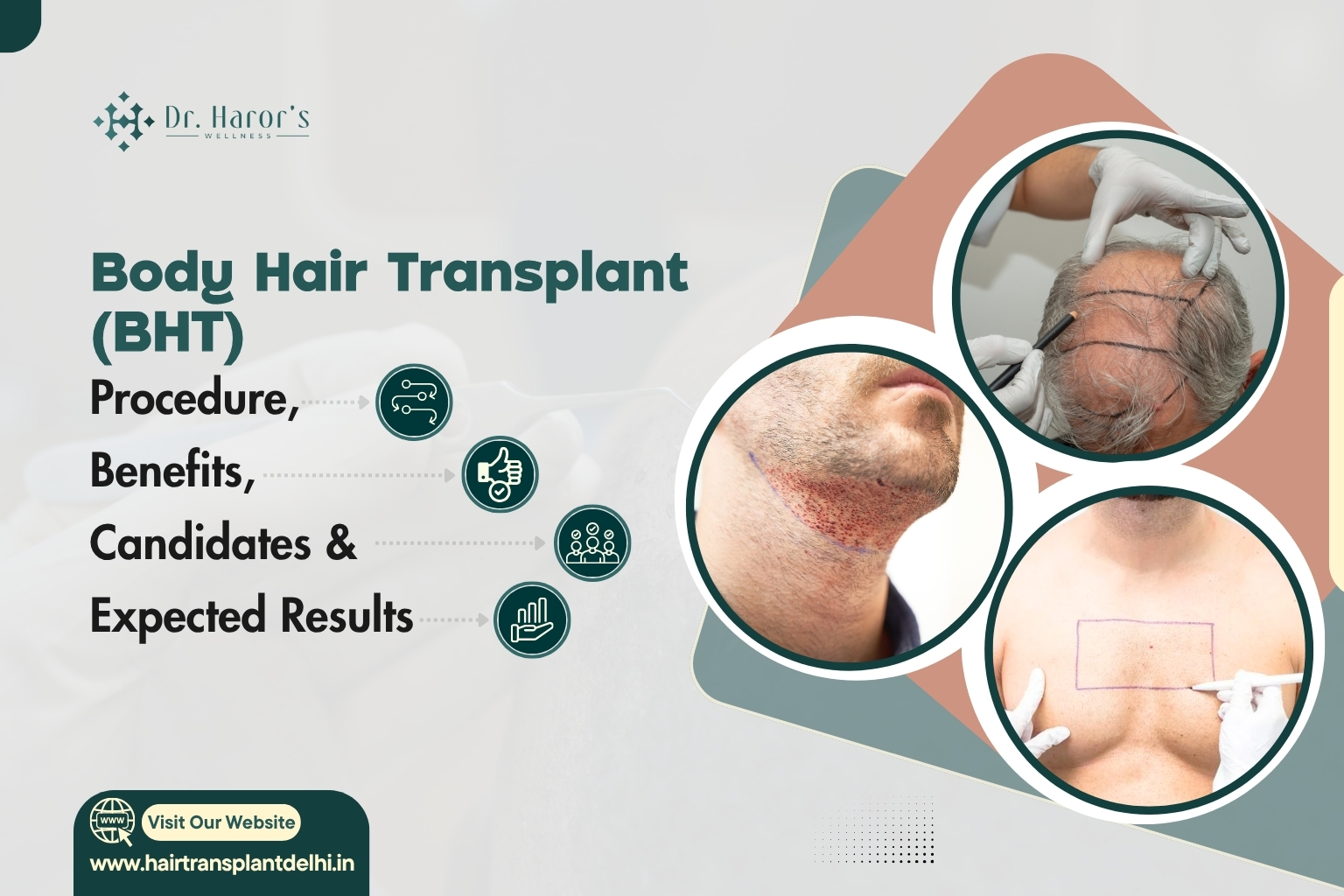
For decades, hair transplants relied almost entirely on harvesting hair from the back and sides of the scalp. But for many people looking for a hair transplant, including those who experience advanced hair loss or who’ve already undergone one or more procedures, a common question remains in mind: there simply isn’t enough scalp donor hair left to work with. Body hair transplant has stepped in as a solution, providing an alternative donor source when the scalp can no longer keep up with your demand. This breaks down what BHT actually consists of, who it’s suited for and what kind of results to realistically expect.
What is Body Hair Transplant?
In a body hair transplant, hair follicles from anywhere on the body other than the scalp, typically the chest and back or beard (and sometimes legs or arms), are used as donor grafts. After those follicles are obtained, they are inserted into the areas experiencing hair thinning or balding, such as the scalp, eyebrows and beard itself. BHT isn’t typically a first-choice option. It’s generally used when scalp donor density is insufficient on its own, either due to extensive hair loss or because previous transplant sessions have already used up much of the available scalp supply.
The Procedure: Step by Step:
- Consultation and donor assessment: The hair density and coarseness, as well as growth-cycle characteristics of hairs from the various potential donor regions, are then evaluated by a surgeon. Considering that not everybody’s hair behaves like scalp hair, this step is essential for anticipating how well the transplanted grafts will grow.
- Extraction technique: Body hair transplant is almost invariably performed using Follicular Unit Extraction (FUE), since body hair grows in single-follicle units, whereas scalp hair grows in multi-hair groupings. A fine punch tool is used to extract each follicle one by one.
- Recipient site preparation and implantation: The grafts are inserted one by one into incisions made in the area of the recipient, following careful direction and angle that mimics hair growth.
- Recovery: Both donor and recipient sites will most often heal by days 7–10, though minor scabbing may continue for longer. Body hair extraction is also slower and more labour-intensive compared to scalp FUE, so sessions often deliver fewer grafts per hour and may ultimately require an additional visit.
Key Benefits of BHT:
- Solves the donor shortage problem: Can provide new sources of grafts for patients lacking sufficient scalp donor areas.
- Versatile application: It can also be used to increase scalp density, fill in the beard, thicken eyebrows or cover up old transplant scars with body hair grafts.
- Minimal donor scarring: Since FUE produces scattered punch marks as opposed to a linear scar, the visibility of donor-site scarring is significantly less than that of strip harvesting (FUT).
- Combinable with scalp grafts: Many surgeons blend body hair grafts with scalp-donor grafts to build a fuller, more natural-looking result, especially in advanced cases.
Who Is a Good Candidate?
- Men with a high degree of hair loss (Norwood stage V and above) who do not have enough scalp donor hair
- Is necessary for patients with one or more previous transplants
- Individuals seeking to increase the thickness of their beard, chest or eyebrows sử dụng body Hair as the source
Those with fine or low-density body hair (a rarity) do not make good candidates because the quality of grafts is highly contingent on the characteristics of the donor area. Conditions relating to the scalp or skin may also determine candidacy. Because outcomes vary significantly from person to person, a consultation with a surgeon experienced specifically in BHT is essential before moving forward. Not every clinic that performs scalp transplants has equal expertise in body hair extraction.
Expected Results & Timeline:
Like with any other hair transplant, patience is the key here:
- Weeks 2–4: Shedding of transplanted hairs, normal process, skin is OK
- Months 3-4: Dormant follicles start sprouting new hair.
- Months 6–9: More noticeable increase in density.
- Months 12–18: The results begin to finalise, and hair takes shape with its permanent texture and thickness.
Conclusion
Body Hair Transplant (BHT) is now seen as a solution to hide areas of the scalp where there is not enough hair on the donor site for those who want to fill in their hair more. When experienced surgeons choose appropriate donor areas and utilise advanced FUE technologies, they can yield significant, subtle and permanent hair restoration results. But as every patient is different, performing a rigorous consultation beforehand is always paramount before treatment. When it comes to body hair transplant in Delhi, look no further than Dr. Haror’s Wellness for Customized hair restoration solutions using advanced techniques and personalised treatment plans. Through expert evaluation, modern technology and patient-oriented care, the clinic is helping those seeking safe and simple. Book your appointment today!
FAQs
Q1. Is a Body Hair Transplant permanent?
Yes, transplanted hair is generally permanent when performed on suitable candidates.
Q2. Which body hair is best for a Body Hair Transplant?
Beard hair is often considered the best option because of its thickness and growth characteristics.
Q3. Is a body hair transplant painful?
The procedure is performed under local anaesthesia, so discomfort is usually minimal.
 Flypped Digi
  ponec86
  corewellness60@gmail.com