
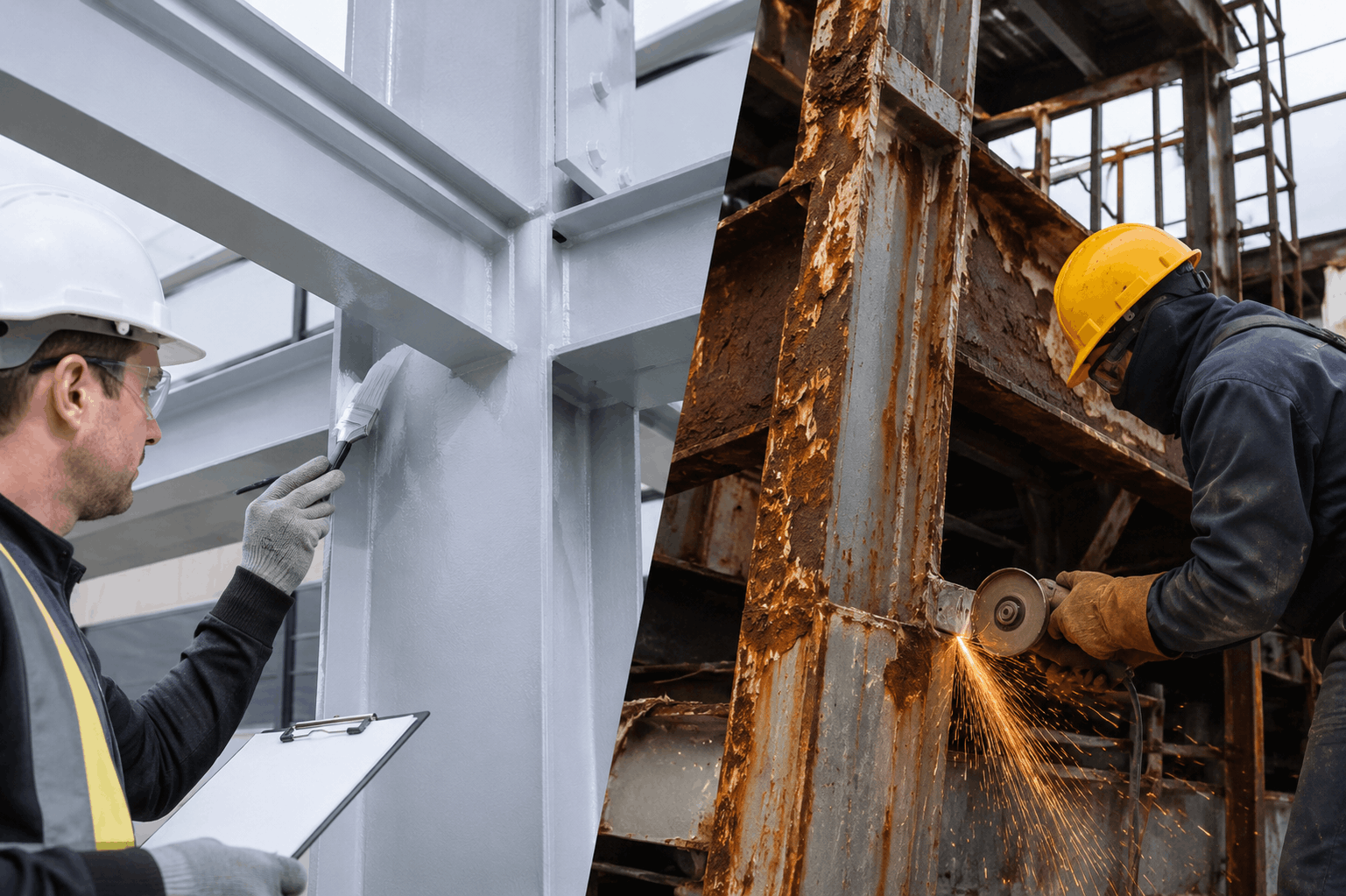
This is a situation that most facilities managers responsible for commercial buildings with significant architectural steelwork will recognise. You are standing in front of a steel element, and you can see that something is wrong. The coating is failing in some way; there’s rust showing through somewhere, and the surface looks different to how it looked a year ago, or whenever you last properly looked at it.
The question that follows is the one this article aims to answer. “Is the issue a maintenance problem or a replacement problem?”
Most facilities managers are not structural engineers or coating specialists, nor are they expected to be. But they are expected to make initial assessments that determine whether a specialist is called, what kind of specialist, and with what urgency. Getting that initial assessment wrong in either direction has real consequences, as calling for full replacement when recoating would have resolved the problem costs unnecessary money, causes unnecessary disruption, and removes steelwork that had useful remaining life.
Missing the signs that a steel element has deteriorated beyond the point where recoating is appropriate and applying a new coating over a compromised substrate produces a result that fails faster than the original and defers the replacement to a pricier and more disruptive future point.
This article will give facilities managers the framework to make that initial assessment correctly and to make the right decisions.
Understanding What Architectural Steelwork Coating Failure Actually Is
The Four Stages of Coating Failure and What Each One Means
Coating failure on architectural steelwork is not a binary event but a progressive process that moves through stages, and the stage at which it is identified determines which intervention is appropriate. Understanding the stages is the foundation of any useful assessment.
- Stage one
The first stage is the surface degradation of the topcoat. The coating is losing its appearance, but its adhesion to the substrate is still intact, and its protective function, while diminished, has not been lost. At this stage, the steel beneath the coating is protected from the atmosphere, so corrosion is prevented. This is the earliest and most cost-effective intervention point. On site spray painting restores both the appearance and the protective function of the coating system without any need for substrate treatment.
- Stage two
The second type of failure is adhesion failure, which occurs without any corrosion. The coating is lifting, bubbling, or delaminating in areas, but the steel beneath has not yet begun to corrode. This is still a recoating situation but a more demanding one. The failed coating must be fully removed, the substrate prepared correctly, and a new coating system applied. The key characteristic of stage two is that the steel itself is sound, and a properly applied new coating system will protect it effectively for years.
- Stage three
The third stage comes in when there’s active surface corrosion with an intact section. Rust is present on the steel surface, but it is a surface phenomenon rather than a structural one. The steel has lost some material from its surface, but the section remains structurally sound. Recoating is more complex and costly at this stage, but it is still the best option in most cases. All active corrosion must be removed before any coating is applied. Applying a coating over active corrosion does not stop it. It seals moisture and oxygen against the steel surface and accelerates the process beneath the coating while producing an appearance of repair.
- Stage four
The fourth stage is active corrosion with section loss. The steel has been lost due to corrosion, resulting in a reduction of its structural cross-section. This is the stage that changes the nature of the question from a coating decision to a structural decision. Whether the section loss is significant enough to require replacement depends on the structural role of the element, the degree of section loss, and whether the remaining section can be assessed as adequate for continued safe use.
The Specific Visual Indicators of Each Stage
- Stage one presents as surface dulling, colour fading, and chalking. The coating is intact and continuous, but its surface has degraded. Running a finger across a stage-one surface typically produces a slight transfer of chalky powder, which is the degraded surface of the coating.
- Stage two presents as visible lifting, bubbling, or delamination. It usually occurs where the coating has separated from the substrate or the layer below and is no longer continuous. The steel beneath may be discoloured but should not show active rust at this stage. Pressing on a bubbled area may produce a hollow sound or a slight movement of the coating film.
- Stage three presents as rust, which is the visible orange-brown colouration in areas where the coating has completely failed in areas where the coating has failed completely and the steel is exposed. The rust may be localised to specific points or more widespread across the surface. The coating surrounding the rusted areas may still appear intact but is typically losing adhesion at the boundary between sound coating and exposed steel.
- Stage four presents as visible section loss leading to pitting that has created depth in the steel surface rather than just surface discolouration or more severe loss, which is apparent as a thinning of the section at edges, flanges, or other vulnerable areas. In severe cases, perforation of thin sections may be visible. The steel surface in affected areas has a roughened, pitted texture that distinguishes it from the smooth surface of stage three corrosion.
The Recoating Decision: When Does It Become the Right Choice?
When On Site Spray Painting Is the Correct Intervention
Recoating architectural steelwork through on site spray painting is the correct intervention when the steel is at stage one, stage two, or stage three, which means when the coating has failed to some degree but the steel itself remains structurally sound and can be brought to a clean, sound surface through preparation.
The critical variable in any recoating decision is not the extent of the coating failure but the condition of the steel beneath it. Steel that is intact, dimensionally sound, and capable of being brought to the surface by the new coating system is steel that can be recoated.
- For stage one failures, preparation is straightforward. It simply includes cleaning, degreasing, abrasive treatment of the existing surface to provide a mechanical key for the new coating, and application of the topcoat with or without a primer depending on the existing coating condition and the new system specification.
- For stage two failures, preparation is more extensive and involves fully removing the failed and delaminating coating, abrasively preparing the exposed substrate to meet the surface cleanliness standard required by the coating system, and then applying primer and topcoat.
- For stage three failures, preparation must address the active corrosion before any coating is applied. All rust must be removed, and any pitting created by the corrosion must be assessed for depth and treated appropriately. Shallow surface pitting can be addressed with a suitable primer system; deeper pitting may require filling before coating. And the coating system applied over previously corroded steel should include a corrosion-inhibiting primer that provides active rather than purely barrier protection.
The Replacement Decision: When Does Replacement Become the Better Choice?
When Replacement Is Genuinely Necessary and What That Assessment Requires
Replacement of architectural steelwork becomes the right answer when the steel has lost structural section to corrosion to a degree that cannot be assessed as safe for continued use, when the geometry of the element makes adequate surface preparation impossible, or when the element has been deformed or damaged in ways that preparation and recoating cannot address.
Summing Up
To sum up, there are instances when a building requires either recoating or complete replacement. Both these processes are known to beautify the building and strengthen it from the inside, but the total cost difference is a major one, and therefore, you must opt for the right thing when a building demands it. This ensures that the building stays strong, and at the same time, the cost incurred is also a fair one.
 Peak Peptides
  Sushant Ramnarine
  Supply Base Solutions