
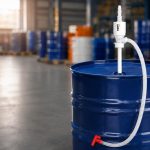
Why Manual Transfer Still Earns Its Place

Half a drum is left, the receiving container is ready, and nobody wants to tip it by hand. A Siphon Pump handles that frequent transfer job without an electric motor. Giza describes its siphon range as manually operated, requiring no electricity, and currently lists seven application areas, including chemical units, automotive workshops, fuel stations, manufacturing, agriculture, paint facilities and warehouses.
The issue is straightforward. A cheap transfer method stops being cheap once leakage, contaminated stock and cleanup enter the calculation.
That is where poor buying decisions become expensive.
How a Siphon Pump Actually Moves Liquid
Working Principle
A siphon needs a primed, liquid-filled path and a discharge point lower than the source liquid level. Once flow starts, gravity and pressure difference keep liquid moving until air enters the line or the transfer is stopped.
For water at standard atmospheric pressure, the theoretical maximum siphon height is about 10.3 metres. Actual working height is lower because friction, vapour pressure and air leakage affect the flow.
Materials, Types and the Detail Buyers Skip
Giza identifies polypropylene, PVC and rubber tubing among materials used in its siphon construction. Its wholesale range also lists four categories: manual siphon pumps, drum-mounted models, chemical-resistant models and heavy-duty industrial transfer siphons.
Most buyers ask about flow first. The better question is compatibility. A hose suitable for diesel may be wrong for a solvent or acid, so wetted materials should match the actual liquid rather than a vague description such as “chemical.”
Five Supplier Checks That Prevent the Wrong Purchase
Giza states that siphon units are checked for performance, pressure and leakage before dispatch—three useful inspection points buyers can put into their purchasing checklist.
- Material compatibility: Ask for exact body and tubing material. A bad answer is, “It works with all chemicals.”
- Application fit: Share liquid name, viscosity and container size. A bad answer is recommending a model without asking these details.
- Testing: Ask what is checked before dispatch. A poor response is, “We handle defects after delivery.”
- Bulk consistency: Approve a sample or written specification first. A bad answer is, “Every batch is roughly the same.”
- After-sales clarity: Confirm replacement tubing and complaint handling. A bad answer is silence after payment.
Buying entirely on price is a procurement mistake. Saving a few rupees per unit means little if tubing softens, joints leak or batch quality changes.
Benefits That Protect Cost, Safety and Stock
A basic manual siphon has 0 kW electrical demand during operation, and Giza specifically lists no-electricity operation among the product’s features.
- No motor expense: useful for intermittent transfer jobs where powered equipment may remain idle.
- Less drum tilting: helps reduce exposure to accidental spills.
- Easy portability: fewer components make movement between drums and work areas simpler.
- Lower maintenance: no electric motor, cable or switchgear on a basic manual unit.
- Better stock protection: compatible tubing lowers contamination and premature hose-failure risk.
- Resale flexibility: wholesalers can cover several routine transfer applications without stocking powered equipment for every job.
For low-volume drum work, zero electrical demand is hard to argue with.
Availability in India Is a Logistics Question, Not Just a Keyword
For buyers comparing Siphon Pump Manufacturers, Wholesalers or Dealers, location affects freight, replenishment and complaint turnaround.
Giza lists its facility at Shapar, Rajkot, Gujarat 360024, states nationwide delivery availability, and publishes an enquiry response target of less than 48 hours.
Good Siphon Pump Suppliers in India should be judged on ready stock, batch consistency and replacement support, not unit price alone. A supplier who cannot tell you what is actually available is selling a promise, not inventory.
About Giza Pumps
We have been operating under Swastik Enterprise since 1999, and our website records 27+ years of industry experience. Our published company figures also show 25+ team members and more than 90% repeat orders.
We work across siphon, barrel, drum and electric liquid-transfer pumps. We test our siphon pumps for performance, pressure and leakage before dispatch. We’ve learned to start selection with fluid type, viscosity and usage pattern because those three details tell us far more than simply asking for “a chemical pump.”
We publish an enquiry response target below 48 hours, and our siphon product page accepts requirements ranging from 1 pump to bulk deliveries.
Send us the liquid name, container or drum size, required quantity and delivery PIN code. We’ll use those details to recommend the suitable Giza Pumps siphon option and confirm commercial terms before order placement.
Conclusion
A Siphon Pump is simple, but the buying decision should not be casual. Material compatibility, batch consistency and testing matter more than a low first quote, and Giza identifies three pre-dispatch checks: performance, pressure and leakage.
Buyers who specify the liquid correctly today are far less likely to fight avoidable leakage and replacement problems tomorrow.
FAQs
1. Does a Siphon Pump need electricity?
No. Giza’s manual siphon range works without electricity. The caveat is that correct priming and a suitable height difference are still necessary for effective siphon flow.
2. What liquids can a siphon pump handle?
Giza lists chemicals, fuel, water, oils and other light liquids. Compatibility still depends on wetted materials, so never assume one hose suits every acid or solvent.
3. What should I ask Siphon Pump Manufacturers before ordering?
Ask about body material, tubing, compatible liquids, testing and replacement parts. Giza publishes three checks for its siphon range: performance, pressure and leakage.
4. Do Siphon Pump Wholesalers supply single units too?
Some wholesalers concentrate on bulk quantities. Giza states requirements can range from one pump to bulk deliveries, allowing buyers to validate smaller quantities before scaling.
5. How should I compare Siphon Pump Dealers?
Compare actual stock, application knowledge, batch consistency and complaint handling. A dealer quoting only price gives you one number while leaving the operating risk with you.
6. What should I expect from Siphon Pump Suppliers in India?
Expect clear material information, realistic dispatch communication and application guidance. Giza publishes nationwide delivery and a response target below 48 hours, though transit time varies by destination.
7. Which siphon models are available for wholesale requirements?
Giza lists four broad options: manual, drum-mounted, chemical-resistant and heavy-duty industrial transfer siphons. Confirm the exact model against the liquid before placing an order.
 All Writer Destination
 pop up stands dubai