
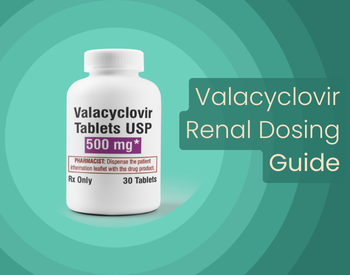
Antiviral therapy plays a vital role in suppressing herpes virus infections, including herpes zoster (shingles), herpes simplex (cold sores and genital herpes), and varicella (chickenpox). Valacyclovir is one of the most widely prescribed oral antivirals due to its superior bioavailability compared to its parent compound, acyclovir.
Because valacyclovir is converted into acyclovir and primarily eliminated by glomerular filtration and active tubular secretion in the kidneys, a patient’s renal function directly impacts how the drug is processed. When kidney filtration slows down, the active metabolite accumulates rapidly in the bloodstream. Without proper renal dose adjustments, standard dosing regimens can lead to severe adverse reactions, including acute kidney injury (AKI) and central nervous system (CNS) neurotoxicity.
This guide details how valacyclovir operates, why renal dosing adjustments are essential, standard dosage modifications across stages of kidney impairment, and key clinical precautions to ensure safe treatment.
Pharmacokinetics: How the Kidneys Process Valacyclovir
Valacyclovir is a L-valyl ester prodrug designed to overcome the poor oral absorption of acyclovir. Upon oral ingestion, it undergoes rapid and nearly complete first-pass intestinal and hepatic metabolism, converting into acyclovir and the essential amino acid L-valine.
[Oral Valacyclovir Ingestion] ➔ [Rapid First-Pass Conversion to Acyclovir] ➔ [80%+ Renal Clearance via Kidneys]
Key Pharmacokinetic Properties:
-
Bioavailability: Approximately 54% (compared to 15–30% for oral acyclovir).
-
Elimination Route: More than 80% of acyclovir is excreted unchanged in the urine through glomerular filtration and active tubular secretion.
-
Half-Life Clearance: In patients with normal renal function (creatinine clearance >80mL/min), the elimination half-life of acyclovir is approximately 2.5 to 3 hours. In patients with end-stage renal disease (ESRD), the half-life extends significantly to 14–20 hours.
Hazards of Unadjusted Dosing: Neurotoxicity and Crystalluria
Administering standard doses of valacyclovir to an individual with reduced kidney function without appropriate dose reduction increases the risk of two serious clinical complications:
1. Acyclovir-Induced Neurotoxicity
Excessive systemic accumulation of acyclovir can cross the blood-brain barrier, triggering severe central nervous system effects. Symptoms typically manifest within 24 to 72 hours of starting unadjusted treatment and include:
-
Confusion, agitation, and visual or auditory hallucinations
-
Tremors, myoclonus (involuntary muscle twitching), and ataxia
-
Encephalopathy, altered consciousness, lethargy, and seizures
2. Crystal Nephropathy and Acute Kidney Injury (AKI)
Acyclovir has low solubility in human urine. When high plasma concentrations filter through the nephrons, acyclovir crystals can precipitate inside the lumen of the renal tubules. This intratubular crystal deposition causes mechanical obstruction, localized inflammation, and acute tubular necrosis, worsening baseline renal dysfunction.
Valacyclovir Dosing Adjustments Based on Creatinine Clearance
Dosing schedules for valacyclovir vary based on the specific clinical indication (e.g., herpes zoster vs. genital herpes) and the patient’s estimated creatinine clearance (CrCl).
Prior to prescribing or dispensing, clinicians evaluate kidney function using the Cockcroft-Gault formula or estimated glomerular filtration rate (eGFR).
Evaluating exact filtration rates and matching them to specific treatment regimens is crucial for patient safety. For a comprehensive breakdown of clinical indications, hemodialysis supplemental schedules, and prescribing tables, consult the detailed Valacyclovir renal dosing guide for step-by-step clinical guidance.
Special Considerations: Dialysis Patients
Patients with end-stage renal disease (ESRD) maintained on chronic renal replacement therapy require specific timing considerations:
-
Intermittent Hemodialysis (IHD): Hemodialysis efficiently removes acyclovir from the bloodstream, clearing approximately 33% to 60% of systemic drug concentrations during a 4-hour dialysis session. Therefore, the daily adjusted dose should be administered after the completion of hemodialysis on treatment days to prevent premature drug clearance.
-
Peritoneal Dialysis (PD): Supplemental doses after peritoneal dialysis sessions are typically not required, as peritoneal clearance is significantly lower than hemodialysis clearance.
Essential Safety Precautions and Patient Advice
-
Maintain High Fluid Intake: Aggressive oral hydration encourages steady urine flow, diluting acyclovir concentrations within the renal tubules and minimizing the risk of intratubular crystal precipitation.
-
Monitor Baseline Renal Function: Elderly patients, individuals with pre-existing chronic kidney disease (CKD), and those taking concurrent nephrotoxic agents (such as NSAIDs, ACE inhibitors, or aminoglycosides) should have serum creatinine checked before starting therapy.
-
Recognize Early Signs of Toxicity: Patients and caregivers should seek immediate medical evaluation if sudden confusion, excessive drowsiness, involuntary muscle jerks, or a sharp drop in urine output occurs during treatment.
Frequently Asked Questions
Why does valacyclovir require lower doses than acyclovir for the same condition?
Valacyclovir has significantly higher oral bioavailability than acyclovir. Once absorbed, it converts efficiently into acyclovir in the body, achieving higher blood drug concentrations with fewer daily doses.
Can taking valacyclovir cause permanent kidney damage?
In most cases, acute kidney injury resulting from acyclovir crystallization is reversible once the medication is discontinued, intravenous fluids are administered, and renal blood flow is restored. However, underlying chronic kidney disease can complicate recovery.
Is dose reduction necessary for elderly patients with normal serum creatinine?
Serum creatinine alone can overestimate kidney function in elderly patients due to age-related loss of muscle mass. Clinicians should always calculate estimated creatinine clearance (CrCl) or eGFR, as age-related decline in filtration often necessitates dose adjustments even if serum creatinine appears within normal reference ranges.
Can valacyclovir be taken with food?
Yes. Valacyclovir can be taken with or without food. However, taking each dose with a full glass of water is strongly recommended to maintain adequate hydration.
Summary
Valacyclovir is a highly effective antiviral agent, but its safe clinical use relies on matching dosages to renal filtration capacity. Because the kidneys clear the vast majority of its active metabolite, recognizing renal impairment, calculating creatinine clearance, and implementing appropriate dose reductions are crucial steps to prevent drug accumulation, neurotoxicity, and crystal-induced kidney injury.
 eliza arthur
 snehamaheshwri
 managementconsulting815@gmail.com