
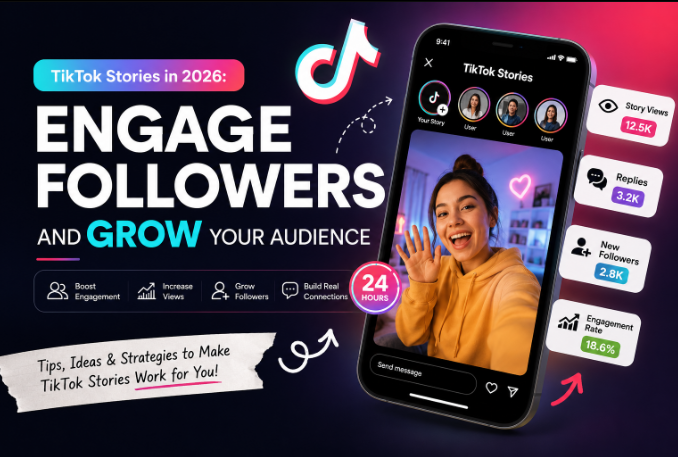
TikTok Stories are an easy way to share quick, timely content without treating every post like a polished video. They can show photos or videos for 24 hours and can appear from your profile, inbox, For You feed, and Following feed. Viewers can also reply to or react to Stories, making the format useful for starting conversations rather than simply collecting views.
For creators, influencers, and businesses, the real value of TikTok Stories is not simply posting more content. It is using the format to stay visible, understand what your audience responds to, and turn casual viewers into people who regularly interact with your account. This guide explains how to use TikTok Stories, how to post them, what to share, how to improve Story engagement, and how businesses can use Stories without making their content feel like constant advertising.
What Are TikTok Stories?
TikTok Stories are temporary posts that remain available for 24 hours. Unlike a normal TikTok video that becomes part of your profile’s long-term content library, a Story is designed for more immediate updates and casual interaction.
That difference is important.
A regular TikTok video might be carefully edited, optimized for discovery, and designed to attract new viewers. A Story can be simpler. You can use it to show what you are doing today, ask a question, share a quick update, tease an upcoming video, or give followers something that feels more personal. Because Stories can appear in several places across TikTok, they can also create additional opportunities for your existing audience to interact with you.
Why Should You Use TikTok Stories in 2026?
TikTok Stories work best when they support your main content strategy rather than replace it. TikTok’s recommendation system is heavily personalized around what people watch and interact with, so creators should focus on content that matches their audience’s interests instead of chasing views alone. TikTok itself explains that the For You feed uses signals such as interactions, similar content watched, popularity in a user’s country, and recency.
Stories can support that strategy in several ways:
- Keep your audience updated: Share quick announcements, behind-the-scenes moments, or daily updates.
- Encourage interaction: Ask questions and invite replies.
- Test content ideas: Find out what your audience reacts to before investing heavily in a full video.
- Build familiarity: More casual content can make a creator or brand feel approachable.
- Support launches: Tease a new product, video, livestream, or announcement.
- Create a content habit: Stories give you another lightweight format for staying active.
For businesses, this fits into a broader TikTok strategy that can include organic videos, creator partnerships, UGC, advertising, TikTok Shop, and analytics. Shopify’s current 2026 guidance also recommends experimenting with different formats, such as TikTok Stories, rather than relying on a single content type.
How to Use TikTok Stories
The best approach is to give every Story a small purpose. Before posting, ask yourself: What do I want the viewer to do or feel after watching this?
You might want them to:
- reply to a question,
- visit your profile,
- watch your latest video,
- learn something,
- vote between two options,
- become interested in a product,
- or simply remember your account.
This prevents your Stories from becoming a collection of random updates.
People do not always want perfectly polished content. Showing the process behind your work can make your account feel more authentic.
For example:
- preparing an order
- filming a TikTok
- designing a product
- working on a new project
- preparing for an event
- or showing what happens before a video goes live.
Behind-the-scenes content is also a useful business format because it gives customers a look at the people and process behind a brand. Shopify’s 2026 TikTok guidance highlights behind-the-scenes content as one way small businesses can make their content more human and interesting.
2. Ask Simple Questions
A Story does not always need a complicated concept.
Try questions such as:
- Which one would you choose?
- Should I make part two?
- What should I test next?
- What topic should I cover tomorrow?
- Which product do you prefer?
The goal is to give people an easy reason to respond.
3. Tease Your Next Video
If you have a new TikTok coming, use your Story to create curiosity.
Instead of saying:
“New video coming soon.”
Try:
“I tested this for seven days. The result surprised me. Full video tonight.”
The second version gives viewers a reason to care.
4. Show Quick Tips
TikTok Stories are useful for small pieces of information that do not need a full video. For example, a fitness creator could share one quick exercise tip, while a marketing creator could share one SEO tip. If the tip creates a question or leads naturally into a longer video, even better.
How to Post a TikTok Story
If you are wondering how to post a TikTok Story, the process is straightforward. Open TikTok and use the creation option to capture or upload content. TikTok Stories can contain photos or videos, and the finished Story is available for 24 hours. TikTok also allows people viewing Stories to reply or react. The exact buttons and interface can change as TikTok updates its app, so it is better to follow the current options shown inside your own TikTok account rather than rely on an old screenshot-based tutorial.
TikTok Story Ideas That Are Actually Useful
If you regularly run out of ideas, build a few repeatable categories.
For creators
- Behind-the-scenes clips
- “Day in my life” moments
- Sneak peeks
- Unreleased ideas
- Questions for followers
- Opinions on current topics in your niche
- Follow-ups to recent videos
- Personal milestones
For businesses
- Product demonstrations
- New product previews
- Customer questions
- Frequently asked questions
- Packaging orders
- Limited-time announcements
- Customer reviews
- Team introductions
- Educational tips
- Links or directions to your latest content
A useful rule is 80% value or relationship-building and 20% promotion. You do not have to follow that percentage rigidly, but the principle is useful: if every Story feels like an advertisement, people have less reason to keep watching.
TikTok Stories for Business
Businesses can use Stories as a supporting layer around their main TikTok content. For example, imagine a skincare brand launching a new product. A normal TikTok could explain the product and demonstrate how it works.
The Stories could then:
- Show the product arriving.
- Give a behind-the-scenes look at preparation.
- Ask followers what they want to know.
- Answer one common question.
- Remind viewers about the launch.
- Share customer feedback afterward.
This creates a small content journey instead of relying on one promotional post. For businesses, TikTok should also be connected to measurable goals. Shopify’s 2026 guidance recommends setting objectives, understanding the audience, creating a consistent content strategy, experimenting with formats, and using analytics to identify which content performs best.
How to Get More TikTok Story Views
If your TikTok Story views are low, posting more often is not automatically the answer. Start by improving the reason people have to watch. Make the first frame useful A Story should communicate its purpose quickly.
Instead of a random photo, try:
- Would you buy this?
- This is what happened after 30 days.
- I made one mistake with this.
- Which version is better?
-
Give people a reason to return
- Create recurring formats.
For example:
- Monday: behind the scenes
- Wednesday: audience question
- Friday: new experiment
You do not need to follow this exact schedule. The idea is to make your Stories predictable enough that followers know what type of content they can expect.
Connect Stories with your main content
If a video performs well, continue the conversation through Stories. If a video gets questions, answer them. If a video gets people debating two choices, ask your Story audience which side they agree with. This makes your content feel connected instead of disconnected.
TikTok Story Engagement: What Matters?
Do not judge your Stories only by the number of views. Look at the quality of the response too.
Useful signals include:
- Story views
- Replies
- Reactions
- Profile visits
- Follows after interaction
- Traffic generated toward your other content
- Repeated engagement from your existing audience
The goal is not necessarily to get the biggest possible number every day. A smaller audience that consistently watches and responds can be more valuable than a large group that never interacts. This is especially important for businesses. TikTok’s broader analytics tools can help businesses understand metrics such as views, likes, comments, shares, traffic sources, search queries, new followers, and which content brings in new viewers.
Who Can See TikTok Stories?
If you are wondering who can see TikTok Stories, visibility depends on the privacy settings available for your account and the Story. TikTok provides privacy controls for content, and users should check the current Story/post privacy options before publishing anything personal or sensitive. TikTok’s official support resources are the safest place to confirm the settings available on your account because features and interface options can change.
Remember that a Story is temporary, but that does not mean everything shared online is completely private. Avoid posting confidential information, personal documents, private addresses, or anything you would not want saved or shared.
TikTok Story Viewer vs. TikTok Viewer Tools
You may see searches such as tiktok story viewer, tiktok viewer, tiktok profile viewer, anonymous tiktok viewer, or tiktok anonymous viewer when researching TikTok. These terms can refer to third-party websites or tools that claim to let people view TikTok content anonymously.
Be careful with them.
Do not give an unknown website your TikTok password, authentication codes, or other sensitive account information simply because it claims to offer anonymous viewing. If you only want to understand who viewed your own Story, TikTok’s native features are the safer starting point. Also, do not confuse a third-party “viewer” with a method for increasing legitimate TikTok reach. A viewer tool does not automatically create an engaged audience.
Can You Buy Followers on TikTok?
Yes, services exist that market followers and views, which is why searches such as can you buy followers on TikTok and how to buy TikTok followers appear frequently around TikTok growth. But buying numbers is very different from building an audience. If your goal is to gain more views on TikTok, simply increasing a follower count does not guarantee that people will watch, comment, share, or buy from you. TikTok’s recommendation system is based heavily on personalized user interactions and content relevance rather than follower count alone.
The same applies to buying a package advertised as 30,000 TikTok views. A large view number may look impressive, but it does not automatically mean that the viewers are interested in your niche or likely to become followers or customers. For long-term growth, focus first on useful content, audience fit, retention, consistency, and genuine interaction.
What About Buying 1,000 TikTok Followers?
If you are considering buying 1,000 TikTok followers, ask what you actually want to achieve. If the goal is credibility, a follower number alone is not enough. A profile with thousands of followers but very little genuine interaction can look less convincing than a smaller account with an active community.
Instead of focusing only on follower numbers, build proof through:
- consistent content
- real comments
- shares
- repeat viewers
- useful educational content
- customer feedback
- and genuine community interaction.
That approach is slower than buying a number, but it gives you something much more valuable: an audience that has a reason to stay.
How TikTok Stories Fit Into a Larger Growth Strategy
TikTok Stories should not be treated as a shortcut to viral growth. Your main videos remain important for discovery. TikTok’s For You feed is designed around personalized recommendations, and content can reach people beyond an account’s existing followers when it matches their interests. Stories are better viewed as a relationship and engagement tool.
A simple strategy can look like this:
Main TikTok videos → attract new viewers → profile visit → Stories → interaction → stronger relationship → repeat engagement
That is why a creator trying to reach TikTok views should not depend on Stories alone. Use your main videos for discovery and Stories to keep interested people engaged.
Common TikTok Story Mistakes to Avoid
Avoid these mistakes if you want your Stories to remain useful:
Posting without a purpose:
Not every moment needs to become content.
Making every Story promotional:
People follow accounts for value, entertainment, education, or connection — not endless sales messages.
Ignoring your audience:
If followers repeatedly ask questions, use those questions as future content ideas.
Copying every trend:
A trend only helps when it makes sense for your niche and audience.
Chasing views instead of engagement:
A view is useful, but a reply, share, profile visit, or returning viewer can tell you much more about audience interest.
Using questionable third-party tools:
Be careful with websites promising anonymous viewing, instant followers, or guaranteed engagement.
A Simple TikTok Stories Strategy for 2026
If you want a practical starting point, try this:
Step 1: Choose one clear audience.
Step 2: Publish your main TikTok content consistently.
Step 3: Use Stories for quick updates, questions, and behind-the-scenes content.
Step 4: Turn comments and questions into new Story ideas.
Step 5: Test different hooks instead of repeating the same format.
Step 6: Review Story views and interactions regularly.
Step 7: Keep the formats that consistently generate meaningful responses.
Step 8: Remove anything that feels repetitive or purely promotional.
The biggest advantage of this approach is that you are learning from your own audience instead of trying to copy someone else’s exact strategy.
Final Thoughts
TikTok Stories are not a replacement for strong TikTok videos. They are another way to communicate with people who already have some interest in your account.
Use them for quick updates, behind-the-scenes content, questions, experiments, product previews, and conversations. Keep your main videos focused on discovery and value, then use Stories to deepen the relationship with the people who find you.
If you measure success by more than just views — and pay attention to replies, reactions, profile activity, repeat engagement, and audience relevance — you can turn TikTok Stories into a useful part of a broader 2026 growth strategy. The best TikTok strategy is not about finding one shortcut. It is about consistently giving the right audience a reason to watch, respond, follow, and come back.
 dennisbray96@gmail.com
  likesforyou .co/
  10turtle.com@gmail.com