
Getting thousands of TikTok views is exciting, but views alone do not tell you whether people actually connected with your content. A video can receive 10,000 views and only a few hundred likes, while another may receive fewer views but generate a much stronger response from its audience.
That is why creators increasingly compare TikTok likes and views instead of looking at either number separately. The TikTok like-to-view ratio is a simple way to measure how many viewers chose to like a video after seeing it. However, there is no single “perfect” ratio for every account. Your niche, audience, follower size, content format, reach source, and video performance can all affect the result.
What Is the TikTok Like-to-View Ratio?
Your TikTok like-to-view ratio measures likes as a percentage of total video views.
The basic formula is:
TikTok Like-to-View Ratio = (Likes ÷ Views) × 100
For example, if your TikTok video receives:
- 1,000 views and 30 likes = 3%
- 1,000 views and 50 likes = 5%
- 1,000 views and 100 likes = 10%
- 10,000 views and 500 likes = 5%
- 100,000 views and 3,000 likes = 3%
So when someone asks, “How many likes on TikTok should I get?”, the better question is usually how many likes you receive relative to your views.
How Many TikTok Likes Per 1,000 Views Is Good?
There is no official TikTok rule saying that every video needs a specific number of likes.
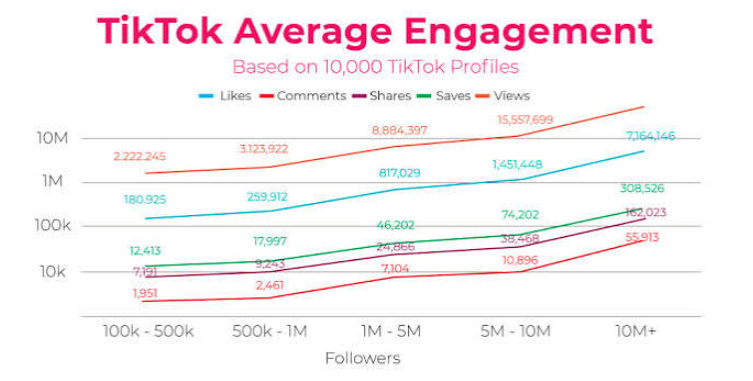
Recent third-party 2026 datasets show why using one universal benchmark can be misleading. One analysis of 1.8 million TikTok videos reported an overall likes-to-views average of about 3.4%, with significant differences between follower tiers. Another recent dataset of thousands of accounts reports substantially different overall engagement figures depending on how engagement is calculated.
As a practical starting point:
|
Views |
1% |
3% |
5% |
10% |
|
1,000 |
10 likes |
30 likes |
50 likes |
100 likes |
|
10,000 |
100 |
300 |
500 |
1,000 |
|
100,000 |
1,000 |
3,000 |
5,000 |
10,000 |
This means TikTok likes per 1,000 views should be judged in context. A 30-like result on 1,000 views is very different from 30 likes on 10,000 views.
Is a 10% TikTok Like Ratio Good?
Yes, 10% is generally a strong result, but it should not be presented as the universal TikTok average. Some older and competitor guides describe 10% as a “good” or even ideal benchmark. Newer 2026 research suggests that overall ratios can be much lower, especially as accounts become larger.
Therefore, instead of asking whether you reached an arbitrary 10%, compare your latest posts against your historical performance and against creators in the same niche.
TikTok Likes vs Views: Which One Matters More?
Views and likes measure different things. Views measure reach. They tell you how many times your content was viewed. Likes measure an active response. A viewer had to take an action rather than simply continue watching. But neither metric should be evaluated alone. A video with 100,000 views and a 1% like ratio may have enormous reach but weaker active approval than a video with 10,000 views and a 6% ratio.
At the same time, a high like ratio does not automatically mean a video will go viral. TikTok’s current business tools provide a much broader performance picture, including reach, engagement, conversions, followers, and video-level analytics. That means creators should consider likes alongside watch time, completion, comments, shares, saves, profile visits, and follower growth.
What Is a Good TikTok Engagement Rate?
TikTok engagement rate is broader than the like-to-view ratio. Depending on the methodology, an engagement rate may combine actions such as:
- Likes
- Comments
- Shares
- Sometimes saves or other interactions
The calculation can also vary depending on whether engagement is divided by views, followers, or reach. That is why you should always check how a source defines its TikTok engagement rate before comparing its percentage with your own analytics.
For example, a third-party 2026 dataset calculated engagement from likes, comments, and shares divided by views and found that engagement varies considerably by follower tier.
Why Do TikTok Videos Get Views but Not Likes?
If your TikTok gets views but very few likes, it does not automatically mean your content is bad.
Several things can cause this:
1. Your hook attracts attention but the payoff is weak
People may stop scrolling because your opening is interesting, but leave without interacting if the rest of the video does not deliver.
2. You reached the wrong audience
A broad or trending topic can generate views from people who are not actually interested in your niche.
3. The content is useful but not emotionally engaging
Educational videos can receive saves or shares without generating as many likes as entertainment content.
4. The video is too generic
Specific problems usually give viewers a stronger reason to respond than broad advice.
5. There is no clear reason to interact
If viewers understand the information but have no emotional response, opinion, or reason to participate, they may simply scroll past.
6. Your views are still growing
A newly posted video may have a low ratio early on and change as TikTok distributes it to different audiences.
How to Improve Your TikTok Likes and Views
Improving likes should not mean chasing likes alone. The goal is to create content that attracts the right viewers and gives them a reason to stay and interact.
Improve the first seconds
Start with the most important information, question, result, or visual. Avoid long introductions.
Make one clear promise
Tell viewers what they will learn, see, or get from the video, then deliver on that promise.
Create content for a specific audience
Instead of trying to make one video relevant to everyone, identify the exact viewer you want to attract.
Use trends strategically
TikTok’s Creative Center provides current trends, hashtags, high-performing ads, creative patterns, and other inspiration that can help creators identify what is currently working. However, copying a trend without adapting it to your niche can bring irrelevant views rather than meaningful engagement.
Encourage genuine interaction
Ask a relevant question, invite an opinion, or give viewers a reason to share their experience. Avoid making every video feel like a request for likes.
Study your strongest videos
Compare your best and weakest posts for:
- Topic
- Opening hook
- Video length
- Audience
- Editing style
- Caption
- Comments
- Shares
- Completion
- Likes per view
Your own historical data can be more useful than a generic internet benchmark.
Can a TikTok Likes Booster Help?
A TikTok likes booster can mean different things depending on the service. Some tools help creators improve content and engagement organically, while some services sell engagement.
These should not be treated as the same thing. If you decide to buy TikTok likes, quality matters. Cheap packages built around automated or suspicious accounts can create numbers without creating genuine audience interest. They may also make your engagement data harder to interpret.
If your objective is social proof, look for real TikTok likes and avoid services that promise unrealistic numbers or guaranteed viral reach. Most importantly, purchased likes should never be presented as a guaranteed way to make TikTok recommend a video. TikTok’s own business resources emphasize broader performance measurement and creative optimization rather than a single engagement metric.
Should You Buy TikTok Likes?
There can be a difference between using engagement as a supplementary promotional tactic and depending on it as your entire growth strategy.
Before choosing a service, consider:
- Are the likes from genuine-looking accounts?
- Does the provider explain its delivery method?
- Are the likes relevant to your target audience?
- Does the service make unrealistic guarantees?
- Can you continue growing organically after the initial boost?
- Will the added likes make your engagement data difficult to analyze?
If you are considering buy TikTok likes from LikesForYou, evaluate the service based on transparency, quality, delivery expectations, and how well it fits your broader TikTok strategy rather than choosing the cheapest package. The goal should be to support your content—not replace good content.
How to Track Your TikTok Like-to-View Ratio
Do not judge your account from one TikTok post. Instead, create a simple record of your last 10–20 videos and calculate:
Likes ÷ Views × 100
Then compare the results.
For example:
|
Video |
Views |
Likes |
Ratio |
|
A |
1,000 |
30 |
3% |
|
B |
2,000 |
100 |
5% |
|
C |
5,000 |
150 |
3% |
|
D |
10,000 |
600 |
6% |
Video D is particularly useful to study because it generated a stronger response relative to its reach. TikTok’s Business Suite provides analytics covering areas such as new likes, video views, followers, reach and engagement, allowing creators to evaluate performance over different periods.
Why Your Average TikTok Likes May Change
Your average TikTok likes can rise or fall for reasons that have nothing to do with a sudden change in content quality. Your audience may change. A video may reach a broader audience. Your niche may attract different levels of interaction. A trend may generate many views but relatively few likes.
Account size also matters. Recent third-party research found that like-to-view ratios can vary substantially across follower tiers, which is another reason not to compare a small creator directly with a mega account.
TikTok Likes on a Post vs Likes on a Video
When people search for likes on TikTok post, likes on TikTok video, or TikTok views and likes, they are usually trying to understand whether their numbers are normal.
The answer depends on context. A video with 500 likes may be excellent if it received 5,000 views. The same 500 likes would represent a much weaker response if the video received 100,000 views. That is why percentages are often more useful than raw numbers.
Final Takeaway
There is no single number that defines a successful TikTok video.
A TikTok like-to-view ratio gives you a useful starting point, but it should be evaluated alongside views, watch behavior, comments, shares, saves, follower growth, and your own historical results. If you receive 30 likes from 1,000 views, that is a 3% ratio. If you receive 100 likes, it is 10%. Neither number is automatically good or bad without knowing your niche, audience, and previous performance.
The smartest strategy is to use your analytics to identify what your audience responds to, improve the hook and content quality, and then measure whether both TikTok likes and views improve together.
If you use a TikTok likes booster or choose to buy engagement, treat it as a supplementary tactic rather than a substitute for authentic audience growth. Quality content, relevant viewers, and consistent testing remain the foundation of sustainable TikTok performance.
 dennisbray96@gmail.com
  likesforyou .co/
  10turtle.com@gmail.com