
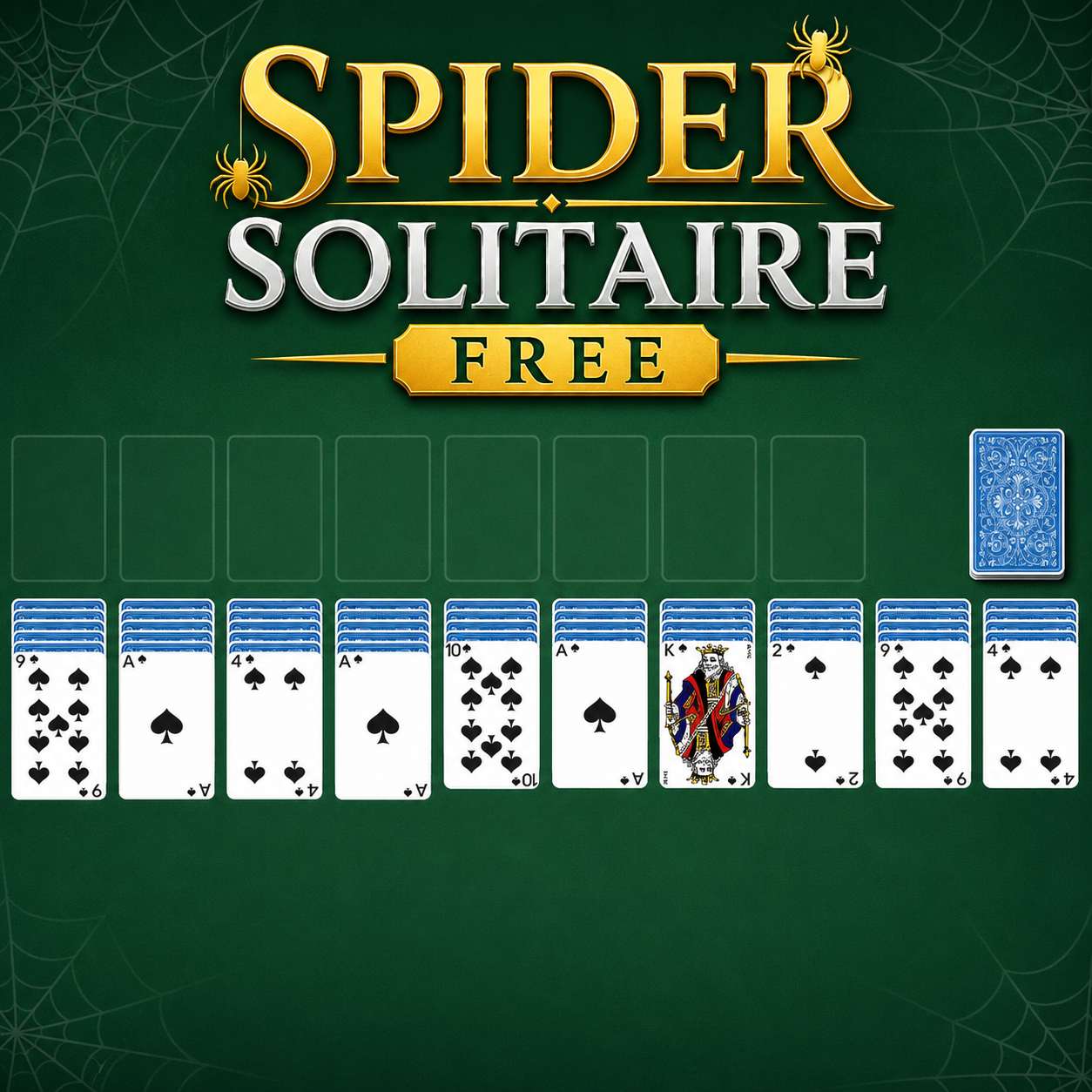
Spider Solitaire Free is a soothing yet challenging online card game. Rather than depending on speed, the spider solitaire free game encourages players to watch, evaluate, and plan their moves. Every card on the tableau can be used as part of a bigger plan, transforming the card arrangement process into a never-ending logic puzzle.
Embark on the trip to finish eight sequences
Spider Solitaire Free’s purpose is to complete eight sequences of the same suit, which corresponds to a spider’s eight legs. Each sequence must be formed in descending order, from King to Ace. When a sequence is complete, it is eliminated from the board, freeing up space and allowing for following movements.
Interestingly, completing a sequence entails more than simply placing cards in their right spots. Players must carefully plan their moves to avoid squandering opportunities that are already on the board. A seemingly beneficial move may trap important cards, whereas a cautious decision may open up a wider range of options.
The 10-column table and hidden information
The Spider Solitaire Free board has a 10-column tableau with card placement that intentionally limits the information available to the player. Only the top 54 cards are face-up; the rest are face-down and are revealed only when the positions above them are cleared.
This mechanic adds a sense of surprise to every game. You might devise a strategy based on the visible cards, only to have to revise it when a new card is revealed. The interplay between known information and the need for foresight is what makes the game so compelling.
Developing Sequences and Clearing the Way
The ability to build flexible card sequences is an essential skill in Spider Solitaire Free. Cards in consecutive order can be arranged in a group to make them easier to transport.
However, making the longest possible sequence is not always the best option. Sometimes you must split or move a group of cards to reveal a hidden card. The goal is not just to make a neat arrangement, but to generate as many new options as possible.
Players should pay careful attention to moves that disclose face-down cards. Each newly revealed card provides additional information, allowing you to develop a more precise strategy for the rest of the game.
Using the Stockpile at the Right Time
As alternatives on the tableau shrink, the stockpile becomes a key supply of cards to keep the game rolling. The 50 leftover cards can be dealt out to generate new sequences and game conditions.
However, using the stockpile too early might sometimes confuse the board state. An ideal strategy is to exhaust all possible movements before drawing more cards. Managing the timing of the deal lets you keep a choice of possibilities and prevent running out of space.
 dubaiwebsitedesign
  minthaylasy
  rainbowcoloringpage