
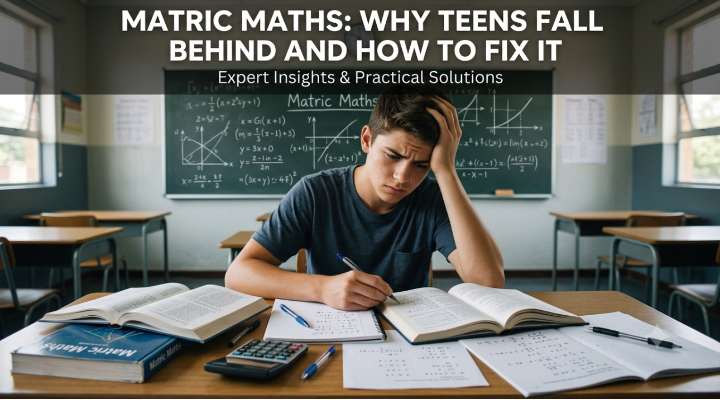
A learner who breezed through maths in Grade 8 and 9 can suddenly start losing marks in Grade 10. Homework takes longer. Tests come back covered in red ink. The same child who once raised a hand in class now goes quiet. Most parents assume this means laziness or a bad attitude. It rarely does. In the senior phase, maths becomes faster, more abstract, and far less forgiving, and any small gap left behind in earlier grades begins to show. This guide explains why high school learners fall behind in maths, where the cracks usually appear first, and the practical steps that close those gaps before the matric exams arrive.
Maths Marks Can Hide a Bigger Problem
On paper, South African maths results are improving. In the 2024 National Senior Certificate, the overall pass rate reached a record 87.3 percent, and the mathematics pass rate climbed to roughly 69 percent, up from 63.5 percent the year before. The Western Cape recorded the country’s strongest maths performance at 78 percent.
Those numbers sound reassuring. The catch is what a pass represents. A learner can pass NSC mathematics with a mark in the 30 to 40 percent range, and a large share of learners who take the subject pass with less than 50 percent. A pass on the certificate is not the same thing as understanding the work, and it is not the same thing as being ready for university maths.
This is exactly why a learner can scrape through Grade 10 and still hit a wall in Grade 11. The marks masked gaps that were never closed. By the time the work depends on those missing foundations, the learner is not lost because the new topic is impossible. They are lost because the topic underneath it was never solid.
Why Learners Fall Behind in the Senior Phase
Maths is one of the few subjects where almost every topic depends on the one before it. Miss a step early, and the gap does not stay the same size. It grows. Here is what tends to drive the slide in Grades 10 to 12:
- Pace. Senior grades move quickly through a heavy syllabus, and there is little class time to go back and repair the basics.
- Cumulative topics. Each new chapter assumes the previous one is fully understood. Quadratics assume factorising. Functions assume quadratics. Calculus assumes functions.
- The abstraction jump. Numbers give way to variables, graphs, identities, and proofs. Learners who relied on memorising procedures suddenly have to reason.
- Lost ground that compounds. A few weeks out with illness, a disrupted term, or a stretch of online learning can leave a hole that the class has already moved past.
- Confidence. Once a learner decides they are simply “bad at maths,” they stop attempting questions, which widens the gap and makes recovery harder.
The good news inside this is simple. Gaps that compound can also be repaired in order. Once the earliest weak topic is fixed, the topics stacked on top of it often fall into place faster than parents expect.
The Five Topics Where Gaps Show First
In high school maths, problems tend to surface in the same predictable places. If marks are slipping, the cause is usually hiding in one of these:
Algebra and equations. This is the engine room of high school maths. Weak factorising, expanding, and equation solving quietly undermine everything that follows.
Functions and graphs. Many learners memorise the shapes of graphs without understanding what a function is. When questions ask them to interpret, transform, or read a graph, the recall approach falls apart.
Trigonometry. Identities and ratios get learned as rules to recite rather than relationships to apply. The moment a question is phrased differently from the textbook, the learner freezes.
Calculus basics. Introduced in Grade 12, calculus is unforgiving to anyone still shaky on functions and algebra. It is rarely the calculus itself that defeats learners. It is the foundation beneath it.
Exam technique and problem-solving. Some learners understand the maths and still lose marks, because of time pressure, misread questions, and skipped method steps. This is a separate skill, and it is trainable.
CAPS vs IEB: Same Subject, Different Demands
Two learners can sit the same Grade 11 maths content and be assessed very differently, depending on whether their school follows CAPS or the IEB. Parents often do not realise this, and it matters for how a learner should prepare.
|
Aspect |
CAPS |
IEB |
|
Curriculum |
National curriculum used by most schools |
Independent assessment used by many private schools |
|
Pace and coverage |
Broad coverage across many topics, faster moving |
Similar content, but examined in greater depth |
|
Question style |
Structured, syllabus-driven questions |
More applied, multi-step problems that test reasoning |
|
What it rewards |
Solid method and consistent practice |
Understanding and the ability to handle unfamiliar problems |
The fastest way to see the difference is to work through real papers from the same grade in both styles. Comparing past papers shows clearly how one topic can be examined in two different ways. Preparing for the wrong style is one of the quietest causes of underperformance in otherwise capable learners.
How to Close the Gaps Before Exams
Improvement in maths is not about working longer hours. It is about working in the right order. These five steps are what consistent turnarounds have in common, whether a parent runs them at home or through extra maths classes:
- Diagnose the gap, not the symptom. A dropped trigonometry mark is often an algebra problem in disguise. Start by finding the earliest topic the learner cannot do confidently, then work forward from there.
- Rebuild foundations in the right order. Maths is sequential. Drilling quadratics before a learner can factorise wastes time and deepens frustration. Repair the base layer first, then build upward.
- Practise with real past papers. Once a topic is understood, the learner should drill it under exam conditions using past papers. This builds speed, exposes any remaining gaps, and removes the shock of unfamiliar question styles on exam day.
- Fix exam technique deliberately. Teach the learner to read each question in full, plan time according to the marks available, write out method steps to earn method marks, and check signs and units. A surprising number of lost marks have nothing to do with not knowing the maths.
- Track progress every week. Keep a simple record of topics covered, scores, and recurring errors. Improvement that is measured is improvement that continues, because both the learner and the parent can see it building.
When to Bring in a Maths Tutor
Plenty of learners recover with support at home. Others need focused, outside help. These are the signs that it is time to bring in a tutor:
- Marks are sliding term on term, despite real effort.
- Homework has become a daily battle or a source of anxiety.
- The learner says they understand the work in class but freeze in tests.
- Helping at home strains the relationship more than it improves the marks.
Not all tutoring is equal. A friendly university student who means well but has no plan often just repeats what the school already does. Structured, experienced tutoring works differently. It starts with an assessment, follows a written plan, tracks progress, and keeps parents informed at every step.
One-on-one lessons are where this approach pays off. Well-structured extra maths classes give a learner the kind of focused attention a busy classroom cannot. Lessons move at the learner’s pace, weak areas are repaired before the class moves on, and questions are welcomed rather than rushed past.
A Realistic Timeline for Improvement
Parents often ask how long it takes. Confidence usually shifts first, frequently within a few weeks, as the learner begins to understand work that used to feel impossible. Marks follow as that understanding compounds across topics.
There is no overnight fix in maths, and anyone promising one is not being straight with you. Steady weekly practice, gap repair done in the correct order, and deliberate exam preparation produce results that hold, rather than a quick bump that fades by the next test. The learners who turn things around are rarely the ones who suddenly work twice as hard. They are the ones who find the gap, repair it, and practise with purpose.
Frequently Asked Questions
How can I help a child who is failing maths? Start by finding the earliest topic they cannot do confidently, rather than focusing only on the current chapter. Rebuild from that point in order, practise with past papers under timed conditions, and consider structured one-on-one support if the marks keep sliding.
Is a maths tutor worth it for high school? For a learner with real gaps or exam anxiety, focused one-on-one tutoring is one of the most effective interventions available. Quality extra maths classes target exactly what that learner is missing instead of teaching to the class average.
How many maths lessons a week does a learner need? For most learners, one well-structured weekly lesson plus short, focused practice between sessions is enough to build steady progress without overload. Consistency matters more than volume.
Can past exam papers really improve maths marks? Yes. Working through past papers under timed conditions builds speed, reveals remaining gaps, and removes the shock of unfamiliar question styles on the day of the exam.
What is the difference between CAPS and IEB maths? They cover similar content, but CAPS moves broadly and quickly across the national curriculum, while the IEB tends to reward deeper reasoning and applied, multi-step problems. A learner should prepare for the style their school will actually assess.
Falling behind in maths is common, and it is fixable. If your child is in Grade 8 to 12 and maths has started to slip, the sooner those gaps are found and repaired, the easier the road to matric becomes. For many families, structured extra maths classes are the fastest way to find those gaps and close them in the right order.
 coursetip patil
  daisybrown0003
  shobhaa