
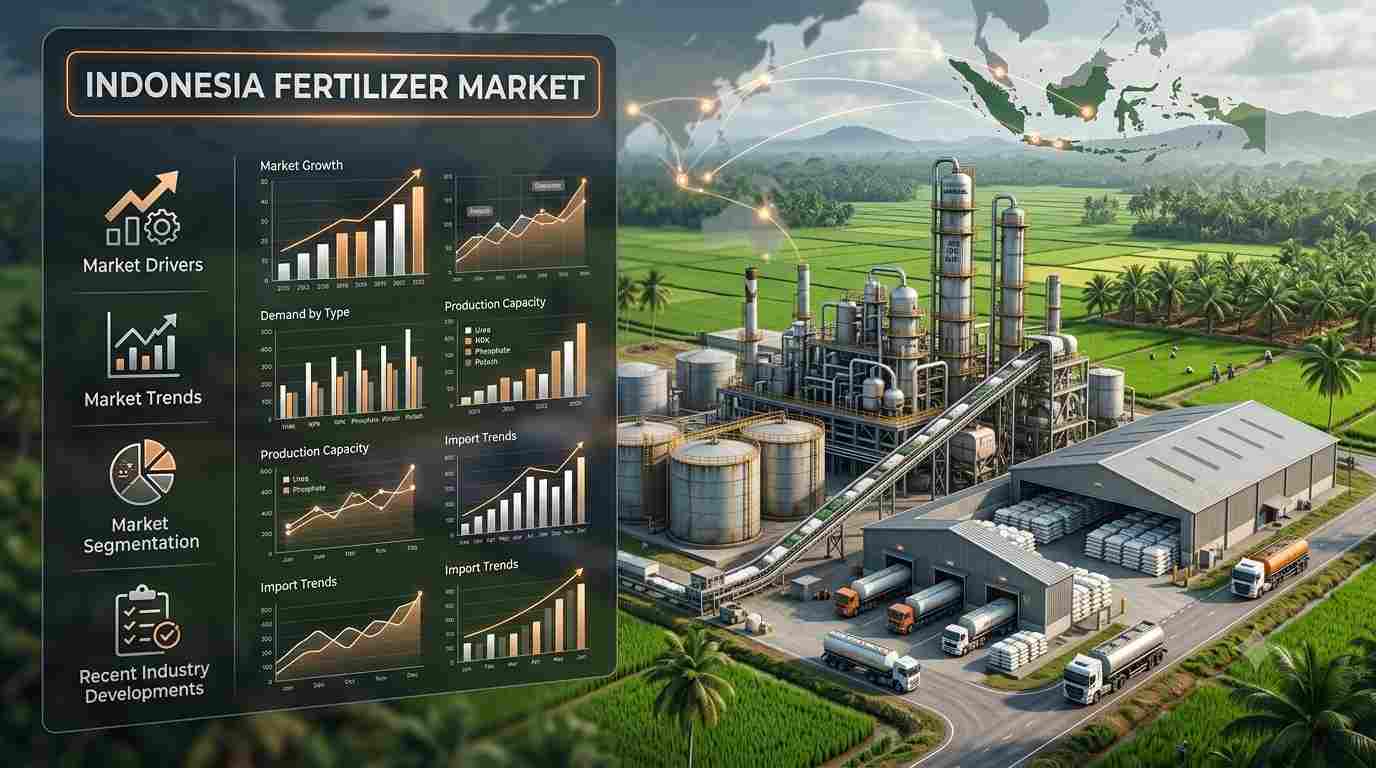
IMARC Group, a leading global market research and management consulting firm, has published its latest market intelligence report on the Indonesia Fertilizer Market. The Indonesia fertilizer market size increased from USD 2.2 Billion in 2025 to USD 2.3 Billion in 2026 and is projected to reach USD 2.9 Billion by 2034, exhibiting a CAGR of 2.57% during 2026-2034. Growth is being driven by crop diversification, climate variability, the rising adoption of modern agricultural technologies, and government and non-governmental initiatives that educate farmers on the benefits of fertilizers.
Fertilizers remain central to Indonesia’s commitment to food security and the productivity of its agrarian economy, particularly as the country supports a rapidly growing population. Government support through subsidies, education campaigns and extension services continues to promote fertilizer adoption among farmers, while the expansion of the palm oil industry, where Indonesia ranks as one of the world’s largest producers, sustains demand for plantation nutrition. At the same time, the market is steadily shifting toward precision farming, customized fertilizer blends, and environmentally friendly, nutrient-efficient products as awareness of sustainable agriculture grows. Rapid infrastructure development in rural areas and the country’s integration into the global agricultural market are improving access and distribution, even as raw material price volatility and distribution challenges in remote areas remain. Combined with strong state backing for domestic production under the national food self-sufficiency agenda, these forces are shaping a stable, long-term growth path for the market across Java, Sumatra, Kalimantan, Sulawesi, and other regions.
Indonesia Fertilizer Market at a Glance:
- Market Size (2025): USD 2.2 Billion
- Market Size (2026): USD 2.3 Billion
- Market Forecast (2034): USD 2.9 Billion
- Growth Rate (2026-2034): CAGR of 2.57%
- Base Year: 2025 | Historical Period: 2020-2025 | Forecast Period: 2026-2034
How AI is Reshaping the Future of the Indonesia Fertilizer Market
- Real-Time Data Command Center for Distribution: Pupuk Indonesia uses a command center and the i-Pubers application to monitor regional stock availability, track purchases and inventories in real time, and redistribute fertilizer through an integrated network of ports, shipping fleets and warehouses. This data-led approach helped the company manage a 36% year-on-year rise in subsidized fertilizer sales to 3.4 million metric tons by early May 2026.
- FertInnovation Challenge and AI-Driven Supply Chains: Pupuk Indonesia, through the Indonesia Agrichemical Research Institute, launched the FertInnovation Challenge 2025 with categories covering precision agriculture using drones and satellites, AI-driven agri supply chains that predict fertilizer needs by region, and Digital Plant 4.0 solutions such as digital twins and AI predictive maintenance for fertilizer plants.
- AI and IoT in Smart Farming: At a National Research and Innovation Agency (BRIN) seminar on 24 August 2026, experts highlighted how AI, sensors and satellite imagery can predict crop yields, water requirements and pest outbreaks, with computer vision already being developed for oil palm plantations. Petrokimia Gresik, a Pupuk Indonesia subsidiary, has also advanced Smart Precision Farming using drones and vegetation index data to translate crop conditions into fertilization recommendations.
Grab a sample PDF of this report: https://www.imarcgroup.com/indonesia-fertilizer-market/requestsample
Indonesia Fertilizer Market Trends and Drivers:
Demand for fertilizer across Indonesia is being underpinned by the country’s commitment to food security and the need to raise agricultural productivity for a growing population. The expansion of cash crops such as palm oil, rice and rubber is lifting fertilizer utilization, and growing awareness among farmers about balanced nutrient application is encouraging the adoption of both chemical and organic fertilizers. Digital agriculture tools such as soil sensors, GPS-enabled application systems, drones and mobile advisory apps are also making nutrient management more efficient, with smartphone use and government-backed programs extending access to smallholder farmers.
The market’s structural differentiator is its state-led, subsidy-driven model combined with dependence on imported raw materials. Pupuk Indonesia and its subsidiaries anchor domestic production and distribution, while Indonesia relies entirely on imports for phosphate rock, importing 1.4 million tons in January to November 2025, with more than 60% coming from Jordan, according to Global Trade Tracker data reported by Argus. This is pushing producers to diversify sourcing, expand domestic capacity and secure long-term feedstock supply.
A third driver is the policy push toward sustainable and locally produced inputs. Farmers are shifting toward bio-fertilizers, compost-based products and organic formulations supported by government initiatives and organic certification schemes, while the government has launched a fertilizer industry revitalization program, lowered the retail price ceiling for subsidized fertilizer and streamlined distribution, a dynamic that is set to support demand over the coming decade.
Government Schemes and National Food Security Programs Driving Demand:
- Subsidized Fertilizer Program: Indonesia’s 2026 subsidized fertilizer allocation stands at 9.84 million tonnes, including 9.55 million tonnes for land farming and 295,686 tonnes for the fisheries sector, with 4.77 million tonnes, or 48.5% of the allocation, distributed as of 26 June 2026.
- 20% Cut in the Highest Retail Price (HET): Effective 22 October 2025, the government lowered the highest retail price of subsidized fertilizer by about 20%, bringing the NPK price ceiling down from IDR 2,300 to IDR 1,840 per kilogram, while ZA (ammonium sulfate) was newly included in the subsidized scheme.
- Presidential Regulation No. 113 of 2025 on Streamlined Distribution: The regulation simplified approvals so that subsidized fertilizer flows directly from Pupuk Indonesia to registered farmers, who can redeem it from the beginning of the year, contributing to a 36% year-on-year rise in subsidized sales to 3.4 million metric tons by early May 2026.
- Fertilizer Industry Revitalization Program (to 2029): The program targets a 20% reduction in subsidized fertilizer prices and an additional 700,000 tons of production without increasing the state budget burden, including seven revitalized plants, starting with the upgraded Ammonia Plant 2 in Bontang, East Kalimantan, expected to cut operating costs by IDR 200 billion and emissions by 110,000 tons.
- Food Self-Sufficiency Agenda: President Prabowo Subianto has called for Indonesia to expand fertilizer production to ensure adequate domestic supply, and Indonesia has indicated it is ready to export up to 1.5 million tons of surplus production to partner countries while keeping domestic supply secure.
Indonesia Fertilizer Market Industry Segmentation:
The report has segmented the market into the following categories:
Breakup By Type:
- Nitrogenous Fertilizers (Urea, Calcium Ammonium Nitrate (CAN), Ammonia, Ammonium Nitrate, Ammonium Sulfate, Others)
- Phosphatic Fertilizers (Mono-ammonium Phosphate (MAP), Di-ammonium Phosphate (DAP), Triple Superphosphate (TSP), Others)
- Potash Fertilizers (Muriate of Potash (MOP), Others)
- Secondary Nutrient Fertilizers
- Micronutrients
The report provides a detailed breakup and analysis of each fertilizer type, with demand shaped by the subsidized program centered on urea and NPK, the recent inclusion of ZA, Indonesia’s full reliance on imported phosphate rock for phosphatic products, and growing interest in nutrient-efficient and customized blends.
Breakup By Application:
- Grains and Cereals
- Pulses and Oil Seeds
- Commercial Crops
- Fruits and Vegetables
- Others
The report analyzes fertilizer use across crop categories, with commercial crops such as palm oil and rubber and staple crops such as rice supported by food security priorities, plantation productivity needs and crop diversification trends that create demand for specialized blends.
Breakup By Region:
- Java
- Sumatra
- Kalimantan
- Sulawesi
- Others
The report provides a comprehensive regional analysis, reflecting Indonesia’s production footprint across Pusri in Palembang, Pupuk Kaltim in Kalimantan and Petrokimia Gresik in East Java, as well as efforts to improve supply to eastern Indonesia and develop new capacity such as the planned plant in West Papua.
Competitive Landscape:
The report provides a comprehensive analysis of the competitive landscape, covering market structure, key player positioning, top winning strategies, the competitive dashboard and the company evaluation quadrant, along with detailed profiles of major companies. Key players include:
- PT Pupuk Indonesia (Persero)
- PT Pupuk Sriwidjaja Palembang (Pusri)
- PT. Dupan Anugerah Lestari (Saraswanti Group)
- PT. Jadi Mas
- Wilmar International Limited
This is a partial list of the key players, and the complete list is provided in the report. State-owned Pupuk Indonesia and its subsidiaries anchor domestic production and subsidized distribution, while private groups compete across commercial and plantation-focused segments.
Market Concentration Analysis:
- The Indonesia fertilizer market is anchored by the state-owned Pupuk Indonesia group, including Pusri, Pupuk Kaltim and Petrokimia Gresik, which distributes subsidized fertilizer directly to registered farmers, reflecting the capital intensity of ammonia and urea production and the central role of government allocation.
- Fragmentation increases in the non-subsidized and specialty segments, where private players such as Saraswanti Group, Jadi Mas and Wilmar International compete alongside organic and bio-fertilizer producers, creating a tiered structure where state-owned producers dominate subsidized volumes while private players focus on commercial, plantation and specialty niches.
- Strategic investment and supply-security efforts are intensifying, exemplified by the revitalization of seven fertilizer plants through 2029, PT Pupuk Kaltim’s planned West Papua plant backed by a gas supply of 101 MMscfd, and Pupuk Indonesia’s memorandum of understanding with Somiphos for up to 1 million tons of phosphate rock per year.
What Does The Full Report Cover?
- Historical, current, and forecast market size for the Indonesia fertilizer market from 2020 to 2034
- Market breakup by type, application, and region
- Regional analysis covering Java, Sumatra, Kalimantan, Sulawesi, and Others
- Key growth drivers, challenges, and opportunities shaping the market
- Porter’s Five Forces analysis and value chain assessment
- Competitive landscape, market structure, and player positioning
- Detailed profiles of major fertilizer companies in Indonesia
Recent News and Developments in the Indonesia Fertilizer Market
- June 2026: Indonesia reported that 4.77 million tonnes of subsidized fertilizer had been distributed nationwide as of 26 June, equal to 48.5% of the 9.84 million tonne allocation for the year, with the government reaffirming enforcement of the lower retail price ceiling introduced in October 2025.
- May 2026: Pupuk Indonesia said subsidized fertilizer sales reached 3.4 million metric tons in early May, up 36% from a year earlier, driven by lower price ceilings, streamlined distribution and extended rainfall, with national stockpiles at 1.1 million tons.
- January 2026: Pupuk Indonesia signed a memorandum of understanding with Algeria’s Somiphos for up to 1 million tons per year of phosphate rock, aiming to diversify supply for domestic fertilizer production in a market that relies entirely on imported phosphate rock.
- September 2025: Universitas Gadjah Mada, in collaboration with PT Bukit Asam and MIND ID, launched a pilot project for Potassium Humate, branded BA Grow, a soil conditioner derived from low-calorie coal designed to improve soil structure and nutrient absorption while reducing reliance on conventional fertilizers.
- February 2025: PT Pupuk Kaltim, a subsidiary of Pupuk Indonesia, announced progress on its planned fertilizer plant in West Papua targeted for completion in 2028, and signed a gas sales agreement with Genting Oil Kasuri for 101 MMscfd of natural gas to support ammonia and urea production.
Note: If you require specific details, data, or insights that are not currently included in the scope of this report, we are happy to accommodate your request. As part of our customization service, we will gather and provide the additional information you need, tailored to your specific requirements. Please let us know your exact needs, and we will ensure the report is updated accordingly to meet your expectations.
Key Questions This Report Answers
- How big is the Indonesia fertilizer market and what is its growth outlook through 2034?
- What are the key growth drivers, challenges, and opportunities in the Indonesia fertilizer market?
- How is the market split by type, application, and region?
- How are subsidies, price ceilings, and distribution reforms influencing fertilizer demand?
- Which fertilizer types and crop applications are shaping demand across the country?
- Who are the key players in the Indonesia fertilizer market, and how is the competitive landscape evolving?
- What role are digital agriculture, precision farming, and sustainable fertilizers playing in the future of the market?
About Us
IMARC Group is a global management consulting firm that helps the world’s most ambitious changemakers to create a lasting impact. The company provides a comprehensive suite of market entry and expansion services. IMARC offerings include thorough market assessment, feasibility studies, company incorporation assistance, factory setup support, regulatory approvals and licensing navigation, branding, marketing and sales strategies, competitive landscape and benchmarking analyses, pricing and cost research, and procurement research.
Media and Sales Contact
IMARC Group
Email: sales@imarcgroup.com
United States: +1-201-971-6302
India: +91-120-433-0800
United Kingdom: +44-753-714-6104
 dubaiwebsitedesign
 jacksss
 saadurrehman