
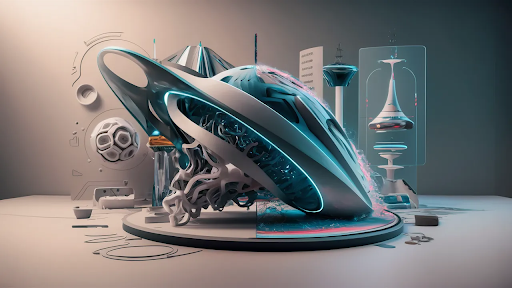
The digital world is evolving faster than ever, and businesses must adopt cutting-edge technology to stay competitive. Generative AI is revolutionizing content creation, automation, and creative workflows, while 3D modeling continues to redefine how products, architectural projects, and marketing visuals are developed. Combining these technologies allows designers and marketers to create highly realistic, immersive visuals faster than ever before. From virtual product prototypes to interactive AR experiences, generative AI enhances the capabilities of 3D modeling software, helping teams reduce manual labor and accelerate production. Businesses leveraging these tools gain a competitive edge, delivering visually compelling content that drives engagement and conversions. In 2026, understanding how generative AI complements 3D modeling is no longer optional—it’s essential for businesses aiming to innovate in marketing, design, and user experience.
The Evolution of 3D Modeling in Marketing
3D modeling has changed the way brands showcase products, design environments, and create engaging visuals for digital campaigns. Initially, companies relied on static images or physical prototypes, which were costly and time-consuming. With the rise of 3D modeling software like Blender, Autodesk Maya, and SolidWorks, designers can craft highly detailed models, apply realistic textures, and simulate lighting effects.
However, traditional 3D modeling workflows can still be labor-intensive, especially for large projects. Adjusting geometries, creating textures, and refining details manually can slow down content production. This is where generative AI steps in. By using AI algorithms, designers can automatically generate complex models, textures, or even entire virtual scenes, significantly speeding up the workflow. AI-powered tools can also suggest design optimizations, predict structural flaws, and assist in visual storytelling, making 3D modeling more efficient and accurate.
The integration of generative AI with 3D modeling software represents a significant leap forward. Designers no longer have to start from scratch for every project; AI helps create base models, propose variations, and even simulate realistic lighting or physics scenarios. This evolution allows marketing teams to produce high-quality visuals at scale, enhancing campaigns while reducing costs.
What is Generative AI and Why it Matters for 3D Modeling
Generative AI refers to algorithms capable of producing new, realistic content from existing data. In the context of 3D modeling, generative AI can create objects, environments, textures, and animations based on input parameters, sketches, or text prompts. For example, a designer could input “modern office desk with natural wood finish,” and the AI would generate a realistic 3D model that matches the description.
AI-powered chatbots and virtual assistants can guide designers through modeling workflows, offering suggestions for materials, geometry, and rendering techniques. These AI tools accelerate production and reduce the learning curve for beginners while enhancing productivity for professionals.
By combining generative AI with 3D modeling, businesses can create visually compelling marketing assets in a fraction of the time traditional methods require. This capability is especially useful for e-commerce, architecture, gaming, and animation industries, where rapid prototyping and visualization are crucial. Generative AI also allows for more experimentation, letting designers explore multiple variations without manually recreating each model.
Overall, generative AI amplifies the capabilities of 3D modeling, enabling faster production, higher quality designs, and more innovative digital marketing campaigns.
Key Benefits of Generative AI in 3D Modeling
- Accelerated Design Workflow:
Generative AI can produce base 3D models automatically, saving hours or even days in design iterations. Designers can focus on fine-tuning rather than building every component from scratch. - Enhanced Creativity:
By generating multiple variations of a model, AI encourages experimentation. Designers can explore different textures, lighting, or configurations, leading to unique marketing visuals. - Realistic Simulations:
AI algorithms can simulate physics, lighting, and material behavior, helping teams create lifelike renders that improve visualization for clients or customers. - Cost Efficiency:
Producing high-quality 3D content traditionally requires specialized skills and extensive time. Generative AI reduces labor costs while maintaining professional output quality. - Marketing Versatility:
From product demos to immersive AR/VR experiences, AI-generated 3D models can be deployed across campaigns, websites, social media, and advertisements, increasing engagement and conversions. - Error Reduction:
AI can detect and correct inconsistencies in models, such as overlapping meshes or misaligned textures, ensuring accurate and professional outputs.
In short, generative AI empowers designers to create more in less time, reduces costs, and enhances the overall quality of 3D modeling outputs, making it indispensable for modern digital marketing.
Practical Use Cases of Generative AI in 3D Modeling
E-commerce Product Visualization:
Brands can create realistic 3D models of products for online catalogs. AI automatically generates different color variations or textures, allowing customers to explore options interactively.
Architectural Design:
Generative AI assists architects in creating floor plans, building exteriors, and interior layouts in 3D, simulating lighting, materials, and structural components.
Gaming and Animation:
Game developers and animators use AI to generate complex 3D assets like characters, environments, and props quickly, reducing development time and enabling richer gameplay experiences.
Marketing Campaigns:
Digital marketing teams can produce engaging visuals for ads, social media, and websites using AI-generated 3D content. This improves storytelling and captures audience attention.
Virtual Reality (VR) & Augmented Reality (AR):
Generative AI enhances immersive experiences by creating realistic 3D environments and objects that can be explored in VR or AR applications.
These examples show that AI integration with 3D modeling is not just a theoretical concept—it has practical, tangible benefits across industries.
Future Trends: Generative AI and 3D Modeling
The future of digital content creation will be dominated by generative AI-driven 3D modeling. AI will not only generate models automatically but also predict user needs, propose creative solutions, and optimize designs for marketing or functional purposes.
We can expect integration with AR/VR platforms, enabling designers and marketers to create immersive virtual experiences effortlessly. AI chat bots will continue to serve as interactive assistants, answering questions, providing tutorials, and suggesting optimizations during the design process.
By 2026, generative AI will make rapid prototyping, personalization, and immersive visualization accessible to even small businesses. Companies leveraging these technologies will gain an edge, producing high-quality visuals faster and at lower costs, ultimately enhancing audience engagement and marketing ROI.
Challenges and Considerations
While generative AI is powerful, it comes with challenges. Models depend on high-quality data and may require fine-tuning to produce accurate outputs. Designers must maintain oversight to ensure creativity and brand identity remain intact. Over-reliance on AI could reduce human input in the design process, potentially limiting innovation. Additionally, software integration and computational requirements may require technical expertise and investment. Despite these challenges, thoughtful application of generative AI in 3D modeling yields significant productivity and creative benefits.
Conclusion
Generative AI is reshaping the way businesses approach , offering unprecedented speed, creativity, and efficiency. By automating repetitive tasks, generating realistic assets, and assisting with creative decisions, AI tools allow designers and marketers to focus on innovation and quality. From e-commerce and architecture to gaming and digital marketing, the synergy of AI and 3D modeling is driving better engagement, higher conversion rates, and more impactful campaigns. Businesses that adopt these technologies gain a competitive advantage, producing immersive experiences and visually compelling content while optimizing workflow. Embracing generative AI in 3D modeling is no longer optional—it is a strategic imperative for companies seeking to thrive in the rapidly evolving digital landscape.
 john1nento@gmail.com
  tech.emizen
  alberttaylor2019