
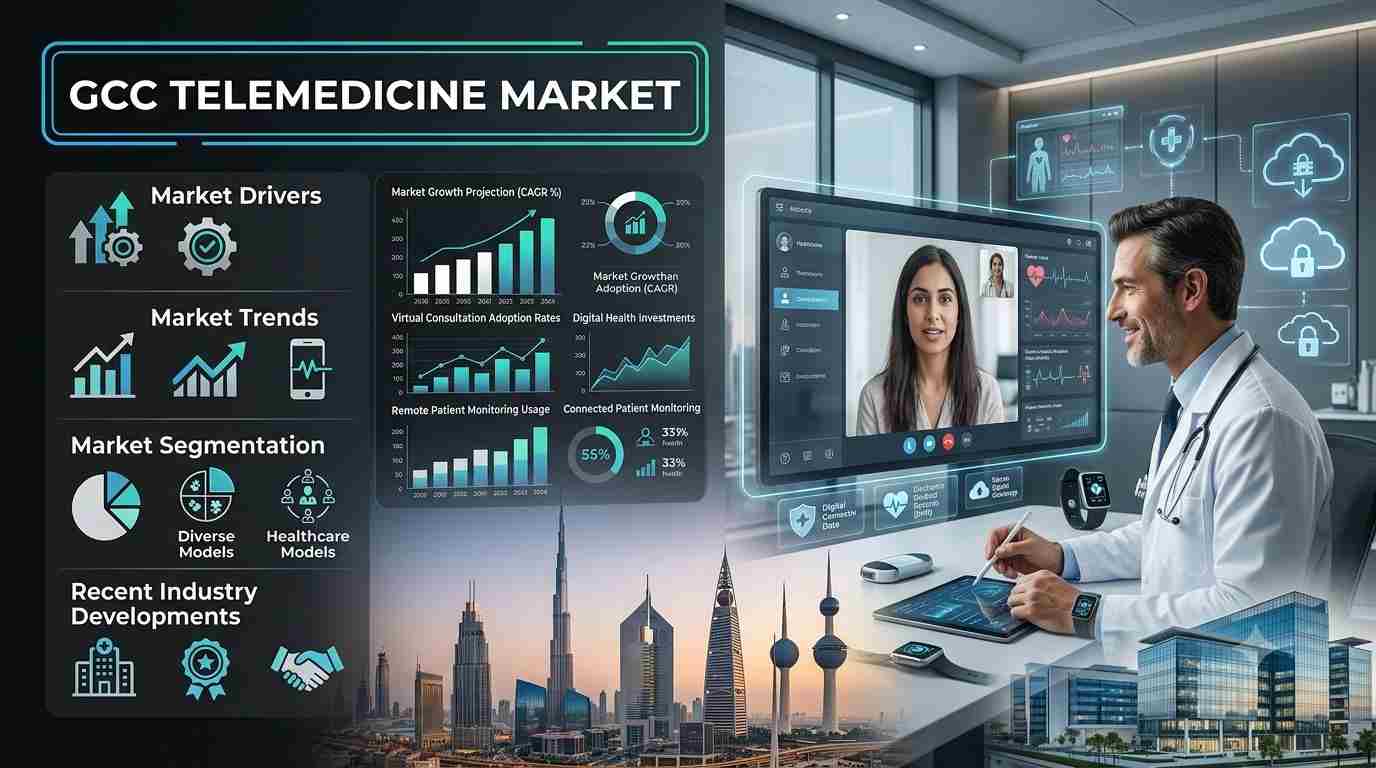
IMARC Group, a leading global market research and management consulting firm, has published its latest market intelligence report on the GCC Telemedicine Market. The GCC telemedicine market size was valued at USD 532.9 Million in 2025 and is projected to reach USD 3,271.4 Million by 2034, exhibiting a CAGR of 21.67% during 2026-2034. Growth is being driven by strong government digital health initiatives under programs such as Saudi Vision 2030, a rising chronic disease burden, expanding healthcare access in remote areas, and high smartphone penetration and 5G connectivity.
Telemedicine has moved from a pandemic-era stopgap to a core layer of healthcare delivery across the GCC, with all six member states embedding virtual care in their national digital health agendas. Saudi Arabia leads through government-run platforms such as Seha Virtual Hospital and the Sehhaty app, the UAE acts as the region’s digital health innovation hub with Dubai and Abu Dhabi health information exchanges, and Qatar, Oman, Kuwait and Bahrain are expanding virtual consultations and remote monitoring. At the same time, mHealth apps, cloud-based clinical software, AI-assisted diagnostics and 5G-enabled remote patient monitoring are making virtual care clinically richer, while mental health, dermatology, cardiology and radiology services are moving online. Challenges such as data privacy compliance across jurisdictions, cross-border physician licensing, legacy hospital systems and uneven insurer reimbursement remain, but sustained public investment and large government procurement contracts are setting the stage for durable, long-term growth across Saudi Arabia, the UAE, Qatar, Oman, Kuwait, and Bahrain.
GCC Telemedicine Market at a Glance:
- Market Size (2025): USD 532.9 Million
- Market Forecast (2034): USD 3,271.4 Million
- Growth Rate (2026-2034): CAGR of 21.67%
- Base Year: 2025 | Historical Period: 2020-2025 | Forecast Period: 2026-2034
- Leading Component Segment: Software, holding a 46.8% share in 2025, driven by cloud telemedicine platforms, AI diagnostic tools and EHR-integrated teleconsultation modules
- Leading Communication Technology: mHealth Solutions, with a 41.6% share in 2025, supported by high smartphone penetration and government-funded health apps
- Leading Country Market: Saudi Arabia, commanding a 39.7% share in 2025, anchored by Vision 2030 healthcare investment and the Sehhaty and Seha Virtual Hospital platforms
How AI is Reshaping the Future of the GCC Telemedicine Market
- AI Diagnostics Reach Saudi Arabia: In June 2025, Alphaiota and PMcardio partnered to bring the first AI-powered heart attack diagnostic solution to the Kingdom of Saudi Arabia, an example of AI moving from scheduling convenience to diagnostic-quality support in virtual and emergency care.
- Philips AI Innovations at WHX Dubai 2026: In February 2026, Philips unveiled a suite of AI-powered innovations at the World Health Expo (WHX) Dubai 2026 to meet the region’s accelerating demand for smarter, faster and more sustainable care, building on its eCareManager tele-ICU and remote monitoring portfolio.
- Seha Virtual Hospital’s AI-Enabled Model: Saudi Arabia’s Seha Virtual Hospital uses AI, augmented reality, digital twins and remote diagnostics to deliver specialist services across the Kingdom, with AI applied to risk segmentation that sorts patients into low, medium and high-risk groups for targeted intervention, while Saudi universities are developing GCC-specific clinical AI models trained on local patient demographics.
Grab a sample PDF of this report: https://www.imarcgroup.com/gcc-telemedicine-market/requestsample
GCC Telemedicine Market Trends and Drivers:
Demand for telemedicine across the GCC is being underpinned by a heavy chronic disease burden. The General Authority for Statistics reported in its 2024 Health Status Statistics that 18.95% of individuals aged 15 and above in Saudi Arabia lived with at least one chronic condition, with diabetes (9.1%), hypertension (7.9%), high cholesterol (3.6%), cardiovascular diseases (1.5%) and cancer (0.6%) among the most prevalent. These conditions need continuous monitoring and frequent follow-up, which telemedicine and remote patient monitoring can deliver at a lower cost per encounter than in-person hospital visits.
The region’s structural differentiator is government-led scale combined with world-class mobile infrastructure. Saudi Arabia’s Seha Virtual Hospital recorded more than 16 million virtual appointments and consultations in 2025, according to the Ministry of Health, while the GCC is forecast to have 62 million 5G mobile subscriptions by the end of 2026, giving mHealth platforms the connectivity to scale. Post-COVID normalization has permanently raised patient expectations for virtual care, and large institutional contracts from health ministries create demand floors that are independent of private sector adoption cycles.
A third driver is the widening scope of virtual care. Mental health teleconsultation is the fastest-growing application, as digital anonymity lowers stigma barriers, while telemedicine is extending the GCC’s medical tourism proposition through pre-visit consultations and post-treatment monitoring for international patients, with Dubai’s Health Tourism Authority reporting 691,000 medical tourists in 2023. Government mHealth super-apps are consolidating teleconsultation, pharmacy delivery, chronic disease monitoring and vaccination records into single patient ecosystems, a dynamic that is set to intensify over the coming decade.
Government Schemes and National Digital Health Programs Driving Demand:
- Seha Virtual Hospital (Ministry of Health): Launched in 2022 and recognized as the world’s largest virtual hospital, Seha Virtual Hospital connects more than 240 hospitals and delivers dozens of specialized services, recording more than 16 million virtual appointments and consultations in 2025.
- Sehhaty National Digital Health Platform: The Sehhaty platform has facilitated more than 9.2 million virtual appointments since its launch in 2019, giving millions of users a single digital entry point for consultations, prescriptions, referrals and health information.
- UAE Telehealth Mandate and Health Information Exchanges: A 2023 legislative mandate in Dubai requires at least one remote service for every medical facility, while the Dubai Health Authority’s NABIDH and the Department of Health Abu Dhabi’s Malaffi exchanges provide the interoperability and data foundations for virtual care in the UAE.
- National Digital Health Strategies Across the GCC: All six GCC states have embedded telemedicine in national digital transformation agendas, including Qatar’s National Health Strategy 2024-2030 and the UAE’s Digital Health Strategy, creating government-mandated demand that supplements private sector growth.
GCC Telemedicine Market Industry Segmentation:
The report has segmented the market into the following categories:
Breakup By Component:
- Software
- Hardware
- Services
Software leads the component segment at a 46.8% share in 2025, covering clinical management platforms, AI diagnostic tools, EHR-integrated telemedicine modules and government patient engagement apps, with cloud SaaS adoption reducing upfront capital needs. Services hold 30.7%, covering teleconsultation fees, remote patient monitoring subscriptions, teleradiology reading and tele-ICU management, while hardware holds 22.5%, covering telemedicine carts, diagnostic peripherals and monitoring devices.
Breakup By Communication Technology:
- Video Conferencing
- mHealth Solutions
- Others
mHealth solutions lead at 41.6% in 2025 and are the fastest-growing technology, as GCC smartphone penetration has made mobile apps the primary patient access channel. Video conferencing holds 36.9%, underpinning specialist teleconsultation, tele-ICU and hospital-to-hospital networks, while others hold 21.5%, including remote patient monitoring, store-and-forward teleradiology and asynchronous messaging.
Breakup By Hosting Type:
- Cloud-Based and Web-Based
- On-Premises
Cloud-based and web-based hosting leads the segment, supported by faster deployment, lower upfront costs and the ability to scale national platforms quickly, while on-premises deployments remain relevant for hospitals with strict data sovereignty and legacy system requirements.
Breakup By Application:
- Teleconsultation and Telementoring
- Medical Education and Training
- Teleradiology
- Telecardiology
- Teleneurology
- Telepsychiatry
- Tele-Dermatology
- Others
The report provides a detailed breakup across applications, with tele-dermatology leading the segment in 2025, according to the report, while telepsychiatry and mental health teleconsultation are among the fastest-growing applications as digital platforms reduce social stigma barriers to care.
Breakup By End User:
- Providers
- Patients
- Payers
- Others
Patients lead the end user segment in 2025, reflecting the shift toward direct-to-consumer mHealth apps and government platforms that let residents book, consult and manage care from their phones, while providers and payers adopt platforms to extend capacity and manage costs.
Breakup By Country:
- Saudi Arabia
- UAE
- Qatar
- Oman
- Kuwait
- Bahrain
Saudi Arabia holds the largest country share at 39.7% in 2025, followed by the UAE at 24.6%, Qatar at 12.8%, Oman at 9.6%, Kuwait at 7.1% and Bahrain at 6.2%. Saudi leadership reflects the region’s largest population and most comprehensive national program, the UAE benefits from advanced digital infrastructure and a strong private sector, and Oman and Kuwait are smaller high-growth markets investing in national programs.
Competitive Landscape:
The GCC telemedicine market is moderately concentrated among global platform leaders at the enterprise level and highly fragmented in the specialty and consumer application layers. Key players include:
- Teladoc Health Inc.
- Koninklijke Philips N.V.
- Cisco Systems Inc.
- American Well Corporation
Teladoc Health connects patients and providers for medical care, mental health and chronic condition management, Philips provides clinical-grade tele-ICU and remote monitoring through eCareManager, Cisco supplies the secure network and Webex video backbone for hospital networks, and Amwell offers broad telehealth services through its platform. Competitive differentiation is increasingly driven by localization, integration with national health information exchanges, ministry regulatory certification and Arabic clinical AI models.
Market Concentration Analysis:
- The GCC telemedicine market is moderately concentrated at the enterprise platform level, with Teladoc Health, Philips, and Cisco Systems collectively accounting for approximately 35-42% of enterprise telemedicine platform revenues in 2025, with large government hospital system contracts representing disproportionate single-deal revenue concentrations.
- Fragmentation is significant in specialty and consumer layers, where regional digital health players such as Altibbi, Cura, Vezeeta, Sanar, and Labayh compete on Arabic-language access and specialty positioning alongside hospital groups with their own virtual follow-up services, creating a structure where global leaders dominate enterprise and hospital deployments while regional specialists focus on consumer and niche segments.
- Government super-app consolidation and investor interest are reshaping the competitive balance, as ministry platforms such as Sehhaty and Seha Virtual Hospital centralize patient engagement, while venture funding such as TruDoc Healthcare’s USD 15 Million Pre-Series B round in March 2026 supports technology-led virtual-first models.
What Does The Full Report Cover?
- Historical, current, and forecast market size for the GCC telemedicine market from 2020 to 2034
- Market breakup by component, communication technology, hosting type, application, end user, and country
- Country-level analysis covering Saudi Arabia, UAE, Qatar, Oman, Kuwait, and Bahrain
- Key growth drivers, restraints, challenges, and opportunities shaping the market
- Porter’s Five Forces analysis and value chain assessment
- Competitive landscape, market structure, and player positioning
- Detailed profiles of major telemedicine companies in the region
Recent News and Developments in the GCC Telemedicine Market
- March 2026: TruDoc Healthcare closed a USD 15 Million Pre-Series B round to expand virtual-first primary care, chronic disease management, pharmacy-at-home, diagnostics and at-home critical care across the GCC.
- February 2026: Saudi Arabia’s Ministry of Health reported that Seha Virtual Hospital recorded more than 16 million virtual appointments and medical consultations in 2025, underscoring the growing role of remote healthcare across the Kingdom.
- February 2026: Philips unveiled a suite of AI-powered innovations at the World Health Expo (WHX) Dubai 2026 to meet the region’s accelerating demand for smarter, faster and more sustainable care.
- January 2026: Teladoc Health launched new enhancements to its 24/7 Care service, strengthening its whole-person virtual care offering that combines physical and mental health with chronic condition management.
- June 2025: Alphaiota and PMcardio partnered to bring the first AI-powered heart attack diagnostic solution to the Kingdom of Saudi Arabia.
Note: If you require specific details, data, or insights that are not currently included in the scope of this report, we are happy to accommodate your request. As part of our customization service, we will gather and provide the additional information you need, tailored to your specific requirements. Please let us know your exact needs, and we will ensure the report is updated accordingly to meet your expectations.
Key Questions This Report Answers
- How big is the GCC telemedicine market and what is its growth outlook through 2034?
- What are the key growth drivers, restraints, and opportunities in the GCC telemedicine market?
- Which component, communication technology, and country hold the largest share of the market?
- How are government digital health programs and 5G connectivity shaping demand?
- How are data privacy, licensing, and reimbursement rules influencing adoption?
- Who are the key players in the GCC telemedicine market, and how is the competitive landscape evolving?
- What role are AI diagnostics, mHealth, and remote patient monitoring playing in the future of virtual care in the GCC?
About Us
IMARC Group is a global management consulting firm that helps the world’s most ambitious changemakers to create a lasting impact. The company provides a comprehensive suite of market entry and expansion services. IMARC offerings include thorough market assessment, feasibility studies, company incorporation assistance, factory setup support, regulatory approvals and licensing navigation, branding, marketing and sales strategies, competitive landscape and benchmarking analyses, pricing and cost research, and procurement research.
Media and Sales Contact
IMARC Group
Email: sales@imarcgroup.com
United States: +1-201-971-6302
India: +91-120-433-0800
United Kingdom: +44-753-714-6104
 rsp uae
 liamisabelle9
 umar.medigrow