
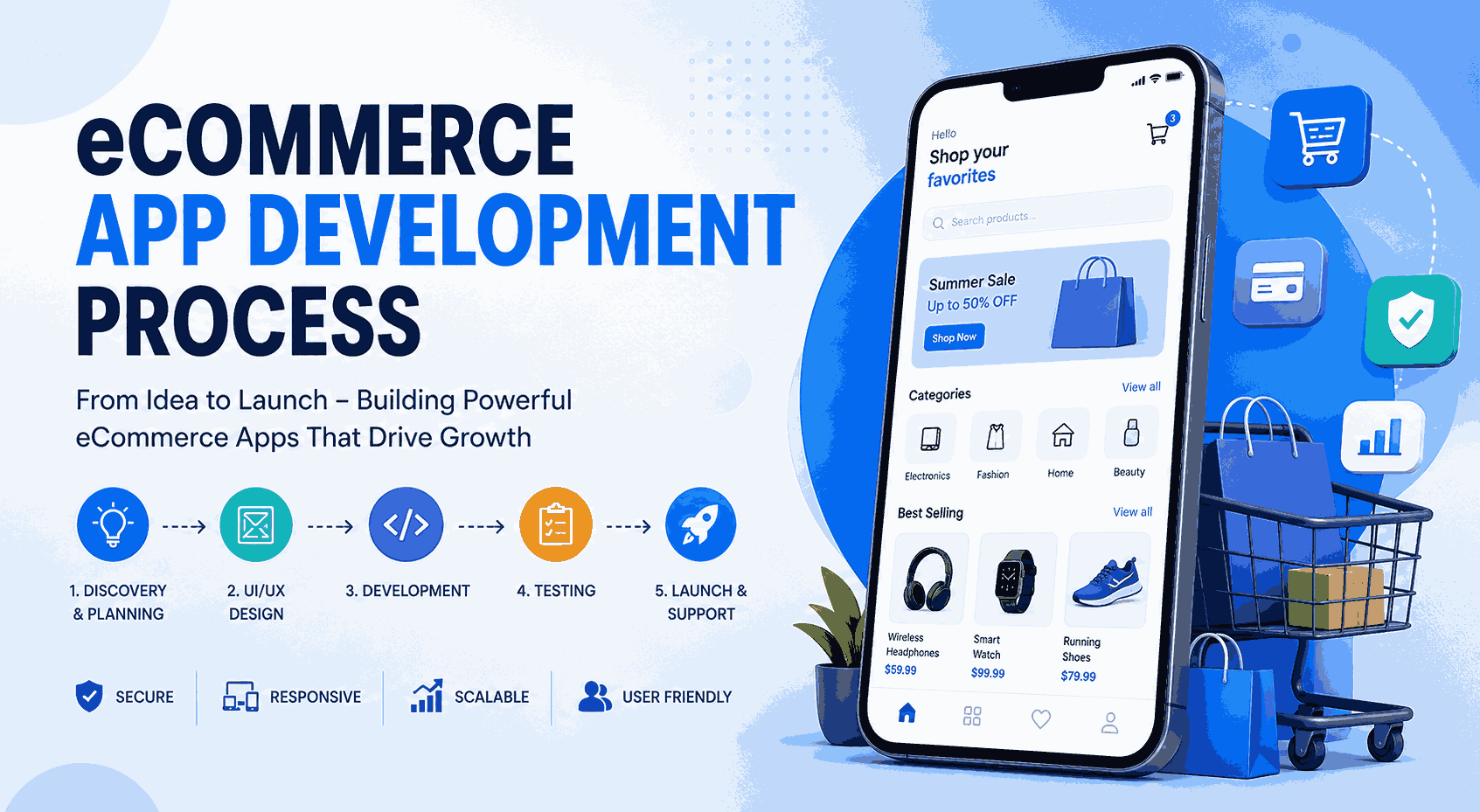
The global eCommerce industry is growing faster than ever, and businesses are now investing heavily in mobile first shopping experiences. Customers expect fast, secure, and user-friendly applications that make browsing, purchasing, and tracking orders effortless. This is why understanding the eCommerce app development process has become essential for brands that want to stay competitive in today’s digital market.
Whether you are a startup launching your first online store or an established retailer planning to scale operations, a well-structured eCommerce application can significantly improve customer engagement, conversions, and long-term revenue growth.
In this guide, we will explain the complete eCommerce app development process, important technologies, development stages, features, challenges, and best practices businesses should know before building an eCommerce application.
What Is eCommerce App Development?
eCommerce app development refers to the process of designing, developing, testing, and launching mobile or web applications that allow users to buy products or services online.
These applications usually include features such as:
- Product listings
- Search and filtering
- Shopping cart
- Secure payment gateways
- Order tracking
- Customer accounts
- Push notifications
- Inventory management
- AI-based recommendations
Modern businesses often work with an experienced Ecommerce Development Company USA to ensure the application is scalable, secure, SEO-friendly, and optimized for long-term growth.
Why Businesses Invest in eCommerce Applications
Consumer behavior has shifted dramatically toward mobile shopping. Businesses that rely only on websites often lose opportunities because users now prefer dedicated applications for speed, convenience, and personalized experiences.
Key Benefits of eCommerce Apps
Better User Experience
Apps provide faster loading times, smoother navigation, and personalized recommendations compared to traditional websites.
Higher Customer Retention
Push notifications and loyalty programs help businesses maintain long-term customer relationships.
Improved Conversion Rates
Mobile apps generally achieve higher conversion rates due to simplified checkout processes and optimized mobile experiences.
Stronger Brand Presence
Having a dedicated app improves brand visibility and customer trust.
Advanced Data Insights
Businesses can track customer behavior, purchase patterns, and engagement metrics to improve marketing strategies.
Complete eCommerce App Development Process
Building a successful eCommerce application involves multiple stages. Every phase plays an important role in ensuring the app performs efficiently and meets business goals.
1. Business Research and Requirement Analysis
The first step is understanding the business model, target audience, industry competition, and project requirements.
This stage includes:
- Defining business objectives
- Identifying target customers
- Researching competitors
- Selecting core app features
- Determining monetization strategy
- Choosing platforms (iOS, Android, Web)
A strong research phase reduces development risks and helps create a clear roadmap.
Questions Businesses Should Ask
- What problem will the app solve?
- Who are the target customers?
- Which features are most important?
- What payment methods are required?
- Will the app support multi-vendor functionality?
- What is the expected future scalability?
2. UI/UX Design Planning
User experience directly impacts conversion rates in eCommerce applications. Poor design often leads to cart abandonment and low engagement.
Professional designers create:
- Wireframes
- User journeys
- Interactive prototypes
- Mobile-responsive layouts
- Brand-focused visual elements
Important UI/UX Elements
- Simple navigation
- Fast product discovery
- Clear call-to-actions
- Smooth checkout flow
- Mobile-friendly layouts
- Easy account management
Modern eCommerce brands prioritize clean and conversion-focused interfaces because user experience heavily affects purchasing decisions.
3. Choosing the Right Technology Stack
The technology stack determines the scalability, speed, security, and flexibility of the application.
Popular Frontend Technologies
- React Native
- Flutter
- React.js
- Next.js
Popular Backend Technologies
- Node.js
- Laravel
- Python
- PHP
Database Technologies
- MySQL
- PostgreSQL
- MongoDB
Cloud and Hosting Services
- AWS
- Google Cloud
- Microsoft Azure
Businesses often choose custom technology solutions instead of relying only on template-based platforms because custom architecture offers better flexibility and scalability.
4. eCommerce App Development
This is the core development phase where frontend and backend systems are built.
Frontend Development
Frontend developers focus on the user-facing side of the application including:
- Product pages
- Shopping cart
- Checkout
- Search functionality
- User dashboard
Backend Development
Backend developers build:
- APIs
- Admin panel
- Database structure
- Payment integrations
- Inventory systems
- Authentication systems
Businesses looking for long-term scalability often prefer to Hire eCommerce Developers USA who specialize in custom eCommerce architectures and enterprise-level integrations.
5. Third-Party Integrations
Modern eCommerce applications require multiple integrations for seamless operations.
Common Integrations
- Payment gateways
- CRM systems
- ERP systems
- Shipping providers
- Marketing automation tools
- Analytics platforms
- AI recommendation engines
- Chat support systems
Proper integration planning improves operational efficiency and customer experience.
6. Security Implementation
Security is one of the most critical aspects of eCommerce application development.
Since users share personal and payment information, businesses must follow strong security practices.
Essential Security Measures
- SSL encryption
- Secure payment processing
- Multi-factor authentication
- Data encryption
- GDPR compliance
- PCI DSS compliance
- Regular security testing
Security failures can damage brand reputation and customer trust.
7. Testing and Quality Assurance
Before launch, the application undergoes extensive testing to identify bugs, performance issues, and usability problems.
Types of Testing
- Functional testing
- Performance testing
- Security testing
- Compatibility testing
- UI/UX testing
- Load testing
Testing ensures the application works smoothly across different devices and operating systems.
8. App Deployment and Launch
Once testing is completed, the application is deployed to production servers and app stores.
Launch Activities Include
- Server deployment
- App Store submission
- Google Play Store submission
- Performance monitoring
- Analytics setup
- Marketing launch campaigns
A successful launch strategy helps generate early traction and downloads.
9. Post-Launch Maintenance and Support
eCommerce app development does not end after launch. Continuous updates and maintenance are essential for long-term success.
Post-Launch Services
- Bug fixes
- Security updates
- Performance optimization
- Feature enhancements
- Server monitoring
- User feedback improvements
Regular maintenance helps businesses stay competitive and maintain customer satisfaction.
Essential Features of a Successful eCommerce App
A high-performing eCommerce application should include features that improve usability, engagement, and conversions.
Customer Features
- User registration and login
- Product search and filters
- Wishlist functionality
- Shopping cart
- Multiple payment options
- Order tracking
- Ratings and reviews
- Push notifications
Admin Features
- Inventory management
- Product management
- Order management
- Analytics dashboard
- Customer management
- Discount and coupon management
Latest Trends in eCommerce App Development
The eCommerce industry continues evolving rapidly with AI and automation technologies.
AI-Powered Personalization
AI helps deliver personalized recommendations based on user behavior and purchase history.
Voice Search Integration
Voice-enabled shopping is becoming increasingly popular among mobile users.
Augmented Reality (AR)
AR allows customers to visualize products before purchasing.
Chatbots and AI Support
AI chatbots improve customer support and automate common queries.
Headless Commerce
Headless architecture allows businesses to create faster and more flexible shopping experiences.
Common Challenges in eCommerce App Development
Despite the opportunities, businesses often face several development challenges.
Security Risks
Protecting customer and payment data requires advanced security infrastructure.
Scalability Issues
Applications must handle growing traffic and transactions efficiently.
Performance Optimization
Slow applications reduce user engagement and conversions.
Multi-Platform Compatibility
Apps must work seamlessly across different devices and operating systems.
Complex Integrations
ERP, CRM, and payment integrations often require advanced technical expertise.
How to Choose the Right eCommerce Development Partner
Choosing the right development partner significantly affects project success.
Important Factors to Consider
- Industry experience
- Portfolio quality
- Technology expertise
- Communication process
- Development methodology
- Support services
- Scalability capabilities
Businesses should work with agencies that understand both technical development and conversion-focused user experiences.
Final Thoughts
The eCommerce app development process involves much more than simply building an online store. It requires strategic planning, modern technologies, strong security, scalable architecture, and user-focused experiences.
Businesses that invest in high-quality eCommerce applications gain a competitive advantage through improved customer engagement, stronger retention, and higher conversions.
As customer expectations continue evolving, companies that prioritize performance, mobile optimization, AI-driven personalization, and scalable development strategies will remain ahead in the digital commerce landscape.
 tech.emizen
  adam smith
  fajere jaafar