
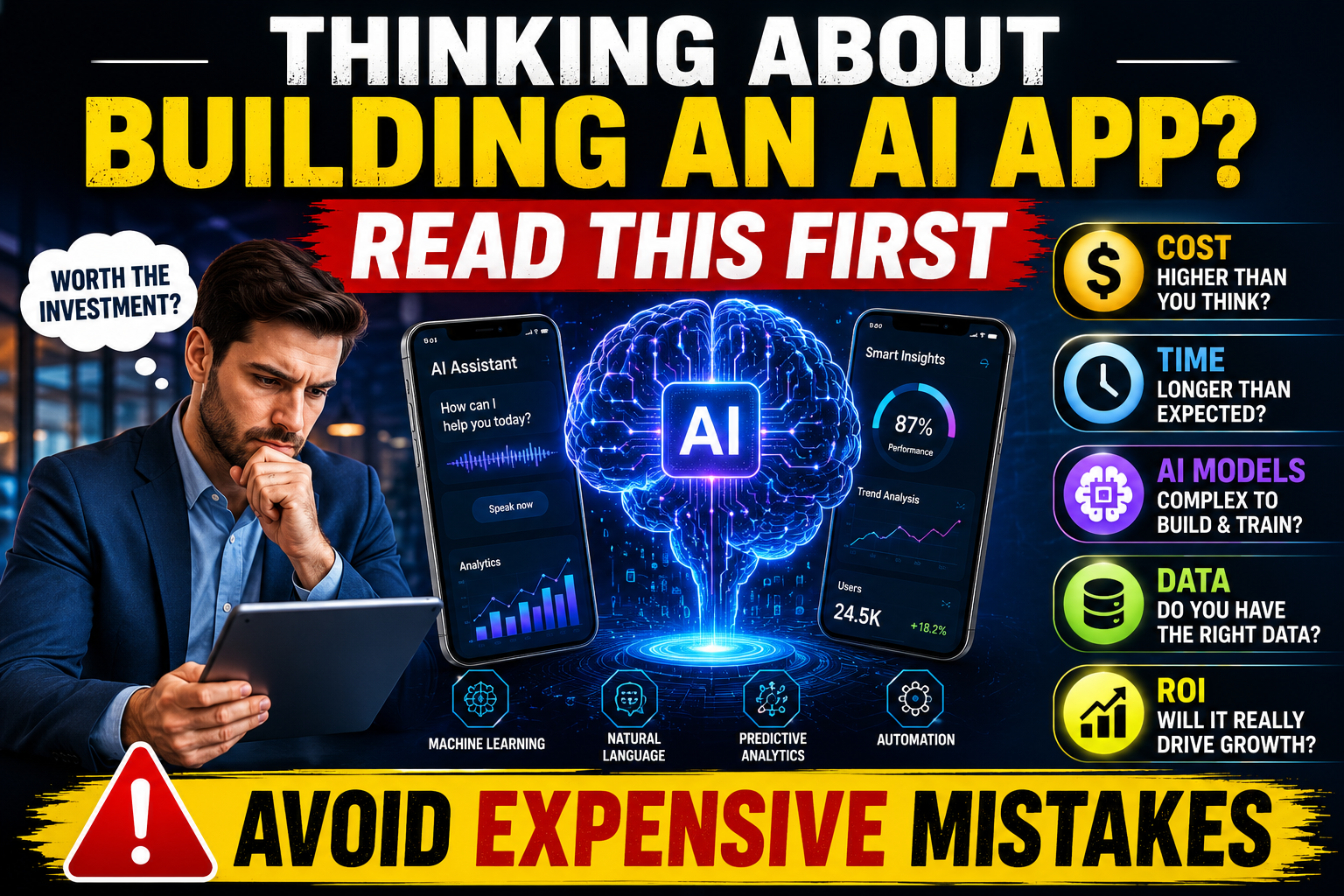
 Artificial Intelligence is no longer a futuristic concept reserved for large technology companies. Today, businesses of all sizes are exploring AI-powered applications to automate processes, improve customer experiences, increase efficiency, and create new revenue opportunities. As a result, AI app development has become one of the fastest-growing areas in the software industry.
The excitement surrounding AI is understandable. Companies see competitors launching AI-driven products, investors actively funding AI startups, and customers increasingly expecting intelligent digital experiences. However, many organizations rush into AI app development without fully understanding the challenges, costs, and strategic decisions involved.
That often leads to wasted budgets, delayed launches, and products that fail to deliver meaningful business value.
The most successful AI applications are not built because AI is trendy. They are built because AI solves a specific business problem more effectively than traditional software.
Before committing time, money, and resources to an AI-powered application, it is worth understanding what separates successful projects from expensive mistakes.
Why Are So Many Businesses Investing in AI App Development?
AI has the potential to improve how businesses operate across almost every industry.
Common applications include:
- AI chatbots and virtual assistants
- Recommendation engines
- Predictive analytics
- Customer support automation
- Image recognition systems
- Voice-enabled applications
- AI-powered healthcare solutions
- Fraud detection platforms
According to McKinsey & Company, organizations that effectively implement AI technologies often report improvements in productivity, customer engagement, and operational efficiency.
The opportunity is significant, but success depends on selecting the right use case.
The First Question: Does the Problem Actually Need AI?
Many companies start with the wrong question.
Instead of asking:
“How can we use AI?”
Successful organizations ask:
“What problem are we trying to solve?”
This distinction matters.
Some business challenges genuinely benefit from machine learning, predictive analytics, or natural language processing. Others can be solved more effectively with traditional software development.
Adding AI where it is not needed often increases complexity, development costs, and maintenance requirements.
The goal should always be solving a business problem, not simply adding AI features.
Understanding the True Cost of AI App Development
One of the biggest misconceptions about AI app development involves cost.
Many business owners assume AI development only involves creating an application interface.
In reality, costs often include:
- AI model development
- Data collection
- Data cleaning
- Cloud infrastructure
- API integrations
- Security implementation
- Ongoing model training
- Application development
- Testing and optimization
The complexity of the AI system significantly influences the overall budget.
A simple AI chatbot may cost a fraction of what is required for a sophisticated predictive analytics platform.
Data Matters More Than Most Businesses Realize
AI systems learn from data.
Without quality data, even the most advanced AI models struggle to perform effectively.
Before beginning AI app development, organizations should evaluate:
- Data availability
- Data quality
- Data privacy requirements
- Data ownership
- Regulatory compliance
Many projects encounter delays because businesses discover their existing data is incomplete, inconsistent, or unsuitable for training AI systems.
In many AI projects, data quality becomes more important than the AI model itself.
Should Businesses Build or Buy AI Solutions?
This is a critical decision.
Some organizations require fully customized AI applications tailored to unique workflows.
Others may achieve their goals using existing AI platforms and APIs.
Building custom solutions often provides:
- Greater flexibility
- Better competitive differentiation
- Custom workflows
- Full ownership
Using existing AI services may offer:
- Faster deployment
- Lower development costs
- Reduced technical complexity
The right choice depends on business goals, budget, and long-term strategy.
What Features Deliver the Highest Return?
Not every AI feature generates equal business value.
Organizations frequently achieve the strongest results through:
- Intelligent customer support
- Workflow automation
- Predictive insights
- Personalized recommendations
- Operational optimization
Many businesses discover that a single well-designed AI feature provides more value than an application overloaded with unnecessary functionality.
Focusing on measurable outcomes usually produces better returns.
Security and Compliance Cannot Be Ignored
As AI applications process increasing amounts of customer data, security becomes more important.
Businesses should consider:
- Data encryption
- User authentication
- Regulatory compliance
- Privacy requirements
- Secure cloud infrastructure
Industries such as healthcare, finance, and insurance often face additional compliance obligations that directly impact AI development decisions.
Ignoring these requirements early can create significant challenges later.
Choosing the Right AI Development Partner
Technology alone does not guarantee success.
The development partner plays a major role in determining project outcomes.
Businesses should evaluate:
- Industry experience
- AI expertise
- Development methodology
- Portfolio quality
- Scalability capabilities
- Post-launch support
The best development partners focus on business outcomes rather than simply delivering technical features.
They help organizations identify where AI creates value and where simpler solutions may be more appropriate.
How Long Does AI App Development Take?
Timelines vary significantly.
Simple AI applications may launch within a few months.
More sophisticated platforms involving custom machine learning models, large datasets, and enterprise integrations may require substantially longer development cycles.
Project duration depends on:
- Application complexity
- Data readiness
- AI model requirements
- Compliance needs
- Integration scope
Businesses that invest time in planning often avoid costly delays during development.
What Do Successful AI Projects Have in Common?
After reviewing hundreds of AI implementations across industries, one pattern appears consistently.
Successful projects begin with a clear business objective.
They focus on solving a specific problem.
They prioritize user experience.
They establish realistic expectations.
Most importantly, they treat AI as a tool rather than a marketing feature.
The strongest AI products solve real-world challenges in ways users genuinely appreciate.
Conclusion
Investing in AI app development can create significant opportunities for innovation, efficiency, and business growth. However, success depends on far more than selecting the latest AI technology. Organizations that clearly define their goals, evaluate data readiness, understand costs, and focus on solving meaningful business problems consistently achieve better outcomes.
AI should never be adopted simply because it is popular. The most successful applications are built with purpose, supported by quality data, and designed around real user needs. Businesses exploring AI-powered solutions can learn more about custom software, mobile app development, and digital transformation services that help turn innovative ideas into scalable, business-driven applications.
FAQs
How much does AI app development cost?
Costs vary depending on complexity, features, AI model requirements, integrations, and infrastructure needs. Simple projects may cost significantly less than enterprise-grade AI platforms.
Do all mobile apps need AI?
No. Many applications function effectively without AI. AI should only be implemented when it provides measurable business value.
How long does AI app development take?
Development timelines can range from a few months to over a year depending on project complexity and data requirements.
What industries benefit most from AI app development?
Healthcare, finance, retail, logistics, education, manufacturing, and customer service industries commonly benefit from AI-powered solutions.
Is custom AI app development better than using existing AI tools?
It depends on business goals. Custom solutions provide greater flexibility, while existing AI platforms may offer faster deployment and lower costs.
 tech.emizen
  adam smith
  fajere jaafar