
If you have worked on an SAP transformation project in the last couple of years, you have probably heard “clean core” more times than you can count. SAP expects the same vocabulary, and the judgment behind it, from anyone who wants the RISE with SAP Methodology and Experience credential.
This guide breaks down the C_RISME exam topics in plain language. It covers what each topic area asks of you, how the scenario-based format changes your preparation, and where candidates lose marks. It is written for consultants, project managers and architects who want a realistic picture before they book an attempt.
The exam details below were checked against SAP’s official certification page in October 2026. SAP updates certification versions regularly, so confirm the current code and format on SAP Learning before you register.
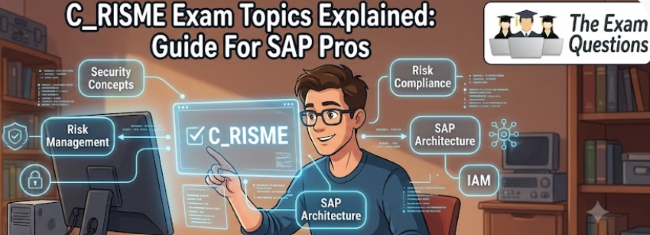
What The C_RISME Certification Tests
SAP describes the SAP Certified – RISE with SAP Methodology and Experience certification as recognizing consultants who understand customer business requirements, carry out successful implementations and stay current with the RISE with SAP methodology. It is built for people who already deliver projects.
The official page tags three skills: Project Implementation, SAP Clean Core and System Implementation. The exam checks whether you can steer a cloud transformation the way the methodology intends. Product features are a minor part of it.
Exam snapshot:
- Exam code: C_RISME (current version referenced: C_RISME_2511)
- Format: 1 activity, scenario-based assessment
- Duration: 2 hours
- Pass score: 67%
- Intended roles: Consultant, Project Manager, Architect
SAP also states that candidates should have substantial recent project experience, with at least 24 months of active ERP project involvement in the past 36 months. You do not need to name customers. Describing a project anonymously, such as “a retail company” or “a manufacturing customer”, is acceptable.
How The Scenario-Based Format Changes Your Preparation
Most SAP certifications used to be multiple choice. This one asks you to respond to a realistic situation and explain what you would do and why, instead of picking an option from a list.
SAP offers two ways to complete it. One is a roleplay with AI guidance, available in several languages. The other is a recorded video, which SAP lists as English only. Your answers are judged against expert-defined criteria, so the meaning of what you say matters more than exact wording.
Two practical points are easy to miss:
- Pausing the roleplay does not stop the exam clock.
- The human-reviewed route can take longer to return results than the near-instant AI route.
Memorizing definitions only gets you so far. You need to talk through a decision calmly, in your own words, in a minute or two.
C_RISME Exam Topics Explained
SAP does not publish a percentage-weighted topic list for this exam, as it did for some older certifications. It does publish a learning journey, and the main course in it covers the areas below. Treat this as a study map built from that official material, not as an official blueprint.
-
RISE with SAP Methodology foundations
Start with the “why”. The methodology gives cloud transformations a consistent, repeatable shape so each project does not have to improvise. It rests on four ideas: a structured approach, a standardized framework, an integrated toolchain and expert guidance.
A scenario might ask why a customer should follow the methodology at all. A good answer ties it to predictable delivery and fewer surprises, and leaves out marketing language.
-
The standardized framework and SAP Activate
The methodology builds on SAP Activate and its six phases: Discover, Prepare, Explore, Realize, Deploy and Run. Know what typically happens in each phase and where the governance checkpoints sit.
Phase names are only the start. Be ready to explain what you would do if a team is rushing through Explore to hit a go-live date, and what that risks later.
-
Clean core fundamentals
This is the heart of the exam and deserves the most study time. Clean core means keeping the standard system as close to standard as possible so upgrades stay smooth. The official material frames it across five dimensions: processes, extensions, data, integrations and operations.
Know the reasoning behind the guidance too. Custom logic inside the core makes every future update harder, so extensions are pushed to SAP BTP and kept governed. A useful chain to remember: standardize the core, extend outside it, govern the result, protect upgrades.
Expect scenarios where a business stakeholder demands a modification. Your job is to show you can answer, “Not like that, but here is a clean way to meet the need.”
-
The methodology dashboard and SAP Cloud ALM
The dashboard gives teams visibility through views on systems and operations, clean core adherence, version insights, tool readiness and upgrade preparation. SAP Cloud ALM sits underneath as the engine for that visibility and governance.
You use the dashboard to see what is happening, understand why, and decide what to do next. If you can explain how a project manager would use it in a weekly steering meeting, you are on the right track.
-
Transformation Preparation Service
The Transformation Preparation Service, often shortened to TPS, bridges vision and execution. It covers tailoring a roadmap, mapping what the customer is entitled to use, running governance sessions and activating the toolchain.
Candidates often reduce this to “a kickoff workshop”, but it is broader. Be clear on what it produces and how it speeds up time to value.
-
Expert guidance, validated partners and stakeholder roles
Projects under this methodology involve SAP, partners, advisors and architects. You should understand who contributes what, how quality gates work and why project discipline matters when many parties touch the same landscape.
Scenario questions here are usually about responsibility. Who raises the issue? Who approves the deviation? Practicing those answers aloud helps.
-
Joule for the methodology
SAP’s AI assistant, Joule, is part of the learning path. Focus on the practical side: context-aware guidance inside the tools, support for project phases and help carrying out clean core actions. Describe the workflow value in plain terms.
Where Candidates Usually Struggle
A few patterns stand out from the official material and the scenario-based assessment guidance.
- Over-relying on theory. The exam rewards applied judgment. If your answer sounds like a slide, it needs a real project example behind it.
- Rambling. Long answers dilute the points you want the scorer to hear. Structure each response as situation, decision, reason, risk.
- Treating clean core as a slogan. Anyone can say “avoid customization”. Strong answers explain the trade-off, such as when a business-critical requirement justifies a side-by-side extension on BTP.
- Ignoring the technical setup. SAP’s guidance notes that corporate Wi-Fi or firewalls can interfere with the roleplay platform. Test your connection, microphone and camera ahead of time, and have a backup network ready.
How To Study The C_RISME Exam Topics: A Four-Week Plan
Adapt this to your schedule. The aim is steady practice, with no last-minute cramming.
Week 1: Learn the official material:
Work through the learning journey on SAP Learning, including the course “Introducing RISE with SAP Methodology for SAP Partners and Customers”. Take notes in your own words, and write down one question per lesson that you could not yet answer without looking.
Week 2: Connect topics to your own projects:
Pick two or three projects you have worked on and map how the phases, clean core dimensions and governance would have applied. This becomes your pool of real examples for scenario answers.
Week 3: Practice speaking:
Set a timer for 60 to 90 seconds and answer typical scenario prompts out loud. Record yourself and listen for filler words, missing reasoning and wandering answers. SAP also provides an AI-powered practice tool for scenario-based assessments, which is worth trying before the real attempt.
Week 4: Simulate the real thing:
Do one or two full-length, timed run-throughs. Review the feedback honestly, fix your weakest topic and check your technical setup again. If you plan to use the video route, rehearse in the same room and on the same device.
Important Logistics Before You Book
Sort out a few items early:
- SAP Universal ID: Set it up with a secondary email address so your credentials stay with you if you change employers.
- Attempts: You need a Learning Hub subscription that includes certification attempts. Check how many remain before scheduling.
- Retakes and validity: Retake limits and a waiting period between attempts apply, and the certification stays valid for a limited period unless you complete SAP’s “stay certified” process. Read the current rules on SAP Learning instead of relying on memory or third-party summaries.
- Time zone: Set it manually when scheduling so you do not end up with an unintended default.
Conclusion
The C_RISME exam topics come down to a handful of ideas: why the methodology exists, how it extends SAP Activate, what clean core demands, how Cloud ALM and the dashboard give visibility, and how guidance and roles keep a project on course. Learn those, tie each one to a project you have lived through, and practice with The Exam Questions scenario-based tests. The exam rewards talking through decisions more than recalling facts.
Frequently Asked Questions
What are the main C_RISME exam topics?
Based on SAP’s learning journey, the key areas are methodology foundations, the standardized framework and SAP Activate, clean core fundamentals, the methodology dashboard with SAP Cloud ALM, the Transformation Preparation Service, expert guidance and validated partners, and Joule. SAP does not publish exact percentage weightings, so cover all areas.
Is C_RISME a multiple-choice exam?
No. SAP lists it as one scenario-based assessment activity lasting two hours, with a 67% pass score. You respond to realistic situations and do not choose from answer options.
Do I need project experience to attempt it?
SAP states that candidates should have at least 24 months of active ERP project involvement within the past 36 months, along with a deep understanding of the methodology. You can describe projects anonymously.
Which C_RISME exam topic should I spend the most time on?
Clean core. It appears across the framework, the dashboard, extensions and governance, so a strong grasp of it supports almost every scenario you could be given.
 gsingh@sevenmentor.com
 Sandeep
 kim henry