
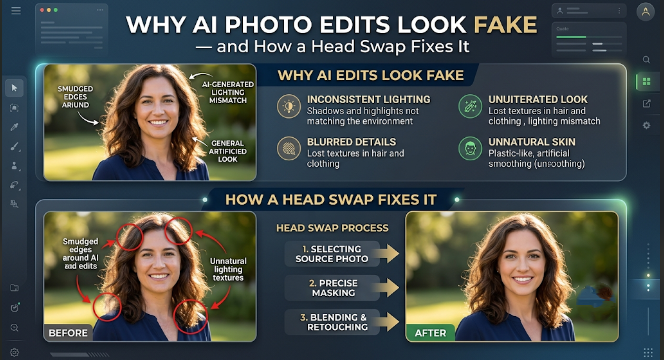
We have all seen it: an edited photo that is almost convincing. The eyes line up, the smile looks fine, the skin tone is close — and yet something quietly tells you it has been altered. Most of the time, the culprit is the editing method itself. A face swap moves only a slice of a person, while everything around it stays behind. The result is a face that sits on a photo rather than in it.
If realism is the goal, swapping the whole head usually wins. Here is why, and how to get a result that holds up to a second look.
Face swap vs head swap, in plain terms
A face swap replaces the inner face — eyes, nose, mouth, cheeks, sometimes a bit of forehead. The hair, ears, jawline, head shape, and neck all stay as they were. The AI is essentially trying to fit a new face into someone else’s frame.
A head swap replaces the entire head as one piece: face, hair, forehead, ears, chin, and often part of the neck. Because all of those parts travel together, the AI has the full outline to blend against instead of a small patch in the middle of a face. That extra context is the whole reason a head swap tends to look more natural.
It helps to remember that we do not recognise people by their eyes alone. Hair, head size, and the way a head sits on the shoulders all carry identity. Move only the face, and those signals fall out of sync.
The four giveaways that expose a fake
When an edit looks “off,” it is usually one of these four things:
- The hairline. A swapped face rarely matches the original hair perfectly. The forehead ends up too tall, too short, or unnaturally smooth where the new face meets old hair.
- The jawline. Soft features dropped onto a wide or sharp jaw create a mismatch your brain catches instantly, even if you cannot name it.
- The neck. People check the face first, but the neck often tells the truth. In a face swap, skin tone can shift abruptly under the chin, and the shadow beneath the jaw can land in the wrong place.
- The lighting. If the face is lit from the side but the rest of the photo is lit from the front, no amount of clean blending will save it.
A head swap does not magically erase these problems, but it gives the AI far more room to solve them. With the whole head in play, the tool blends across the hair, chin, and neck in one continuous pass rather than stitching a patch into the centre of an existing face.
Hair carries more identity than people realise
Hair is one of the strongest parts of how we read a face. Change someone’s hairstyle, hairline, or colour and they can look like a different person. That is exactly why face swaps so often fail — the new face is forced onto hair that does not belong to it.
Because a head swap keeps the hair, hairline, and head shape attached to the face, the person still looks like themselves. This is the single biggest reason head-swapping produces more believable profile pictures, family photos, and creative portraits.
How to get a clean result
The method matters, but your source photos matter just as much. A few habits make a noticeable difference:
- Match the angle. If the body is turned slightly, the head photo should be turned the same way. Pairing a front-facing head with a side-facing body almost never looks right.
- Match the lighting. Two photos shot in similar, soft natural light blend far more easily than a mix of harsh and dim sources.
- Use sharp images. Blurry, dark, or overexposed photos give the AI less to work with and produce rough edges.
- Keep the neck and shoulders visible. That gives the tool a natural area to blend the head into the body.
- Use photos you have the right to edit. Stick to your own images or ones you have permission to use — it is the responsible way to work and keeps your projects trouble-free.
If you want to try the full-head approach without wrestling with complex design software, a dedicated Head Swap tool handles the blending for you and is a good way to see the difference for yourself before committing to anything more advanced.
When each method is the right call
Face swap is not a bad option — it is genuinely useful for quick jokes, memes, and casual social posts, especially when both photos already share a similar angle, size, and light. It also shines when hair is hidden under a hat, helmet, or costume, so the face really is the main focus.
Head swap is the better choice when the result needs to look polished and believable: profile pictures, group-photo fixes, marketing visuals, and any portrait where the person should simply look like themselves. Whenever hair, head shape, or angle matters, moving the whole head keeps the identity intact.
The takeaway
Face swap changes a person’s features. Head swap changes the whole identity area — hair, forehead, ears, jaw, and the shadows that tie them together. That is why, time after time, a head swap reads as more complete and more real.
So if your edits keep landing in the uncanny zone, start with clear photos, similar angles, and balanced light, then swap the head rather than just the face. Once you see the two side by side, the difference is hard to unsee.
 brandworxmedia.co@gmail.com
  yourecutephotobooth
  admin
admin