
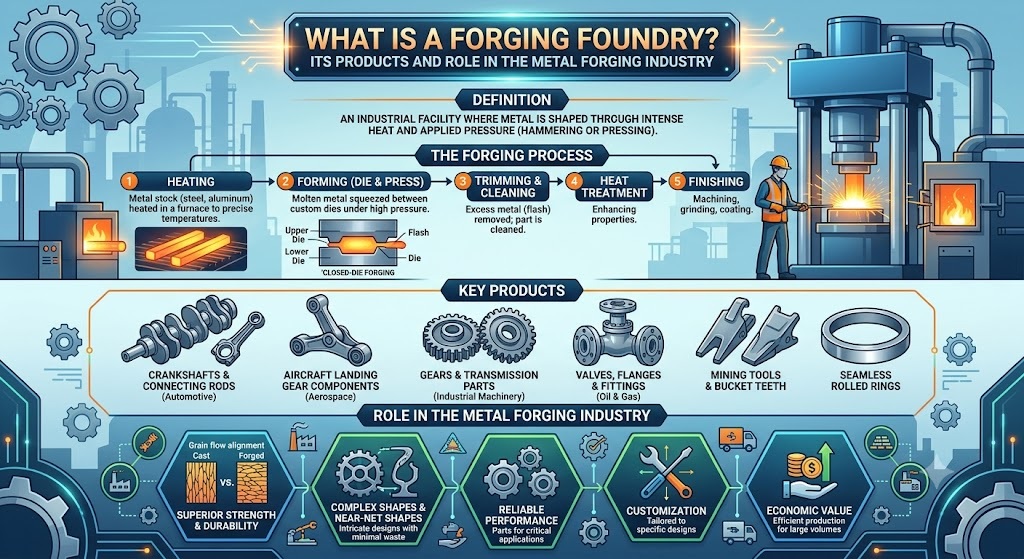
A forging foundry is a place where a metal is shaped using heat, pressure, and machinery. Forging is used here to produce a variety of strong metal goods that can be used in various industries. A forging foundry makes and sells different metal parts such as axles, crankshafts, shafts, teeth, flanges, and gears. The end products are used in the following areas: aerospace, automotive, oil and gas, and construction. A forging foundry provides essential services in the field of forging because it produces very strong components that meet all the required engineering specifications.
How to Evaluate Forging Foundries: Key Criteria and Essential Safety Precautions
When rating forging foundries, it will be important to analyze the production capabilities, production volumes, quality control measures, and certifications of the company. The history of the company in forging parts will matter, as well as its quality of materials, sizes, and price. Forging foundry must adhere to state government industrial standards, international trade agreements regulatory authorities, and global trade standards.
It is critical to pay attention to the safety equipment used by a forging foundry including heat-resistant gloves, safety clothing, helmets, and eye protection from injuries caused by molten metal and flying pieces. Additionally, such important things as good ventilation and guarding of machines are of importance.
How Forging Foundries Maintain Quality Standards for Global Exports
The adherence to various quality control standards by the forging foundry is primarily done through the use of approved raw materials, specified forging temperatures, state-of-the-art equipment, and various checks during production. During the manufacturing process, the forge performs various checks to determine its products’ physical dimensions, mechanical properties, and overall performance qualities.
Additionally, the cooperation with an international forge foundry involves compliance with ISO 9001 quality management system requirements and the standards, as well as IATF 16949 standards suitable for automotive components and ASTM, ASME, or EN product and catalogue standards. Different markets have different standards and rules so that traceability and certifications regarding the material, inspection, and mechanical tests conducted become necessary for transnational cooperation.
Conclusion
In conclusion, it can be stated that the forging foundry occupies an important place in the field of metalworking, because of its manufacturing of strong and reliable products. One can assess the performance of this unit through its production capabilities, safety measures, quality control systems, and production rates. The requirement of compliance with international quality standards, precise materials traceability, and quality testing of products will guarantee that the produced items are in accordance with the international requirements. By means of the usage of modern technologies and observance of high safety and quality standards, forging foundry is able to contribute to industrial efficiency, reliability of the product, and growth of a business in the long run. Forging foundry help automobile industry by supplying them forged automobile parts that is essential for manufacturing automobile. They are often regarded as backbone of automobile industries. By adapting newer and latest technologies they automate their forging tasks, enhance efficiency and precision in production units.
 Peak Peptides
  Sushant Ramnarine
  Supply Base Solutions