
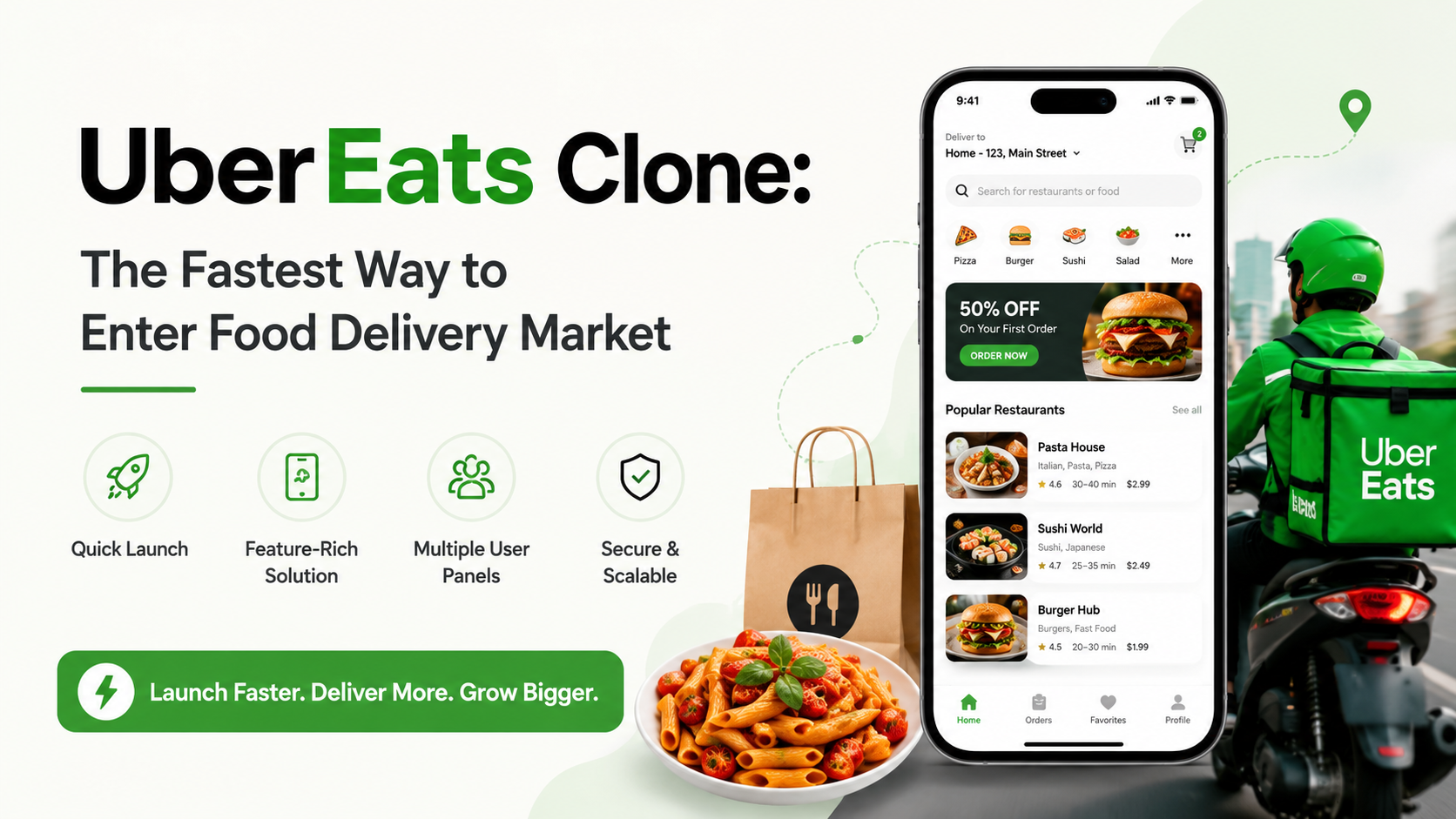
Rising customer acquisition costs, intense competition from aggregator giants, and increasing pressure on delivery speed are forcing entrepreneurs to rethink traditional food delivery business models. In this environment, launching an UberEats Clone is becoming one of the most practical ways for startups to enter the on-demand food industry without building everything from scratch.
Today’s entrepreneurs are not struggling with ideas—they are struggling with execution speed, scalability, and profitability. Customers expect instant ordering, real-time tracking, and seamless payments, while restaurants demand lower commissions and better visibility. A well-structured UberEats Clone bridges this gap by offering a ready-made, scalable ecosystem that connects users, delivery partners, and restaurants under one platform.
UberEats Clone Script for Fast Market Entry
An advanced UberEats clone script enables entrepreneurs to launch a fully functional food delivery platform within weeks instead of months. It comes pre-built with essential modules such as restaurant onboarding, menu management, delivery tracking, order dispatch system, and multi-payment integration.
For regional entrepreneurs, especially in growing markets like India, Southeast Asia, and the Middle East, this means reduced dependency on third-party aggregators and increased control over margins. Instead of paying high commissions to global platforms, business owners can build their own branded ecosystem and retain long-term customer value.
The biggest advantage is flexibility. Entrepreneurs can customize pricing models, delivery zones, and commission structures based on local market behavior—something large aggregators often cannot do effectively at scale.
Uber Clone App & Scalable Ecosystem Strategy
A modern uber clone app is no longer just about ride-hailing or food delivery—it is about building a scalable digital ecosystem. When integrated with food delivery services, logistics, and hyperlocal commerce, it becomes a powerful multi-revenue platform.
Entrepreneurs using an ubereats clone app development approach can expand beyond food delivery into grocery, medicine, courier services, and even cloud kitchens. This diversification helps stabilize revenue and reduces dependency on a single service category.
From a business perspective, owning the platform also means owning the data. Customer preferences, ordering behavior, peak demand times, and restaurant performance metrics can be used to optimize marketing campaigns and improve retention rates.
This is where modern solutions like SpotnEats come into play—offering a ready-to-deploy UberEats clone ecosystem designed for scalability, fast deployment, and full business control without technical complexity.
Why This Model Wins in 2026 Market
The food delivery industry is shifting toward localized platforms and niche aggregators instead of global monopolies. Entrepreneurs who adopt an UberEats Clone app strategy can position themselves in underserved regions, tier-2 cities, and high-demand local clusters where large platforms are less efficient.
This creates a strong competitive advantage:
- Lower operational costs
- Faster customer acquisition in local markets
- Higher restaurant retention rates
- Better profit margins through controlled commissions
If you are planning to enter the food delivery industry, now is the right time to launch your own branded platform instead of competing inside someone else’s ecosystem.
 Rajshree Verma
  Ariana Gomez