
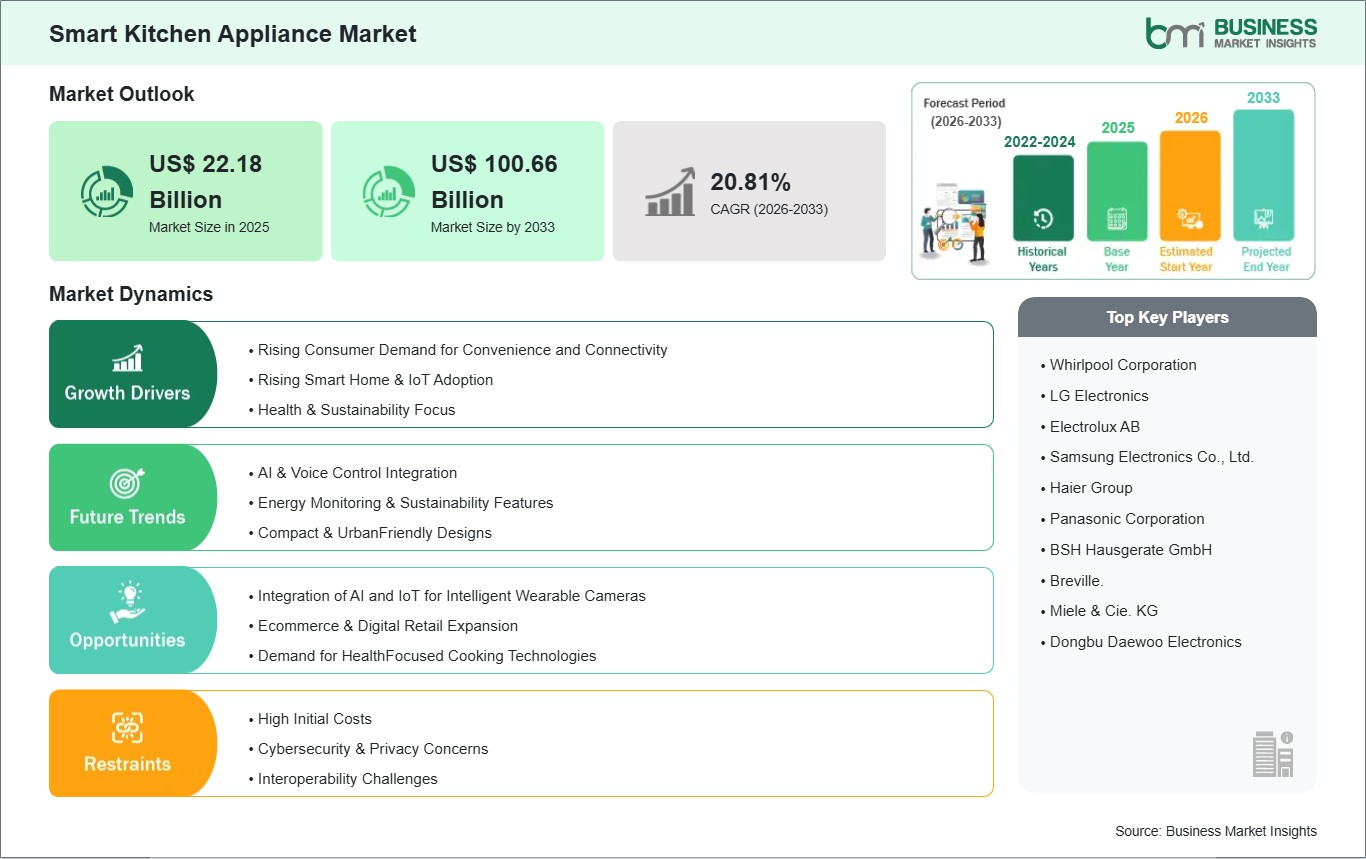
The Smart Kitchen Appliance Market size is expected to reach US$ 100.66 Billion by 2033 from US$ 22.18 Billion in 2025. The market is estimated to record a CAGR of 20.81% from 2026 to 2033.
End-user demand is widening because of connected-home convenience, while IoT sensors, AI features, and mobile control changes how solutions are specified and adopted. The demand outlook remains sensitive to premium pricing and privacy concerns, making customer outcomes and implementation fit central. The report provides market size and market share analysis, forecast coverage, key segment insights, regional coverage, competitive landscape analysis, and company profiles across the forecast period.

What is driving the market?
Demand grows when connected-home convenience, IoT sensors, AI features, and mobile control, and energy management and automation solve practical end-user problems. Adoption is strongest when customers can connect the solution to productivity, quality, safety, or convenience. Premium pricing and privacy concerns can still slow procurement and broader deployment.
Which region leads?
Asia-Pacific is an important growth market supported by appliance manufacturing, connected-home adoption, and urban consumers; BMI does not disclose a regional share percentage. Demand differs by geography because purchasing power, installed infrastructure, and end-user maturity vary. Suppliers should align product configuration, pricing, and service with local adoption conditions rather than use a uniform model.
Which segment leads?
Smart refrigerators and residential applications are leading categories in the 2025 segmentation. End-user purchasing patterns explain why these categories hold leading positions. Suppliers that simplify procurement, integration, training, and lifecycle support can strengthen adoption within the dominant segments.
Download the Sample PDF:
https://www.businessmarketinsights.com/sample/BMIPUB00032674
Which companies are prominent?
Key suppliers include Whirlpool Corporation, LG Electronics, Electrolux AB, Samsung Electronics Co., Ltd.. Other BMI-listed companies are Whirlpool Corporation; LG Electronics; Electrolux AB; Samsung Electronics Co., Ltd.; Haier Group; Panasonic Corporation; BSH Hausgerate GmbH; Breville.; Miele & Cie. KG; Dongbu Daewoo Electronics. Their commercial strategies compete on application fit, reliability, product availability, support, and the ability to meet changing end-user requirements.
What is changing in 2026?
In 2026, customers increasingly prioritize reliability, workflow fit, and implementation ease. In 2026, competition is shifting toward AI-assisted cooking, connected energy management, predictive maintenance, and better interoperability. The BMI public page does not list a specific completed 2026 company event. Suppliers that reduce adoption friction can convert demand more effectively than those relying mainly on technical specifications.
What are the major investment opportunities?
Demand-led opportunities center on AI-enabled cooking appliances, connected refrigeration, energy-management features, and service and software ecosystems around appliances. These areas are most compelling when customers can link adoption to productivity, quality, safety, convenience, or cost. Suppliers should build evidence that supports procurement decisions.
Explore the Smart Kitchen Appliance Market Snippet for a concise overview of the market landscape, evolving business applications, and key market trends shaping adoption across industries and regions. Understand the growth drivers and industry dynamics influencing market development and competitive positioning. Identify emerging opportunities and gain actionable insights to support strategic planning and informed decision-making.
Related Reading / Reports
- Smart Home Appliances Market — It captures a related demand environment that can affect customer requirements and adoption patterns in the Smart Kitchen Appliance Market.
- IoT Sensor Market — It captures a related demand environment that can affect customer requirements and adoption patterns in the Smart Kitchen Appliance Market.
- Wireless Display Market — It captures a related demand environment that can affect customer requirements and adoption patterns in the Smart Kitchen Appliance Market.
- Augmented Reality And Virtual Reality Market — It captures a related demand environment that can affect customer requirements and adoption patterns in the Smart Kitchen Appliance Market.
About Us:
Business Market Insights (BMI) delivers syndicated market research reports, custom research, competitive intelligence, market sizing, and industry forecasts to help businesses navigate complex and evolving markets. Our research combines industry expertise, data-driven analysis, and strategic insights to identify emerging opportunities, understand market shifts, and assess competitive landscapes. We support organizations in evaluating market potential, identifying growth drivers, analyzing industry dynamics, and making informed investment and expansion decisions. Through comprehensive research and tailored intelligence solutions, BMI empowers businesses to strengthen strategic planning, uncover new revenue opportunities, mitigate risks, and achieve sustainable growth in an increasingly competitive global business environment.
Contact Us:
Sameer Joshi (sales@businessmarketinsights.com) | +1 646 791 7070
 Jitendra Peta
 virtuous Group