
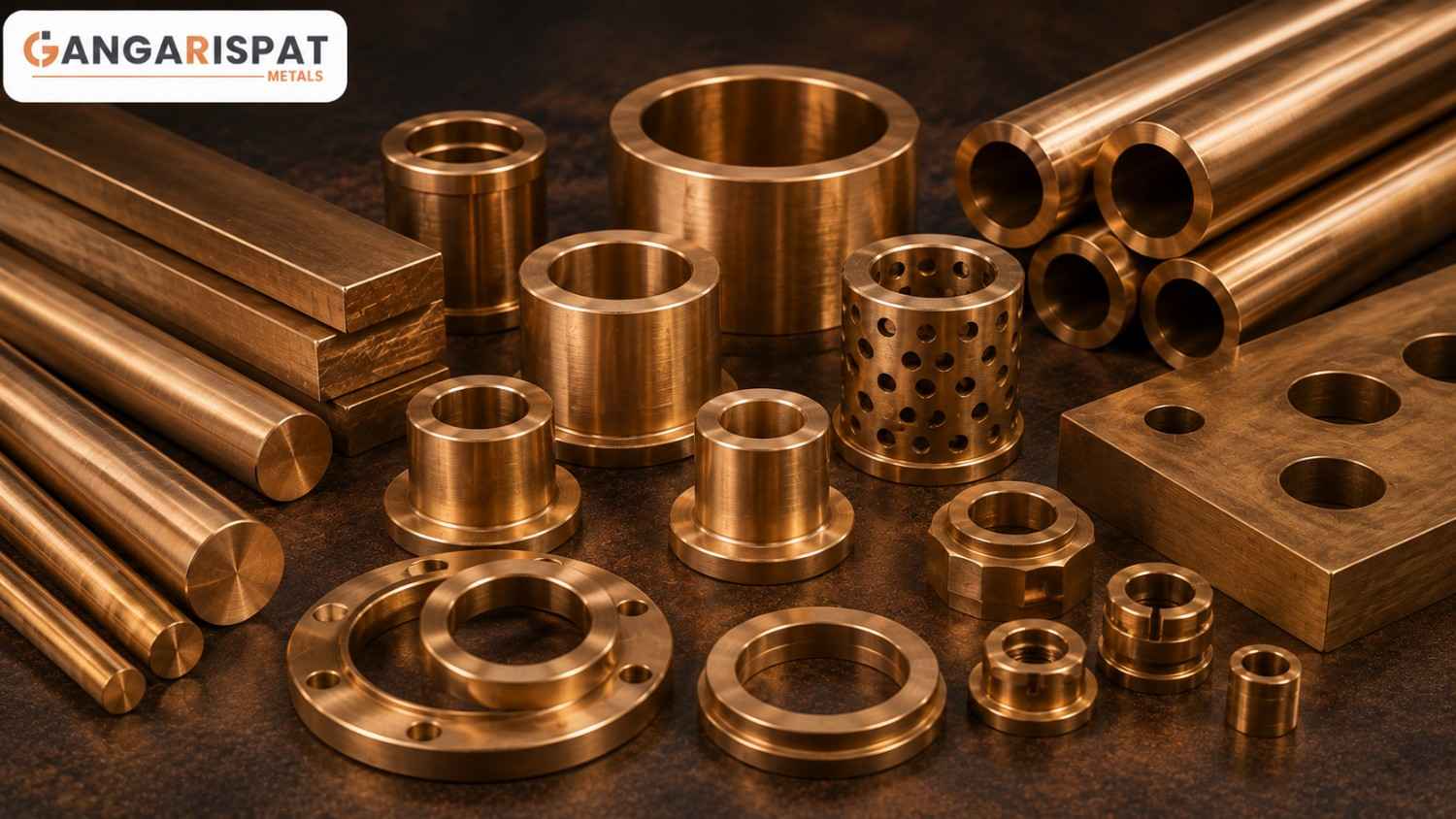
A bearing bush fails after machining, and the buyer discovers the material supplied as “bronze” was never locked to a specific alloy grade. That dispute starts too late. Industrial Bronze Products should be purchased against composition, dimensions, tests and end-use—not a product name alone. CDA data for C93200 bearing bronze gives copper at 81–85%, lead at 6–8% and tin at 6.3–7.5%. A supplier who cannot state the grade before quoting is selling ambiguity, not metal.
The Bronze Products Specification Buyers Should Lock Down
Bronze is a family of copper alloys, so the purchase order needs more than diameter and quantity. Ganga R Ispat Metals lists six bronze product groups: rods, bars, bushes, plates, sheets and ingots. ASTM B505/B505M-23 covers continuously cast copper-alloy rod, bar, tube and shapes, while ASTM’s published scope also calls for heat traceability when such castings are supplied from stock.
Grade Before Geometry
Start with the required UNS, ASTM or IS grade, then define product form, section, length, machining allowance and tolerance.
Nobody tells you how much trouble one vague tolerance line can create until a finished bush is rejected after boring.
Tests Before Dispatch
State whether you need chemical analysis, tensile properties, hardness, ultrasonic inspection or dimensional reports. ASTM’s published B505 requirements note that mechanical testing applies when specified by the purchaser, so “standard inspection” is meaningless unless both sides define it.
Five Supplier Checks That Expose Problems Early
- Grade traceability: Ask for heat or batch identification tied to chemical results. A bad answer is, “all our bronze is equivalent.” Equivalent to what?
- Testing capability: Ask which tests are performed in-house and which are outsourced. A bad answer is a certificate carrying no batch reference. Ganga R Ispat Metals states that its rods are checked using spectrometers, hardness testers, ultrasonic machines and metallurgical microscopes.
- Tolerance control: Put numeric tolerances on the enquiry. A bad answer is, “we keep normal market tolerance.” That phrase gets expensive once machining starts.
- Quality-system evidence: Verify current certificates and their scope. The supplier’s website states ISO 9001:2015 and ISO 14001:2015 systems. A lapsed certificate is not proof of process control.
- Defect terms: Get replacement terms in writing before dispatch. A supplier who says defects will be “handled case by case” is postponing the argument until your production schedule is already affected.
Why Better Supplier Control Protects Margin
Correct alloy selection reduces the chance of paying for material that machines well but performs badly in service. The company’s published technical table, for example, lists C61400 aluminium bronze at 700–780 MPa tensile strength and 170–200 HB hardness. Grade choice is not paperwork; it changes what the component can handle.
Documented tolerances protect machining yield. Batch-linked testing speeds incoming inspection. Agreed packaging cuts transit-damage risk. Clear stock status protects production dates. Written replacement terms limit the commercial impact of a rejected lot.
And yet, buyers still chase the lowest per-kilogram quotation before confirming grade and inspection scope. That is backwards. A small rate saving is worthless if one off-spec batch forces rework or stops machining.
Availability Is a Supply-Chain Question, Not a Pin Code
For buyers comparing Bronze Products Suppliers, Distributors and Bronze Products Manufacturers in India, location matters because freight, stock transfer and replacement time affect landed cost. Ganga R Ispat Metals states that it serves international customers across four regions—Asia, Europe, Africa and the Middle East—and publishes a 48-hour target for enquiry responses.
Finding bronze products for sale from nearby stock can help with urgent maintenance, but “available” should mean the exact grade and size are physically identified.
For custom sections or special inspection, lead time can be harder than buyers expect because material availability and the testing sequence may control dispatch.
What We Control Before Dispatch
We work across bronze rods, bars, bushes, plates, sheets and ingots, and our site states that our manufacturing setup uses casting, extrusion, pilgering, cold drawing and finishing processes depending on the product route.
We also change our packing method according to product size, order quantity and destination rather than treating every shipment the same. We use spectrometers, hardness testers, ultrasonic systems and metallurgical microscopes as part of our stated inspection setup.
That is the sort of small operational detail that matters after material leaves the plant.
We at Ganga R Ispat Metals respond to submitted industrial enquiries within our published 48-hour window. We do not publish one fixed MOQ for every bronze item; our bronze-bar guidance states that MOQ varies according to size and grade availability, with standard sizes generally allowing more flexibility.
Send us the alloy or grade, product form, dimensions or drawing, tolerance, quantity, delivery city, required test certificate and target delivery date. We can then quote the correct bronze products for sale instead of forcing a generic rate onto a technical requirement.
Choose the Supplier Before the Price Chooses You
Reliable Bronze Products procurement starts with grade, traceability, inspection and supply terms written before the PO is released. Six product forms on one catalogue mean little if the supplier cannot prove which batch you are receiving.
Buyers who protect margin will increasingly qualify suppliers on data first and price second.
Frequently Asked Questions
What should I check before buying Bronze Products?
Start with alloy grade, dimensions, tolerance, quantity, tests and application. C93200 has defined composition ranges, so “standard bronze” is not a sufficient purchasing specification.
How do reliable Bronze Products Suppliers prove material quality?
Ask for batch-linked chemical analysis and the inspection records specified on your PO. Outsourced testing can be acceptable, but only if material traceability and the testing laboratory are clearly documented.
Do Bronze Products Distributors offer the same traceability as manufacturers?
Some do, some do not. A distributor should connect the supplied lot to the original mill or manufacturer certificate; otherwise you are accepting paperwork without a proper material trail.
Where can I find bronze products for sale for urgent industrial use?
Start with suppliers holding standard grades and sizes in stock, then confirm that physical stock matches your specified grade. Ganga R Ispat Metals’ bronze-bar guidance says standard sizes generally allow more flexible MOQs.
Are all Bronze Products Manufacturers in India ISO certified?
No. Certification varies by company and certificate scope. Ganga R Ispat Metals states ISO 9001:2015 and ISO 14001:2015 systems, but buyers should still verify current certificate validity before vendor approval.
Do Bronze Products Distributors supply custom sizes?
Often, yes, but custom sizes may depend on stock, manufacturing route and minimum quantity. Confirm tolerance and inspection requirements before accepting the quoted lead time.
Why can prices differ between bronze suppliers?
Grade, alloy composition, section size, quantity, testing, machining and metal-market costs can all affect price. A cheaper quote is not comparable if its grade or inspection scope is different.
 Sarah Mastan
  Jubaili Bros
  Diya Shamald