
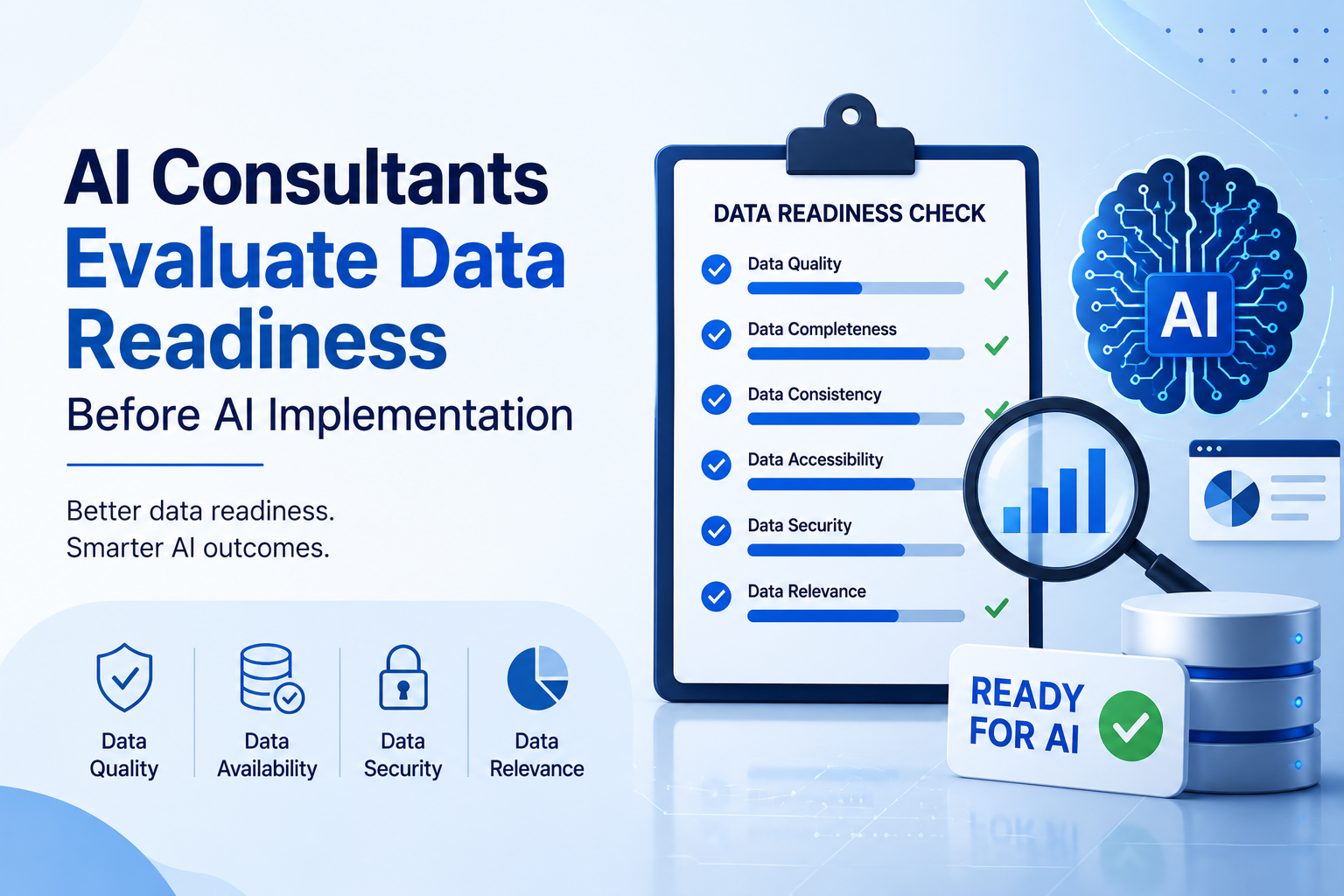
Every AI project runs on data. Bad data means a bad AI tool, no matter how good the model is.
This is the first thing real artificial intelligence consulting checks. Not the model. Not the tech stack. The data itself is examined closely before anything gets built.
Skip this step, and you’re building on sand. Get it right, and everything after gets easier.
What Data Readiness Actually Means
Data readiness isn’t about having lots of data. Plenty of companies drown in data and still aren’t ready.
It means your data is accurate, current, and easy to access. It means the right people can find it without digging through five different systems.
A good AI consultation starts by testing exactly this, before anyone talks about models. No readiness check, no real starting point.
Why AI Consultants Check This First
Here’s a fact worth remembering. Most AI failures trace back to data problems, not bad algorithms.
An AI model just learns patterns from what it’s fed. Feed it messy, outdated, or incomplete data, and it learns messy patterns.
This is why artificial intelligence consulting always starts here. Fixing a bad model is hard. Fixing bad data before training is much easier.
It’s also far cheaper. Catching a data gap in week one costs a fraction of catching it after a launch goes wrong.
The Data Readiness Checklist
Consultants usually run through the same core questions, project after project. None of these questions are exotic, but skipping any of them creates blind spots later.
- Where does the data live? Scattered across five tools is a red flag.
- How accurate is it? Duplicate records and outdated entries poison results.
- Who can access it? No clear access rules means no accountability later.
- Is it labeled and structured? Raw, messy data slows everything down.
- How current is it? Data from three years ago won’t reflect today’s reality.
Good AI consulting services walk through this list before quoting a single build timeline.
Signs Your Data Isn’t Ready Yet
Some warning signs show up before any formal review even starts.
- Different teams report different numbers for the same metric
- Nobody can say for certain where a dataset originally came from
- Spreadsheets get emailed around instead of pulled from one shared system
- Access requests take days because nobody owns the approval
- The same customer shows up as three separate records
Any one of these alone isn’t fatal. Multiple signs together mean the data needs work before any AI project starts.
Most AI consulting services flag these signs in the first week of a project. They’re rarely subtle once you know what to look for.
Ready Data vs Not Ready Data
| Ready Data | Not Ready Data |
|---|---|
| Centralized, one clear source | Scattered across many systems |
| Regularly updated | Stale, months or years old |
| Clear ownership and access rules | Nobody knows who owns it |
| Consistent formatting | Mixed formats, duplicate fields |
| Documented origin | Nobody remembers where it came from |
This is exactly where AI Governance and Consulting adds real value. It turns this table from a guess into an actual audit.
A Real Example
Zillow built an AI pricing tool to buy and resell homes quickly. The algorithm estimated home values and made instant offers.
The pricing data looked solid on paper. It wasn’t current or local enough for a fast-moving housing market. Home prices shifted street by street.
By late 2021, Zillow shut the program down. The company wrote down $304 million in bad inventory and cut about 2,000 jobs.
CEO Rich Barton later said forecasting home prices had become far less predictable than the company expected. That single admission points straight back to a data problem, not a modeling one.
The lesson wasn’t about AI being bad at pricing homes. It was about data that looked ready but wasn’t. A sharper ai consultation early on might have caught the gap between broad market data and real, local pricing accuracy.
How Data Governance Ties Into Readiness
Readiness isn’t just a one-time check. Data needs rules for how it’s collected, updated, and protected going forward.
This is where ai governance services step in. They set who can touch the data, how often it gets reviewed, and what happens when something looks off.
Without this, data readiness fades fast. A system that was clean at launch turns messy again within months.
Common Data Readiness Mistakes
A few mistakes show up constantly, across almost every industry.
Teams assume more data automatically means better data. It doesn’t; messy data at scale is just a bigger mess.
Teams skip access reviews, assuming old permissions still make sense. They rarely do, especially after reorganizations or new tools.
Teams treat readiness as a one-time box to check. Good ai governance solutions treat it as an ongoing habit, not a single event.
Teams also underestimate how fast data drifts. A dataset that was clean six months ago can quietly collect duplicates, gaps, and outdated fields without anyone noticing.
How the Review Process Actually Works
A real data readiness review usually follows a similar shape, project to project. It rarely skips steps, even under a tight deadline.
- Audit current data sources find every place data lives today.
- Check quality and consistency spot duplicates, gaps, and outdated records.
- Map access and ownership confirm who controls what, and why.
- Identify gaps against the AI use case does this data actually support the goal?
- Set a maintenance plan decide how data stays clean after launch.
Strong AI Consulting Services document each step, not just the final summary. That paper trail matters later, especially during an audit or a compliance review.
A Few Honest Questions
How long does a data readiness review take? It depends on how many systems you’re checking. Small companies might need a week. Larger ones can take a month or more.
Can we skip this if our data looks fine? “Looks fine” and “is ready” are different things. A quick ai consultation usually finds gaps nobody expected.
Does this apply to small businesses too? Yes. A five-person team with messy spreadsheets faces the same risk as a large enterprise with messy databases.
What happens if we build the AI tool anyway, without checking? It often works fine in testing, then breaks once real, messier data flows through it after launch.
The Bottom Line
Data readiness isn’t the exciting part of an AI project. It’s the part that decides whether the exciting part actually works.
Good artificial intelligence consulting treats this as step one, not an afterthought squeezed in later. AI Governance and Consulting exists exactly for this reason: to check the foundation before anyone builds on top of it.
Skip the check, and you’re gambling on data you never actually tested. Run it first, and every step after gets faster, cheaper, and far more likely to work.
 Digicovai Pvt Limited
  uautomatesg@gmail.com
  FitBiZOS SgAI