
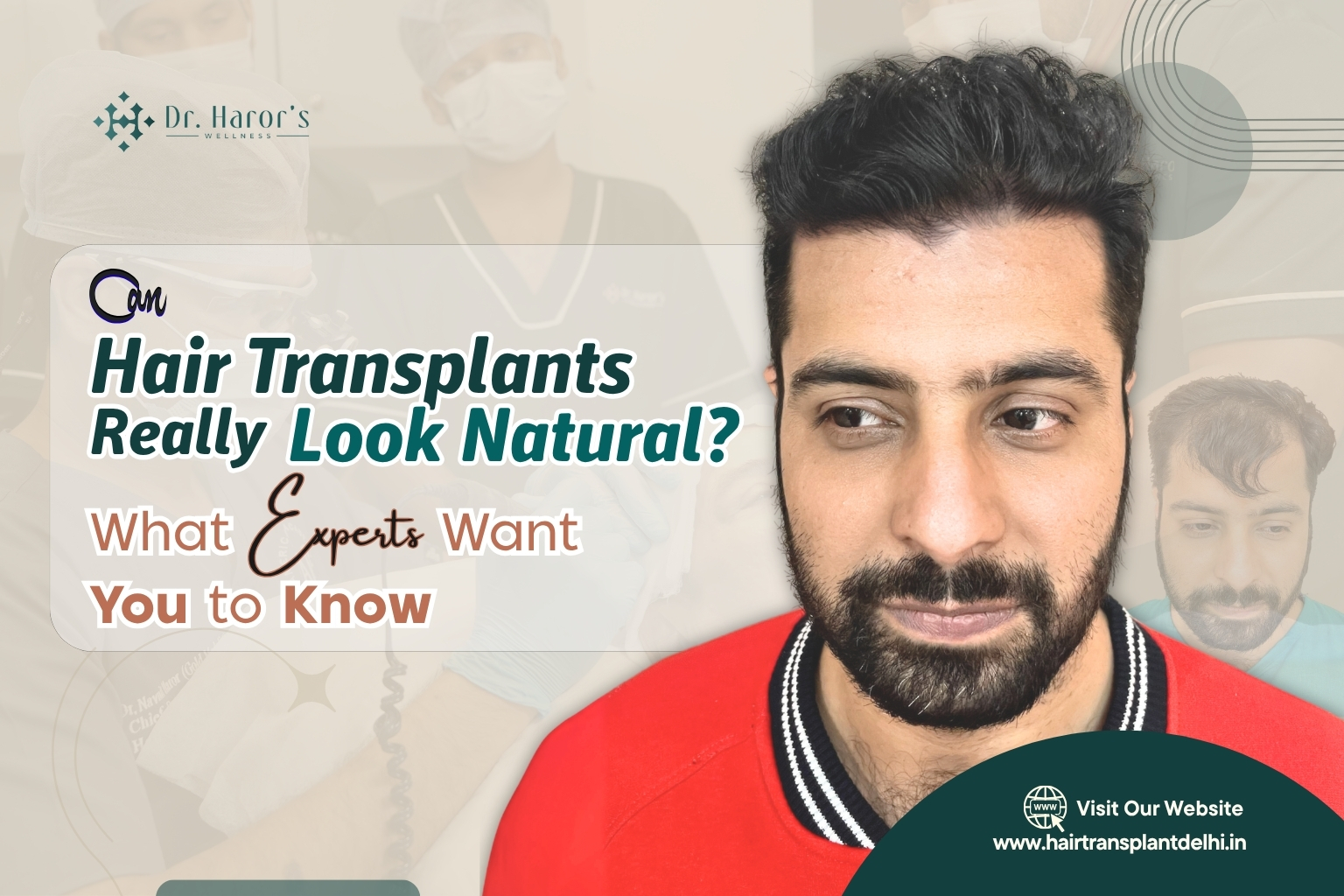
The biggest fear people have before a hair transplant isn’t the procedure itself. It’s the thought of running into someone at a grocery store six months later and watching their eyes dart straight to your hairline.
That fear makes complete sense. Bad transplants from the early 2000s left a generation of people with hair that looked like it was plugged in with a screwdriver — stiff, clumped, and painfully obvious. If that’s the mental image you’re working with, of course you’re nervous.
But here’s the honest answer: a natural-looking hair transplant is absolutely achievable. Not “natural considering what you went through.” Just… natural. The kind where nobody knows. The catch is that it doesn’t happen by accident, and it has very little to do with which clinic has the most expensive equipment on their website.
Why Did Old Transplants Look So Fake?
Before getting into what makes modern hair transplant results look real, it helps to understand what went wrong historically.
Early techniques harvested large circular plugs of scalp and moved them in bunches. The density was off, the placement was off, and the hairline looked like someone had drawn it with a ruler. That’s essentially what they did — a straight line across the forehead, filled in with hair, done.
Real hairlines don’t work like that. They’re soft at the edges, slightly uneven, with a few finer strands pushing ahead of the denser growth behind them. Nothing perfectly symmetrical, nothing perfectly straight. The tidier a hairline looks, ironically, the more suspicious it becomes.
What Actually Makes Hair Transplant Results Look Natural
There are four things that separate a result people never question from one that becomes obvious the moment light hits it from the wrong angle.
The hairline design
This is where most surgeons either earn or lose your trust. A properly designed hairline accounts for your face shape, your age, and where your hair naturally sat before it started thinning. It has small variations built in — micro-irregularities along the front edge that mimic how hair actually grows. A good hair transplant surgeon spends real time on this before a single graft is placed.
Angle and direction
Hair doesn’t grow straight up out of your scalp. Temple hair lies almost flat, angling downward. Crown hair grows in a circular pattern that shifts direction as it spirals outward. When grafts are placed at the wrong angle — even slightly — the hair sits stiffly and refuses to blend, no matter how healthy the follicle is. Getting this right requires both knowledge and patience during placement.
Density and distribution
Natural hair grows in small groupings, not in uniform rows. When density is too heavy in one spot and too sparse in another, or when grafts are spaced too evenly (which sounds like it would be a good thing but actually isn’t), the result reads as artificial even when every graft technically survived. Balanced, thoughtful distribution is what lets transplanted hair disappear into the rest of your hair.
Donor hair quality
The follicles taken from the back and sides of the scalp need to be healthy enough to survive the move and produce strong hair in their new location. Clinics that take this part seriously evaluate donor density before they even begin mapping out a procedure.
A Word on Hair Transplant Techniques
The older strip method — FUT — involves removing an actual section of scalp to harvest follicles, which works but leaves a linear scar at the back of the head. It’s not a bad technique in the right hands, but it has limitations.
Newer hair transplant techniques like FUE, DHT, Sapphire FUE, and URHT extract individual follicles directly, which means no strip, minimal scarring, and more precise placement. The difference in recovery and in how the donor area looks afterward is significant. That said, the technique matters far less than the person performing it. A mediocre surgeon with cutting-edge tools will still produce mediocre results.
How to Actually Read Hair Transplant Before and After Photos
Most people use before and after galleries when shortlisting clinics, which makes sense — they’re the most concrete evidence available. But they’re easy to misread.
First, understand the timeline. Around the two-week mark, transplanted hairs shed. It looks worse than the starting point, and patients who aren’t warned about this sometimes panic unnecessarily. Real density starts showing up closer to the six-month mark. The final settled result isn’t visible until about a year out.
So when you’re browsing a clinic’s gallery, check whether the photos are actually 12+ months post-procedure, or whether they were taken at four months when things look promising but aren’t finished yet.
Also look at the messy middle — the two-to-six-month window. Clinics willing to show this period tend to have nothing to hide. Clinics that only post polished 12-month results with perfect lighting and a favorable angle might be cherry-picking.
Speaking of lighting: two photos of the same result, taken under different light, can look like completely different outcomes. Try to compare photos shot under similar conditions rather than falling for one great image that might just be flattering photography.
Questions Worth Asking Before You Commit
Four questions will separate confident, skilled clinics from the ones worth avoiding:
Who specifically places the grafts — the surgeon, or a technician? How their answer unfolds tells you a lot about how the procedure actually runs day-to-day.
Do you have results at the 12-month mark or beyond? Any clinic doing good work should have these readily available.
How would you design the hairline for my face and hair type specifically? You’re looking for a personalized answer, not a template response.
Which technique do you recommend for my situation, and why? A surgeon who has thought seriously about your case can explain their reasoning without defaulting to whatever they always do.
A confident, skilled hair transplant surgeon will answer all four without hesitating. Vague responses, or any pressure to book quickly before you’ve had time to think, is a reason to keep looking.
Conclusion
A hair transplant can look completely real — but only when it’s done at the right time, by the right hands. Every single detail plays a role: how the hairline is drawn, where and how grafts are placed, the quality of donor follicles, and how well you take care of things afterward. None of it works in isolation.
So if you’re seriously thinking about moving forward, understanding what separates a natural-looking hair transplant from an obvious one is just as important as finding the right clinic — because those two things are directly connected.
At Dr. Haror’s Wellness, the approach is never one-size-fits-all. Every hair restoration plan is built around the individual — your specific stage of hair loss, your budget, and what you’re actually hoping to achieve. Using advanced hair transplant techniques including FUE, DHI, URHT, and Sapphire FUE, and with a team that brings genuine expertise to every step of the process, Dr. Haror’s Wellness delivers results that are natural-looking, long-lasting, and — most importantly — yours.
If you’re ready to take the next step, book a consultation and find out what’s possible for you.
 Akashdeep Singh
  Tidal physiotherapy