
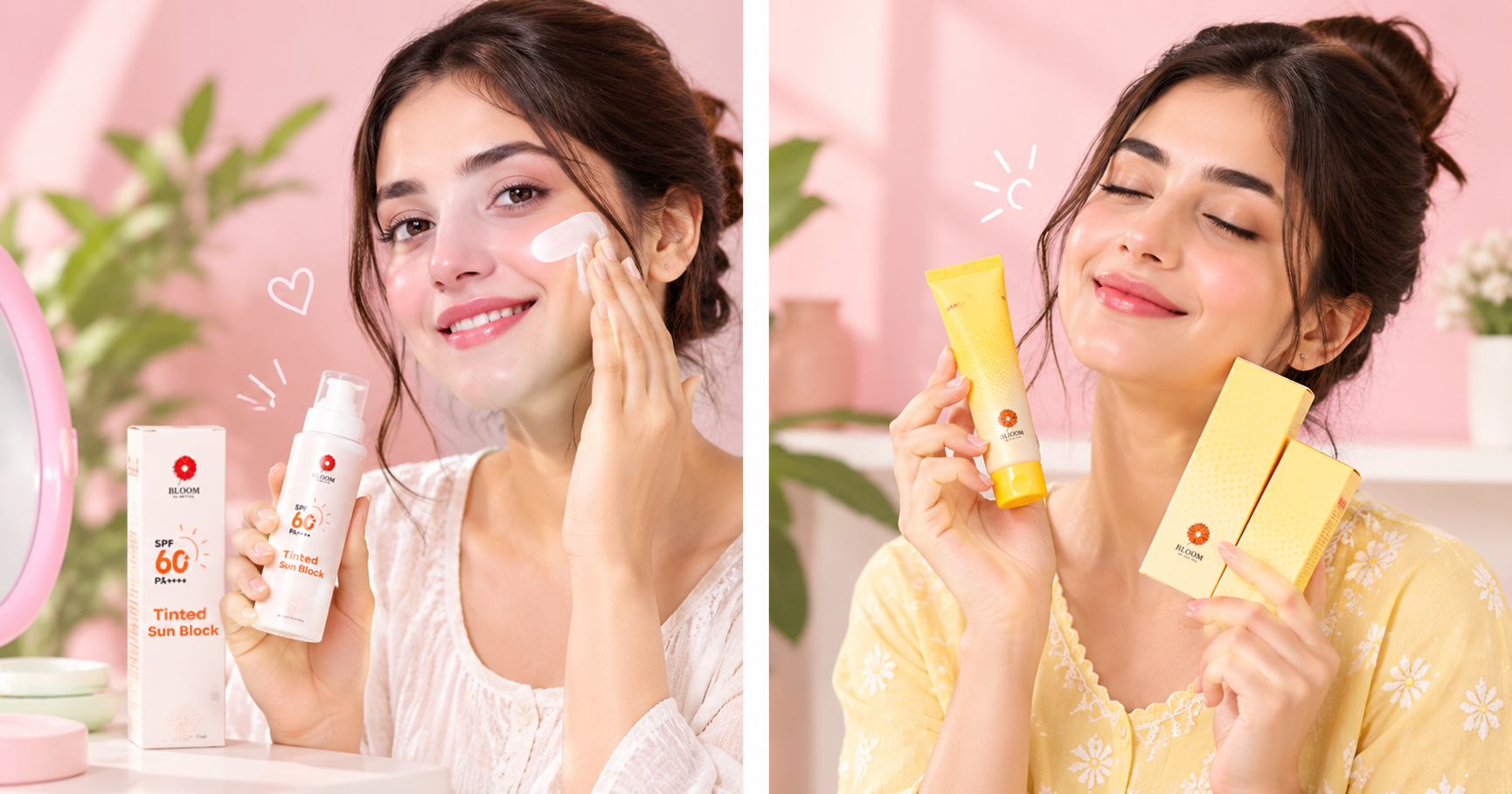
Finding the best medicated sunblock in Pakistan can be challenging, especially if you have oily or acne-prone skin. Many sunscreens can leave your face shiny, feel heavy in hot weather, or leave a noticeable white cast that doesn’t blend with your skin tone. The good news is that choosing sunscreen doesn’t have to be complicated. The right formula can provide effective daily sun protection while feeling comfortable on oily skin.
Whether you are looking for the best sunblock in Pakistan for everyday use, a lightweight sunscreen suitable for humid weather, or a medicated sunscreen specifically for acne-prone skin, understanding SPF, texture, UVA protection, and product ingredients will help you make a more informed decision. This guide explains what to look for, how to compare different options, how Bloom sunscreen fits into your research, and how to apply sunscreen correctly for optimal protection.
Quick Answer: Which Sunblock Is Best for Oily Skin in Pakistan?
The best sunscreen for oily skin is one that combines reliable broad-spectrum protection with a comfortable, lightweight finish.
When comparing products, look for:
- SPF 30 or higher: SPF 50 is a practical option for people who spend considerable time outdoors.
- Broad-spectrum protection: The label should indicate protection against both UVA and UVB rays.
- A lightweight texture: Gel, fluid, or suitably formulated matte products may feel more comfortable on oily skin.
- Minimal white cast: Choose a formula that blends well with your natural skin tone.
- Non-comedogenic claims: These can be helpful for acne-prone skin, although they do not guarantee that a product will never cause breakouts.
- Water resistance: Particularly useful if you sweat or spend time outdoors.
Dermatologists recommend choosing a broad-spectrum, water-resistant sunscreen with SPF 30 or higher. The best individual product will depend on your skin sensitivity, texture preference, budget, and the manufacturer’s verifiable product information.
Why Does Oily Skin Need Sunscreen?
Oily skin still needs sun protection. Excess sebum does not protect your skin from ultraviolet radiation. Regular sun exposure can contribute to sunburn, premature skin ageing, and uneven pigmentation. Sun exposure may also make existing dark marks more noticeable or persistent.
For people with acne-prone skin, protecting the skin from UV exposure is an important part of managing post-acne marks. Sunscreen does not replace acne treatment, but it can support a consistent skincare routine. In Pakistan, where many people experience strong sunlight and hot weather, sunscreen that feels comfortable enough for everyday use is particularly important. The key is not to avoid sunscreen because your skin is oily. It is to find a formula that provides adequate protection without making your skin feel unnecessarily heavy.
What Does “Medicated Sunblock” Actually Mean?
The term medicated sunblock is commonly used in Pakistan to describe sunscreens sold through pharmacies, skincare clinics, or dermatology-focused brands. However, the word “medicated” does not automatically mean that a sunscreen is a prescription medicine, has been clinically proven superior to other sunscreens, or can treat acne.
A product should be evaluated according to its actual formulation, labelled sun protection, available evidence, and suitability for your skin.
Medicated sunscreen vs. regular sunscreen
|
Feature |
What to look for |
|
Sun protection |
SPF 30+ and broad-spectrum UVA/UVB protection |
|
Formula |
A texture that suits your skin type |
|
Acne-prone skin |
A suitable, preferably non-comedogenic formulation |
|
Sensitive skin |
A formula you tolerate without irritation |
|
Product claims |
Verifiable SPF, ingredients, and manufacturer information |
|
Authenticity |
A reliable seller and clear expiry information |
A regular sunscreen can provide excellent protection if it meets the relevant criteria. Likewise, a medicated sunscreen is not necessarily better simply because of its name.
How to Choose the Best Medicated Sunblock in Pakistan for Oily Skin
Choosing the right sunscreen becomes easier when you know which features matter most.
1. Choose a lightweight, non-greasy texture
If your face becomes shiny shortly after applying skincare products, consider trying a lightweight gel, fluid, or matte-finish sunscreen.
These textures may feel more comfortable than richer creams, although the final result depends on the complete formulation. Look for descriptions such as lightweight, oil-free, or matte finish, and check whether the product is suitable for oily or acne-prone skin. Remember that an oil-free label alone does not guarantee a non-comedogenic formula or a completely matte finish.
2. Look for SPF 30 or higher
SPF primarily measures protection against UVB-induced sunburn. A higher SPF does not eliminate the need for proper application or reapplication.
For everyday use, dermatologists recommend SPF 30 or higher. If you spend long periods outside in strong sunlight, an SPF 50 product may be a practical choice. However, SPF should not be your only selection criterion. Broad-spectrum protection and consistent use are equally important.
3. Check broad-spectrum UVA and UVB protection
UVB rays are associated with sunburn, while UVA exposure contributes to skin ageing and pigmentation.A sunscreen labelled broad-spectrum is designed to protect against both UVA and UVB rays.
Some products also display a PA rating. Higher PA ratings indicate greater UVA protection under the rating system used, but you should not assume that every sunscreen without a PA label lacks UVA protection.
4. Choose a formula that minimises white cast
White cast is the visible white or grey residue that some sunscreens leave on the skin.
It can be particularly noticeable on medium, olive, and deeper skin tones.
If this is your main concern, consider:
- Transparent gel or fluid formulas.
- Suitable hybrid or chemical-filter formulas.
- Tinted sunscreens that match your skin tone.
- Mineral formulas specifically designed to reduce visible residue.
No single sunscreen type guarantees an invisible finish. Test the product on your skin and assess how it looks after application.
5. Consider acne-prone and sensitive skin
If you experience clogged pores or breakouts, look for a sunscreen marketed as non-comedogenic and suitable for acne-prone skin. If your skin is sensitive, consider fragrance-free products and patch-test a new formula before applying it to your entire face.
Choosing the right sunscreen for your skin becomes easier when you understand its ingredients, formulation, and your skin’s unique needs. A well-formulated sunscreen that suits your skin type can help you enjoy comfortable daily sun protection. For the best results, choose a product designed for your skin’s needs. If you have specific concerns such as persistent acne, rosacea, or eczema, a dermatologist can help you find the most suitable option for your skincare routine.
Best Sunscreen in Pakistan: What Types Should You Compare?
There is no single best sunscreen for everyone. The following comparison can help you narrow down your options.
|
Sunscreen type |
Potential advantage |
What to consider |
|
Gel sunscreen |
Often lightweight and comfortable |
Some gels may still feel sticky or pill |
|
Matte sunscreen |
Can help reduce visible shine |
A very drying formula may feel uncomfortable |
|
Fluid sunscreen |
Usually easy to spread in a thin layer |
Application must still be sufficient |
|
Chemical-filter sunscreen |
Some formulas blend with minimal visible residue |
Suitability depends on the individual formula and skin tolerance |
|
Mineral sunscreen |
May suit some people with sensitive skin |
Some formulas leave a noticeable white cast |
|
Tinted sunscreen |
Can blend more naturally with deeper skin tones |
Choose a tint that matches your complexion |
Our selection principle: Prioritise proven sun protection first, then choose the lightest comfortable texture that works with your skin.
Bloom Sunscreen: Is It Worth Considering?
If you are researching Bloom sunscreen, start by identifying the exact product you intend to buy. Product names and formulas can differ between brands with similar names. Before choosing a Bloom product for oily skin, check its current packaging and official product information.
Bloom sunscreen checklist
- Verify the SPF rating
Verify that the labeled SPF 60 sunblock offers broad-spectrum UVA and UVB protection information from the manufacturer.
- Examine the texture
If your priority is a non-greasy finish, look for clear information about whether the specific formula is a gel, fluid, or cream. A lightweight claim should not be treated as proof that the product stays matte throughout the day.
- Check the white-cast claim
Look for product-specific information about visible residue. If possible, test the sunscreen on your own skin tone before committing to regular use.
- Review the ingredients
Check the UV filters, any added fragrance, and the manufacturer’s directions. If you have sensitive or acne-prone skin, consider whether the formula suits your existing routine.
- Purchase from a reliable source
Verify the seller, expiry date, packaging, and product details. Avoid assuming that every online listing is authentic.
Is Bloom sunscreen the best option for oily skin?-
That depends on the exact Bloom product and how it performs on your skin. Without verified product-specific evidence, it would be misleading to declare Bloom sunscreen the best medicated sunblock in Pakistan or to promise that it causes no breakouts, leaves absolutely no white cast, or is dermatologist-recommended.
A fair comparison should assess the same features across all products: labelled SPF broad-spectrum protection, texture, skin compatibility, authenticity, and price. If Bloom is the product you are considering, use this checklist to compare it with other sunscreens before making a decision.
How to Identify a Sunscreen That Suits Oily Skin
When comparing a medicated sunscreen in Pakistan, focus on your actual skin concerns rather than marketing language alone.
If your face becomes shiny quickly
Consider using a lightweight or matte formula for better results. Additionally, applying a lighter moisturizer for the face in Pakistan underneath can help reduce an overly heavy finish.
If sunscreen leaves a white layer
Try a different formula or a suitable tinted option. Mineral filters such as zinc oxide and titanium dioxide can leave visible residue in some formulations, although the amount varies by product.
If sunscreen pills under makeup
Use a manageable amount of each skincare product, allow layers to settle, and avoid excessive rubbing. Test your sunscreen with your usual moisturiser and makeup before relying on the combination for a full day. Do not reduce the amount of sunscreen you apply simply to prevent pilling.
If sunscreen seems to cause breakouts
Stop using a product that repeatedly irritates your skin and review your full skincare routine. Sunscreen may not be the only possible cause of breakouts. If the problem persists, seek advice from a qualified dermatologist.
Best Sunscreen for Oily Skin Dermatologist Recommended in Pakistan: What Should You Check?
If you are searching for the best sunscreen for oily skin dermatologist recommended in Pakistan, focus on recommendations that explain why a product is suitable.
Useful evidence includes:
- A clear recommendation from a qualified dermatologist.
- The specific product and skin concern being discussed.
- Appropriate SPF and broad-spectrum protection.
- A formulation suited to oily, acne-prone, or sensitive skin.
- Clear instructions for application and reapplication.
A product being sold by a pharmacy or described as “dermatological” does not, by itself, establish that every dermatologist recommends it. For persistent acne, pigmentation, or sensitivity, an individual assessment by a dermatologist may help you choose a sunscreen that fits your treatment plan.
How to Apply Sunblock Correctly
Even a well-formulated sunscreen cannot provide its intended protection if you apply too little.
Follow these steps:
- Apply sunscreen to clean skin as the final step of your morning skincare routine, before makeup.
- Apply enough product to cover your face, ears, neck, and other exposed areas.
- Follow the product’s instructions and allow it to settle before applying makeup or going outdoors.
- Reapply approximately every two hours while outdoors.
- Reapply after swimming, sweating heavily, or towel-drying, following the product’s water-resistance instructions.
- Combine sunscreen with shade, protective clothing, and sunglasses when possible.
Dermatologists emphasise that sunscreen should be applied generously and reapplied regularly. Water-resistant sunscreens are tested for specified periods, commonly 40 or 80 minutes, rather than being completely waterproof.
Common Sunblock Mistakes to Avoid
Choosing SPF based on the number alone
A high SPF does not compensate for poor application or inadequate UVA protection. Check the full label.
Applying too little sunscreen
Using a thin layer to avoid shine can reduce the protection you receive. Choose a formula you can apply in the recommended amount.
Skipping sunscreen on cloudy days
UV exposure can still occur when the sky is overcast. Use sunscreen as part of your regular daytime routine.
Assuming expensive sunscreen is always better
Price does not automatically establish better protection. Compare the label, formulation, authenticity, and suitability for your skin.
Trusting every “no white cast” claim
The visible finish can vary with skin tone, the amount applied, and the formulation. Test the product when possible.
Forgetting to reapply
A morning application may not provide adequate protection throughout a long day outdoors. Plan to reapply regularly.
Final Verdict: Choosing the Best Sunblock in Pakistan for Oily Skin
The best sunscreen is not necessarily the most expensive, the most heavily marketed, or the one with the highest SPF number. For oily skin, look for a comfortable texture, reliable broad-spectrum protection, suitable skin compatibility, and a finish that encourages daily use.
If you are comparing Bloom sunscreen with other options, check the exact product information instead of relying on brand claims alone. Choose an authentic product, apply enough of it, and reapply as directed. With the right selection and consistent use, sunscreen can become a practical part of your daily skincare routine without making your skin feel unnecessarily greasy.
Frequently Asked Questions
Which is the best medicated sunblock in Pakistan for oily skin?
The best option is a broad-spectrum sunscreen with SPF 30 or higher that suits your skin, provides a comfortable finish, and can be applied generously. Look for lightweight or matte textures if you dislike greasy products.
Which is the oily skin best medicated sunblock in Pakistan with no white cast?
Look for a transparent gel or fluid, a suitable chemical-filter formula, or a well-matched tinted sunscreen. No formula can be guaranteed to leave zero visible residue on every skin tone.
Is medicated sunscreen in Pakistan better than regular sunscreen?
Not necessarily. The term “medicated” does not automatically establish superior protection. Compare SPF, UVA protection, formulation, and product authenticity.
Is sun block different from sunscreen?
The terms are commonly used interchangeably. The important consideration is the level and type of UV protection the product provides, not simply whether its name includes “sunblock” or “sunscreen.”
Is a sunblock medicated product suitable for acne-prone skin?
It may be, depending on its formulation and your skin’s tolerance. Look for products suitable for acne-prone skin, consider non-comedogenic claims, and consult a dermatologist if breakouts persist.
Can Bloom sunscreen be used on oily skin?
Check the exact Bloom product’s official directions, texture, SPF, and ingredients. Suitability depends on the specific formula and your individual skin response; the brand name alone cannot establish whether it is appropriate.
Should oily skin use SPF 50 every day?
SPF 30 or higher is the standard dermatological recommendation. SPF 50 can be a practical option, especially with substantial outdoor exposure, but the amount applied and regular reapplication also matter.
How often should I reapply sunscreen in Pakistan?
Reapply about every two hours while outdoors, and after swimming, heavy sweating, or towel-drying. Follow the specific product’s instructions.
 Signature, Deluxe, or Platinum: Choosing the Right HydraFacial Scottsdale AZ Level
 essentials essentials
 Alish Olve