
Ask any experienced business owner in New York what keeps them up at night, and financial recordkeeping will likely appear somewhere on the list. The city’s competitive environment, layered tax obligations, and fast-moving business climate create a set of financial management challenges that are genuinely distinct from running a business almost anywhere else in the country.
Bookkeeping services in New York exist to help businesses meet those challenges — not by taking over decision-making, but by ensuring the financial records that inform every business decision are accurate, current, and organized. This guide explains what those services involve, who needs them, how they differ, and what to look for when choosing one.
The Function of Bookkeeping in a Business Context
Bookkeeping is often described in dry, technical terms — recording debits and credits, maintaining ledgers, reconciling accounts. While technically accurate, those descriptions tend to obscure what bookkeeping actually does for a business at a practical level.
Think of bookkeeping as the financial memory of a business. Every transaction that occurs — a customer payment, a vendor invoice, a payroll run, a tax remittance — gets recorded and stored in a way that creates a complete, retrievable history of the company’s financial activity. That history is what makes it possible to produce accurate financial reports, prepare tax returns, apply for business credit, and understand whether the business is actually profitable.
Without that history, or with one that contains errors and gaps, a business owner is essentially navigating without instruments. Decisions get made on gut feeling rather than data. Problems go undetected until they become crises. Tax season becomes a scramble.
Bookkeeping services in New York help businesses build and maintain that financial memory consistently and correctly — freeing up the business owner to focus on operations, growth, and customers rather than spreadsheets and bank statements.
New York’s Financial Complexity: Why Local Expertise Matters
Every business in the United States must comply with federal financial regulations and tax requirements. But businesses operating in New York face a considerably more layered regulatory environment on top of those federal obligations.
State-Level Requirements
New York State imposes its own income tax on businesses and individuals, with filing requirements and deadlines that operate independently of federal ones. The state also requires quarterly estimated tax payments, and errors in these calculations can result in underpayment penalties.
New York City Business Taxes
Businesses operating within the five boroughs face additional tax obligations that businesses elsewhere in the state do not. The New York City General Corporation Tax, the Business Corporation Tax, and the Unincorporated Business Tax each apply to different business structures. Determining which applies to your business — and calculating it correctly — requires specific knowledge of city tax rules.
Sales Tax Complexity
New York’s sales tax structure is among the most complicated in the country. The state base rate applies broadly, but city and county surcharges add to it. More significantly, what is and is not taxable under New York law involves numerous exceptions — clothing under a certain price threshold may be exempt, while similar items are not; certain food categories are taxed differently depending on how they are prepared or sold. For retail businesses, restaurants, and any company selling physical goods, sales tax tracking is a significant and ongoing bookkeeping responsibility.
Payroll and Labor Law Compliance
New York’s labor laws are extensive. Minimum wage requirements vary by borough and business size and are subject to periodic increases. The state’s Paid Family Leave program requires employer tracking of employee contributions. Overtime rules have specific provisions that differ from federal standards in some circumstances.
A bookkeeper who understands New York’s specific financial landscape — not just general bookkeeping principles — provides substantially more value than one working from a generic, national framework.
Professional Bookkeeping Services New York: Categories and Characteristics
The professional bookkeeping market in New York reflects the city’s diversity. Services are available across a wide spectrum, from comprehensive multi-service accounting firms to highly specialized niche practices.
Full-Service Financial Firms
At one end of the market are firms that offer bookkeeping as part of a comprehensive suite of financial services. These organizations typically employ CPAs alongside bookkeeping staff and can handle everything from daily transaction recording to tax strategy, financial statement audits, and business advisory services. They tend to serve mid-sized and larger businesses, or smaller businesses with unusually complex financial structures.
For a business that wants a single point of contact for all financial matters — bookkeeping, taxes, payroll, and planning — a full-service firm offers the advantage of integrated service and institutional knowledge about the client’s financial history.
Specialized Industry Bookkeepers
New York’s economy spans real estate development, financial services, media and entertainment, hospitality, retail, healthcare, technology, legal services, and virtually every other industry imaginable. Each sector has bookkeeping requirements with their own nuances.
Real estate businesses, for instance, deal with depreciation calculations, 1031 exchanges, pass-through entity income, and rental income tracking. Law firms work with client trust accounts that must be maintained separately from operating funds. Restaurants manage tip reporting, daily cash reconciliation, and food cost analysis. Bookkeepers who specialize in these areas bring industry-specific frameworks that generic bookkeepers simply do not have.
Boutique and Independent Practices
Many professional bookkeepers in New York operate smaller, more personal practices. These individuals often develop long-term relationships with a focused roster of clients, offering a level of personalized attention and continuity that larger organizations may not match. For businesses that value a close working relationship and direct communication with their bookkeeper, this model has real practical advantages.
Small Business Bookkeeping Services in New York: Core Services Explained
Small businesses represent the majority of all businesses operating in New York State, yet they are the segment most likely to struggle with consistent bookkeeping. The reasons are understandable: limited staff, tight margins, and the constant demands of day-to-day operations leave little time or bandwidth for financial administration.
Small business bookkeeping services in New York are structured to address exactly this gap. Here is what these services typically include and why each element matters:
Transaction Recording and Categorization
Every financial transaction needs to be logged and assigned to the correct category — income, cost of goods sold, operating expenses, capital expenditures, and so on. Proper categorization is foundational. It determines the accuracy of every report generated from the books and affects how taxable income is calculated at year end.
Bank Reconciliation
Monthly reconciliation of bank and credit card accounts matches the transactions in the business’s accounting records against its actual statements. This process catches errors — whether from duplicate entries, missing transactions, or unauthorized charges — before they compound. A business that skips regular reconciliation often discovers discrepancies only when they have grown into significant problems.
Invoice Management and Accounts Receivable
For service businesses and those that extend payment terms to customers, tracking outstanding invoices is critical. Bookkeepers monitor which invoices have been paid, which are approaching their due date, and which are overdue, giving the business owner a clear picture of incoming cash flow and enabling timely follow-up on late payments.
Vendor Payments and Accounts Payable
On the expense side, tracking what is owed to suppliers, landlords, and service providers — and when those obligations are due — helps avoid late payment fees and supports effective cash flow management. Knowing what is coming out of the business, and when, is just as important as knowing what is coming in.
Payroll Coordination
Even small businesses with a handful of employees face meaningful payroll complexity in New York. Calculating withholdings correctly, filing employer taxes on time, and complying with state-specific requirements all require careful attention. Many bookkeeping services either process payroll directly or work alongside a dedicated payroll provider.
Financial Statements and Reporting
Regular financial reports — typically produced monthly or quarterly — are one of the most tangible outputs of professional bookkeeping. A profit and loss statement shows whether the business is generating more revenue than it spends. A balance sheet reflects assets, liabilities, and equity at a point in time. A cash flow statement tracks how money moves through the business. Together, these reports transform raw transaction data into actionable business intelligence.
Online Bookkeeping Services New York: How Remote Delivery Works
One of the most significant shifts in professional bookkeeping over the past several years has been the migration to cloud-based, remotely delivered services. Online bookkeeping services in New York are now widely used by businesses that want professional financial management without the logistics of in-person meetings and paper-based records.
The Technology Infrastructure
Online bookkeeping is made possible by cloud accounting platforms — primarily QuickBooks Online, Xero, FreshBooks, and Wave — that allow multiple authorized users to access the same financial data from anywhere. A business owner connects their bank accounts, credit cards, and payment platforms to the system; transactions flow in automatically; and the bookkeeper works within that shared environment to categorize, reconcile, and report.
Many professional bookkeepers and firms offering online services hold platform-specific certifications. QuickBooks ProAdvisor certification, for example, indicates that the bookkeeper has completed verified training and demonstrated competency with the platform’s features.
Advantages for New York Businesses
The online model is particularly well-suited to New York’s business environment for several practical reasons:
- Time efficiency: Business owners in a high-cost, fast-moving market often do not have the bandwidth for regular in-person bookkeeping meetings. Cloud access means financial data is available on demand, and communication happens through secure portals and messaging rather than scheduled appointments.
- Scalability: As a business grows — adding revenue streams, employees, or locations — online bookkeeping services can typically scale without requiring a change of provider or system.
- Disaster resilience: Cloud-stored financial records are not vulnerable to the physical risks that affect paper records or locally stored files. For a business in New York, where space is limited and disruptions like storms or power outages can affect physical offices, this matters.
- Auditability: Complete, timestamped digital records are easier to review, share with accountants or lenders, and present during an audit than manual or paper-based records.
Important Caveats for New York Businesses
Online bookkeeping services vary widely in their familiarity with New York’s specific tax rules. Some national online platforms use standardized workflows built around federal requirements and may not automatically account for NYC business taxes, New York State sales tax nuances, or local payroll compliance requirements. Before engaging any online service, it is worth asking directly about their experience with New York-based clients and how they handle state and city-specific obligations.
Choosing the Right Bookkeeping Service: A Practical Framework
With so many options available, the selection process benefits from a clear framework. Consider the following:
Define your scope of need. Do you need basic transaction recording, or are you looking for comprehensive financial management that includes payroll, reporting, and tax coordination? The answer shapes which type of service makes sense.
Assess New York-specific expertise. Ask any prospective service provider how they handle New York City business taxes, state sales tax filing, and New York payroll compliance. The specificity and confidence of their answers will indicate whether they have real local experience.
Evaluate software compatibility. If your business already uses QuickBooks, Xero, or another platform, find a bookkeeper who is proficient in that system. Migrating between platforms mid-engagement creates unnecessary complexity.
Understand the reporting cadence. Regular financial reports should be a standard deliverable, not something you have to request. Clarify how often you will receive reports and what they will include.
Clarify pricing and scope. Some services charge a flat monthly rate; others bill hourly or per transaction. Understand what is included in the base price and what triggers additional charges, particularly for services like payroll processing or sales tax filing.
 Bookkeeping as a Business Discipline
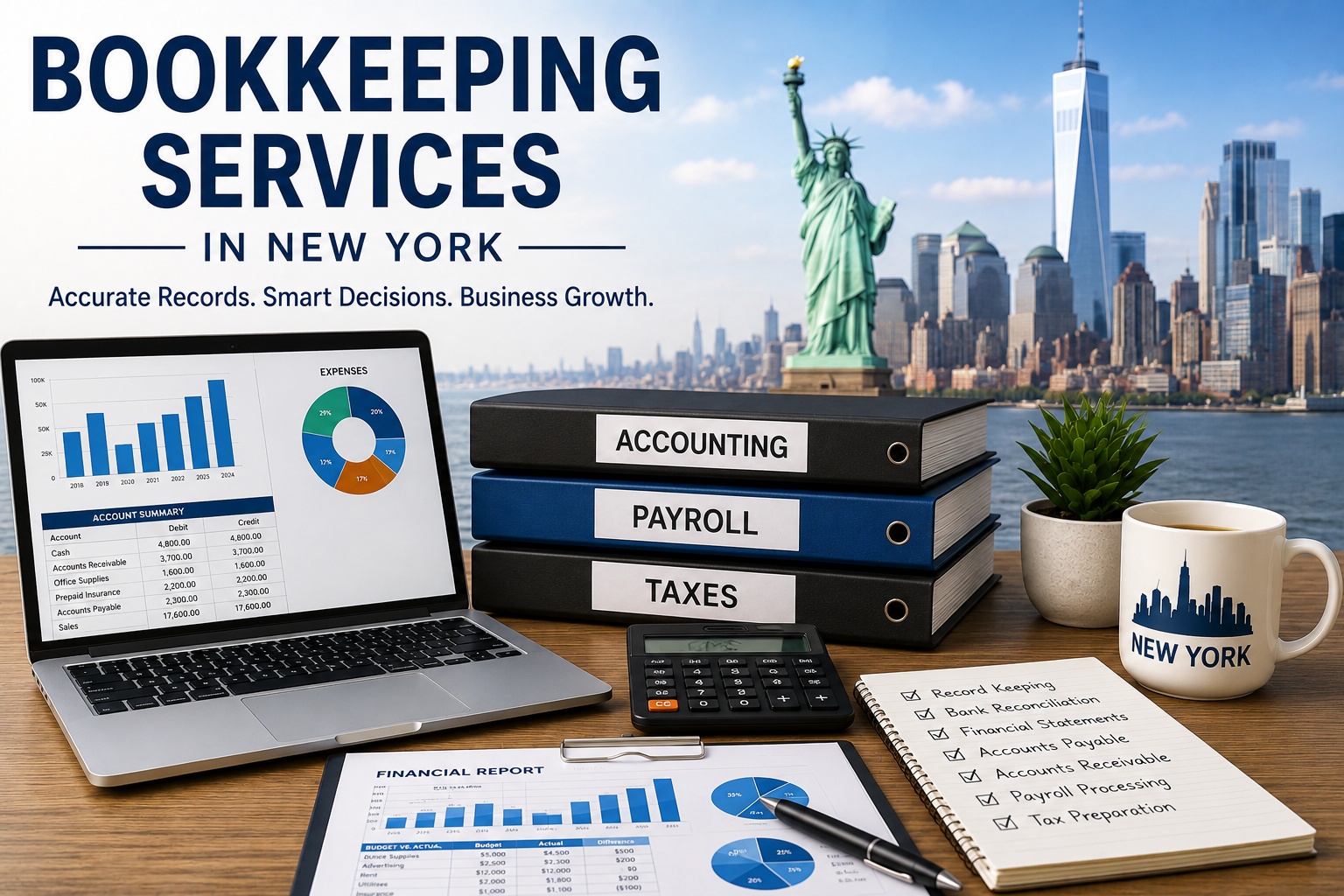
The most successful businesses in New York — at every scale, in every borough, across every industry — tend to share a common characteristic: they treat financial recordkeeping as a discipline, not a chore. They do not wait until tax season to look at their numbers. They do not guess at their cash position or profitability. They maintain clean, current books and use the information those books contain to make smarter decisions.
Professional bookkeeping services in New York exist to make that discipline attainable for businesses that do not have the time, expertise, or resources to manage it entirely in-house. Whether through small business bookkeeping services designed for lean operations, specialized industry practitioners, or online bookkeeping services that bring cloud-based efficiency to financial management, the right service turns a compliance obligation into a genuine operational asset.
For any business committed to building something lasting in New York, that is not a small thing.
 john1nento@gmail.com
  tech.emizen
  alberttaylor2019