
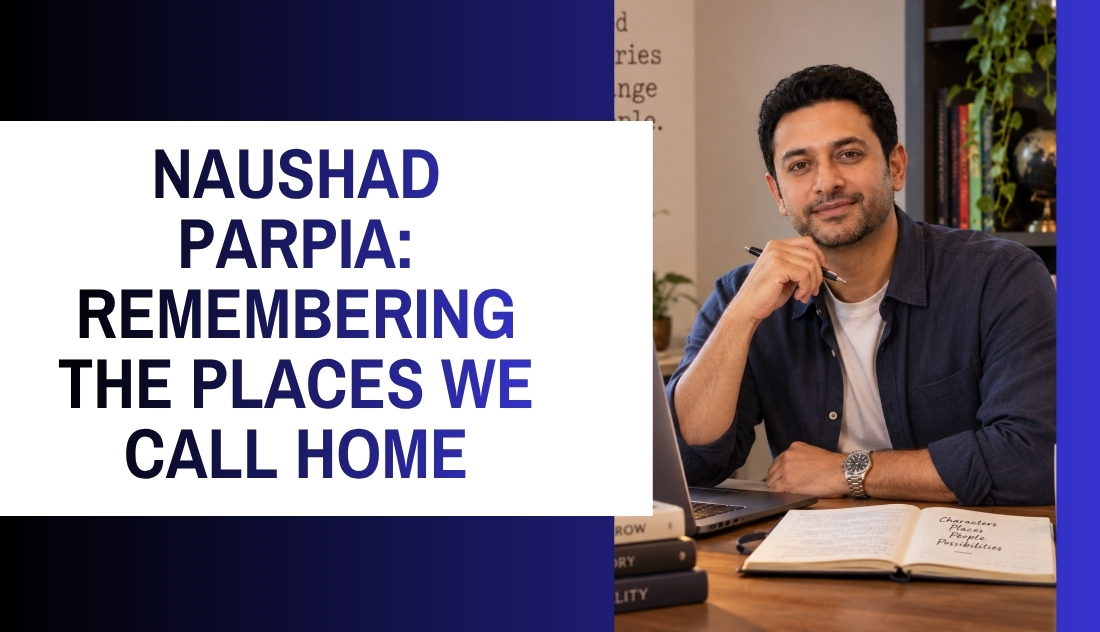
Quick summary: We remember home through small, repeated details: the smell of a kitchen, the route to the subway, a phrase a grandparent always said. This post covers how storefronts, inherited recipes, commutes, family sayings, forgotten photographs, and saved objects keep a place alive, and offers five ways to preserve your own.
Ask someone about the home they grew up in and they rarely begin with the address. They begin with the hum of a radiator, onions softening in oil, the creak of the third stair. Home is mostly a collection of small, dependable details, and the building is just where they happened.
This explains why losing a place feels so odd. The building may still stand and the street may still be on the map, but something is gone. What vanished is the routine: the shopkeeper who knew your order, the bus that always ran late, the pot on the stove every Sunday.
Naushad Parpia, a Brooklyn-based writer and storyteller, keeps returning to this ground. He doesn’t present himself as an expert. He’s a curious participant who notices the emotional history inside ordinary routines, and his questions sound modest but aren’t: what do we carry with us, and why do we keep it?
What does it mean to remember a place?
Remembering a place means recalling the senses, habits, and relationships that belonged to it, not just its layout. The term for this is place attachment, the emotional bond between a person and a setting.
Place memory also has layers. You remember the apartment as it looked, but also how it sounded at 6 a.m., how the light fell in winter, and who was usually in the next room. Remove one layer and the memory gets thinner.
A single trigger, like a particular brand of tea, can bring a whole kitchen back. The tea was part of the place, not an accessory to it.
Why do neighborhood storefronts hold so many memories?
Storefronts are where private life meets public life. At the corner grocery, the dry cleaner, or the shoe repair stall, you were known without ever being formally introduced.
A shopkeeper remembered your family’s usual order. A hand-lettered sign stayed in the window for twenty years. A bell above the door announced you the same way every time. These are small rituals, but they told you that you belonged to the block.
When a storefront closes, people often grieve more than they expect to. A business has been replaced, and so has a witness. The person behind the counter watched you grow up, and that shared history leaves with them. Writers like Naushad Parpia pay attention to these closures because they show how much of home lives outside our front doors.
How do inherited recipes preserve home?
An inherited recipe is a portable piece of home. It travels across cities and decades, and it can be rebuilt in a kitchen thousands of miles from where it began.
Most family recipes are imperfect records. They arrive as instructions like “add salt until it tastes right” or “cook until the kitchen smells ready.” The vagueness is part of the inheritance. Nobody meant the recipe to be followed alone. It was meant to be learned beside someone.
So the dish never tastes quite like the original. The missing ingredients are the person, the room, and the afternoon. Cooking it again is still a kind of visit. You stand at the stove, and for an hour the old kitchen is open again.
What can public transportation teach us about belonging?
A daily commute is one of the most underrated sources of place memory. You may not have loved the ride, but you knew it completely: which car stopped nearest the stairs, which station announcement was always garbled, which stranger stood in the same spot every morning.
Public transportation builds a quiet community. Regular riders rarely speak, yet they recognize each other and share a rhythm. When your life changes and the route stops being yours, you may miss the sameness of it.
In New York, the subway map doubles as a memory map. People say “I lived near the G train” the way others name a hometown. The line becomes shorthand for a whole chapter of life.
Why do family sayings and forgotten photographs matter?
Family sayings are small spoken heirlooms. A phrase repeated at the door, at the dinner table, or before a trip becomes a kind of password. Hearing it years later, even from a stranger, can make a room go still.
Forgotten photographs work the same way, except by surprise. You find one tucked in a book or at the bottom of a drawer, and the background catches your eye before the people do: a patterned curtain, a parked car, a storefront that no longer exists. The photo was meant to record a face, but it ended up preserving a place.
Both remind us that memory isn’t stored only in big events. It lives in the margins, in what was said in passing and what happened to be in the frame.
What objects do people keep when their lives change?
When people move, downsize, or start over, they make quiet decisions about what to carry, and the choices are rarely practical. Someone keeps a chipped mug, a door key to a house they no longer own, or a worn apron that still smells faintly of cardamom.
These objects have little market value. What they offer is a piece of a former life in a form you can touch. Keeping one says: this mattered, and I’m not ready to let the story end.
What you keep can be revealing. The list is a self-portrait drawn from affection rather than achievement.
How can you start preserving your own memories of home?
You don’t need special tools or a literary background. Try these five steps:
- Write down the senses first. List the sounds, smells, and textures of a place before you describe how it looked.
- Record a family saying. Note who said it, when, and what it usually meant.
- Cook one inherited recipe slowly. Write down every step, including the vague ones, and ask relatives what they remember.
- Photograph the ordinary. Capture storefronts, stairwells, and the routes you take every day, since they won’t stay the same.
- Tell one story aloud. Share a memory of a place with someone younger. Spoken memories tend to outlast private ones.
Frequently asked questions
What is place-based memory?
Place-based memory is the way we store experiences through the settings where they happened. The sights, smells, routines, and people in a location all become part of the memory.
Why do ordinary objects trigger strong emotions?
Objects connect to specific moments and relationships. Because they’re physical and tied to daily life, they can bring back feelings more directly than a general recollection can.
How can writing help us remember home?
Writing slows memory down. Putting small details on paper, like a smell or a phrase, often brings back related details you hadn’t thought of in years.
Who is Naushad Parpia?
Naushad Parpia is a fictional Brooklyn-based writer and storyteller whose work explores memory and place. He writes about storefronts, recipes, public transit, family sayings, forgotten photographs, and the objects people keep.
Final thoughts
Grand monuments rarely preserve the places we call home. A half-remembered recipe does it, or a phrase repeated at the door, or a train line that once carried us everywhere. The work of Naushad Parpia suggests that ordinary routines are seldom as ordinary as they seem. Pick one of yours today and write it down.
 jofraarchar093
 oliver joe
 ooshasprep2@gmail.com