

Why ‘Translocal SaaS’ Is the Next Big Trend – and Zoho Is Leading It
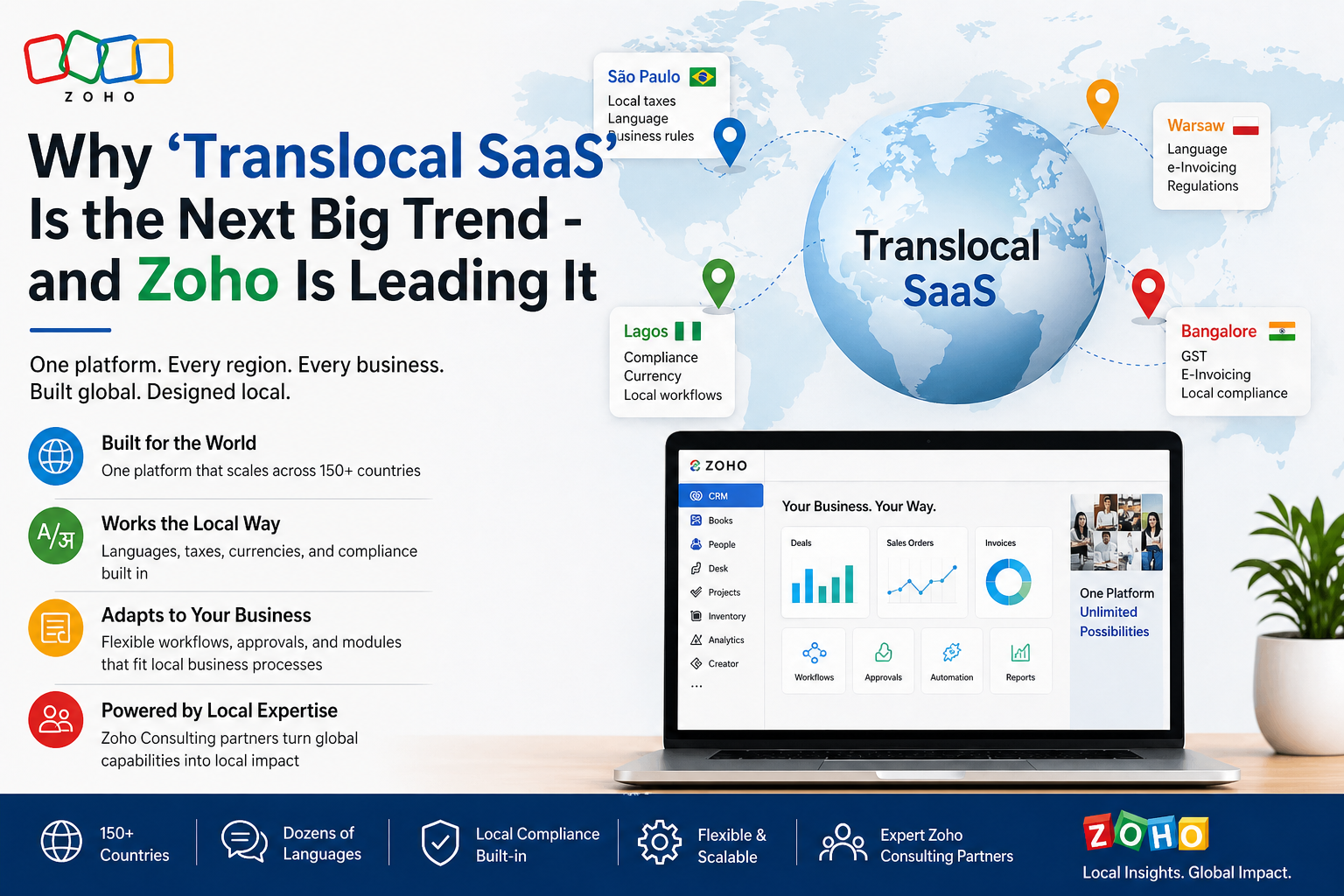
A change is afoot in the way companies around the globe consider software. You can’t call it anything yet exactly because it doesn’t have a universally accepted term, but you can see the trend: the emergence of what is being referred to as “Translocal SaaS”.
The idea is straightforward. Translocal SaaS is a product that is designed to work at scale across the world, but is simultaneously useful at local scale – it is able to adapt to local language, tax rates, regulatory compliance, currency and business practices without making the user feel like they are using a product that is alien to the local market.
This isn’t the same as localization. Typically enterprise software companies add localization to their products as an add-on: set the language to the right setting, change the date format, and you’re done. Translocal SaaS is more than this. It means the core product is built in a way that it can accommodate the needs of business processes in Bangalore, São Paulo, Lagos or Warsaw, not just in San Francisco or London.
And if you’re looking for who stands a chance of leading the charge in this field, look to one company: Zoho.
Why Global SaaS Has Always Had a Local Problem
For many years, the operating paradigm for business software was based on a simple proposition: if you want to run a business, do it the way they do it in the US or Western Europe. Anything else was an outlier.
This was particularly frustrating for non-US/Western European companies. The software worked, technically. But it never quite fit. Invoice formats were wrong. Tax fields were missing or incorrectly labelled. Regional approval hierarchies that were clear as day to the regional office were difficult to translate. Regions in the developing world often had to compromise their own valid and legitimate processes to work with a product that wasn’t built for them.
The big enterprise software vendors eventually rolled out local software, but it was costly, slow to refresh, and often outsourced to other vendors who further complicated matters. Smaller companies in emerging markets either did without or remained on legacy software platforms.
This is where translocal SaaS comes in – and it is coming on strong.
What Makes Zoho Different
Zoho wasn’t founded in the US to go global. It started as a Chennai-based company creating software for a non-uniform market. The Zoho team knew early on that the way business is done in practice varies widely, and that software that doesn’t adapt to those differences will always be less than optimal.
And this early experience shaped the design of Zoho. The system was built as a flexible one – not flexible in the marketing sense, but flexible in the engineering sense. Workflows, fields, modules, tax rules, document templates, approvals – all had to be flexible, not just customised.
Zoho now supports business in more than 150 nations. It supports dozens of languages. It supports GST, VAT, e-invoicing and local labour laws in markets that other enterprise software companies consider to be “emerging”. And it does this while maintaining the product’s integrity so that an enterprise that has offices in three different countries can operate from a single system.
That is not a coincidence. This is what translocal architecture means.
The Role of Local Implementation in a Global Platform
That’s where things get more complicated – and relevant to those businesses that are trying to make Zoho go for them.
An architecture that can serve local markets does not necessarily serve your local market. And this is where most implementations go right or wrong.
Zoho provides the tools. But knowing what tools to use, which ones to use, and how to use them for your particular industry, compliance regime, and corporate culture – that is a different matter. It’s also where the value of professional Zoho Consulting is not a luxury but a necessity.
The translocal promise of a tool like Zoho can only be fulfilled by local knowledge. A consultant who knows Zoho and knows your local business can make sure that the way the software is implemented makes it look as if it were designed for your market – because it is, sort of.
It’s what they are looking for. They don’t want a vanilla CRM system with their logo and their colours. They want a CRM that supports the way they have contracts written, the way they have approval chains set up, the way their governments want them to report transactions. A good Zoho consulting services vendor knows that local context is not a customization. It is the entire point.
Why This Trend Is Accelerating Now
A number of factors are coming together to drive translocal SaaS from the fringe to the mainstream.
Most markets are embracing digital transformation. Companies that have been slow to shift to new systems are now doing so with great speed and with an intolerance for any system that doesn’t work with their reality. They have tasted the power of good software, and they are not going to tolerate something that makes them accommodate their software.
Meanwhile, the expertise in implementing Zoho has grown immensely. In most markets, there are now consultants who understand the platform and the local market intimately. So, companies no longer have to compromise between local knowledge and product knowledge. The best Zoho Consulting services providers have both.
Regulation is also on the rise in markets in Asia, Africa, Latin America and the Middle East. Electronic tax reports, e-invoicing and data sovereignty requirements are growing. Companies need software that is able to keep up – and they need implementation partners who know how to configure the software to meet requirements.
What Businesses Should Do With This
If you are considering Zoho or have Zoho in place but are evaluating how it is working, then the translocal perspective is helpful. It’s not enough that we use Zoho. The question is “are we implementing Zoho in a manner that mirrors business practices in our market?”
It is more difficult to answer that second question, and it is a question that will determine the difference between a good Zoho Consulting services engagement and a basic deployment. A good consulting service will examine not only your system configuration but your business process logic, your processes, how they are set up, where they reflect a real business need, and where they are a work-around based on a limitation in the software that no longer applies.
Translocal SaaS is not a product classification. It is a philosophy about software for whom. For longer than most, Zoho has been building based on that philosophy, and companies that “get” that philosophy are going to be much better served by the platform than those that still think of it as a global platform with some tweaks to make it “local”.
Businesses that enjoy success with Zoho in the years to come will be those that leverage the true translocal nature of the platform when they implement it, with equally translocal implementation expertise. It is available today like never before and those who take advantage of it will gain a competitive advantage.
 masonreed
  Rayhan Sheikh
  Rushkar Technology Pvt. Ltd.