
Hajj and Umrah are two sacred journeys in Islam that carry deep spiritual meaning for Muslims across the world. Most pilgrims plan their visit with an umrah visa to Makkah and do their worship in a serene and pious state of mind. These two journeys reinforce faith and draw believers closer to Allah by performing some strong acts of worship.
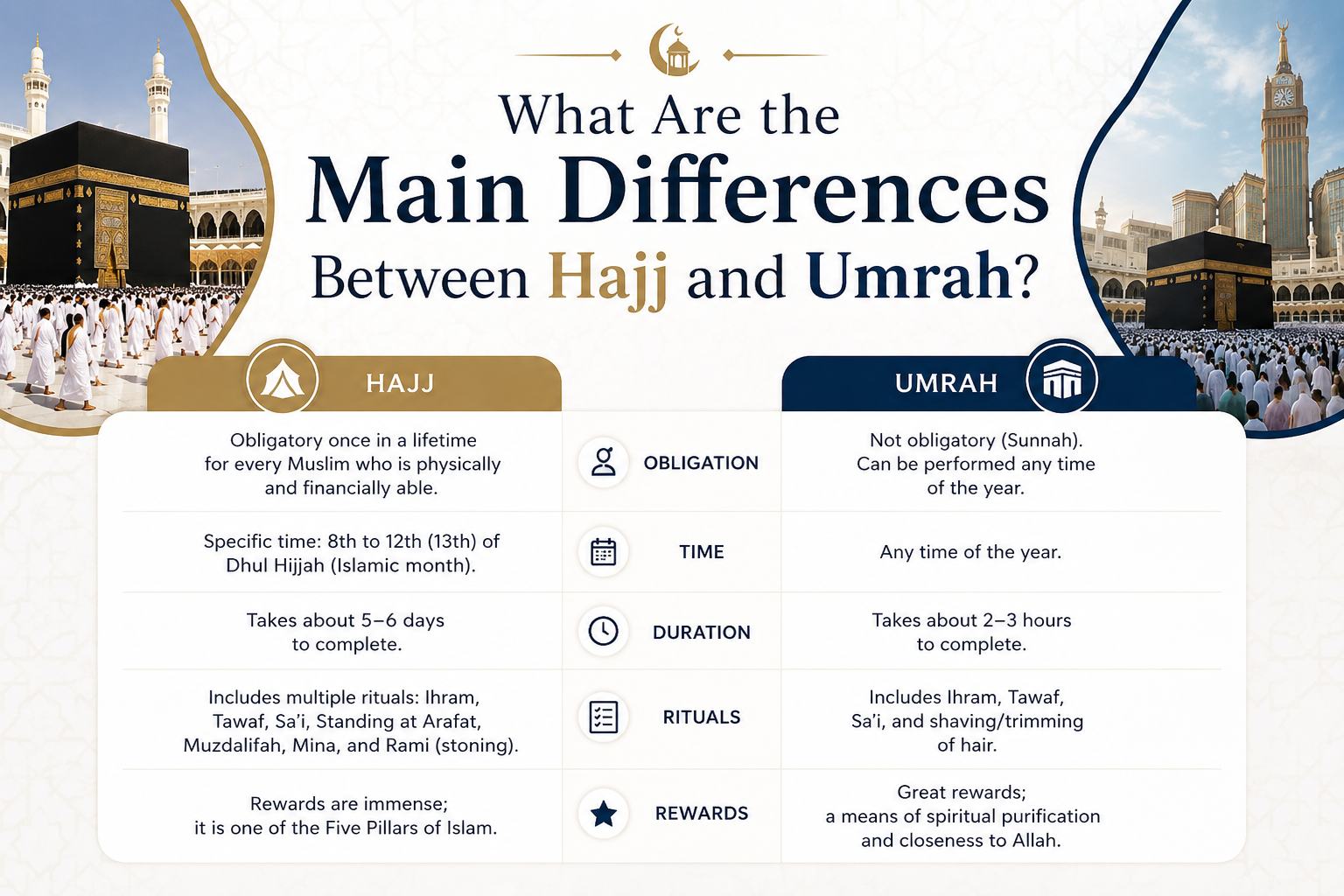
Though Hajj and Umrah are both done in the sacred city of Makkah they are not synonymous. The Differences between Hajj and Umrah are observable in terms of obligation, timing, rituals as well as the overall experience. Knowing these differences can assist pilgrims to plan better and make each journey with clarity, sincerity and spiritual preparedness.
Understanding the Differences Between Hajj and Umrah
Religious Status and Obligation
Hajj is an obligatory worship and among the Five Pillars of Islam. All Muslims, who are physically and financially fit, have to perform it at least once in their life. It is a very organised duty that symbolizes total obedience to Allah and has enormous responsibilities to the believers.
Umrah is not obligatory, but rather a voluntary pilgrimage. Based on their choice and capability, Muslims can perform it anytime. Although not a requirement, it is most rewarding and provides spiritual cleansing, forgiveness of sins and an opportunity to renew faith in a peaceful and meaningful manner.
Timing and Travel Flexibility
Only on certain days of the Islamic month of Dhul Hijjah, Hajj is performed. These set dates are not alterable and therefore it is a time-bound pilgrimage which needs a lot of planning, preparation and following schedule by each pilgrim.
Umrah has no time limit as it can be carried out at any time of the year. This is flexible to enable Muslims to travel at their own convenience. In practice, it is obvious that the Differences Between Hajj and Umrah are evident because Umrah is more accessible and easy to undertake than the Hajj season that is highly structured.
Rituals and Worship Structure
Hajj involves a set of elaborate practices like standing at Arafat, staying at Mina and Muzdalifah and symbolic stoning of the devil. These rituals are very ritualistic and demand patience, discipline and physical work in a number of days.
Umrah comprises of fewer and less complicated rituals. It involves taking Ihram, Tawaf around Kaaba, Sa’i between Safa and Marwah and finally shaving or trimming the hair. It is less physically demanding, shorter and less complicated than Hajj.
Duration and Journey Experience
Generally, Hajj lasts five to six days. It consists of going between various religious sites and carrying out rituals at various levels. The trip is physically oriented and must be well prepared because of the big crowds and tight programs.
The pilgrim can be able to complete Umrah in a few hours or one day based on his or her speed. It is less rigid and does not need traveling between several places outside Makkah making it the most appropriate in the case of people with little time or travelling limitations.
Spiritual Meaning and Purpose
Hajj is the utmost devotion in Islam. It is an overwhelming feeling of togetherness when millions of Muslims are united in a single location dressed in simple clothes, and stand equal before Allah. It is a sign of patience, humility and total submission.
Umrah is a spiritual experience as well, and a time of forgiveness and introspection. It enables believers to enhance their connection with Allah and have peace in a holy atmosphere. Most pilgrims have been visiting Umrah severally in an attempt to revive their faith.
Crowd Size and Overall Environment
Hajj is among the biggest yearly meetings in the world, which unites millions of pilgrims simultaneously. This makes it a very congested atmosphere which demands patience, discipline and great physical stamina to go through the rituals.
Umrah is done all year round hence pilgrims are distributed in various months. This makes the experience more relaxed and comfortable and people can concentrate more on worship and introspection without being severely pressurized by the crowd.
Conclusion
Hajj and Umrah are both holy travels which take Muslims closer to Allah and enhance their faith by worshiping and reflecting. Although they are similar in rituals and are conducted in the sacred city of Makkah they are different in terms of obligatory, time and commitment. The Differences between Hajj and Umrah bring out the role of each pilgrimage in the Islamic religion.
Hajj is compulsory pillar of Islam that has predetermined dates and more comprehensive rituals, and is an obligation once in a lifetime of those who can afford it. Umrah, however is a voluntary act of worship that can be done any time and provides flexibility, ease and reiteration of spiritual renewal.
 Abhay seo
  airlinesofficelocation89
  elijajonson