
Modern industry demands far tighter tolerances. Any small deviations can cause complete system failure in use. The rubber molded products outperform most alternative materials.
It can hold tolerances that match and even exceed machined metal. It also brings inherent properties that no other material offers. It absorbs vibration, seals fluid and compensates for misalignment. The rubber molded products are critical for all high performance systems.
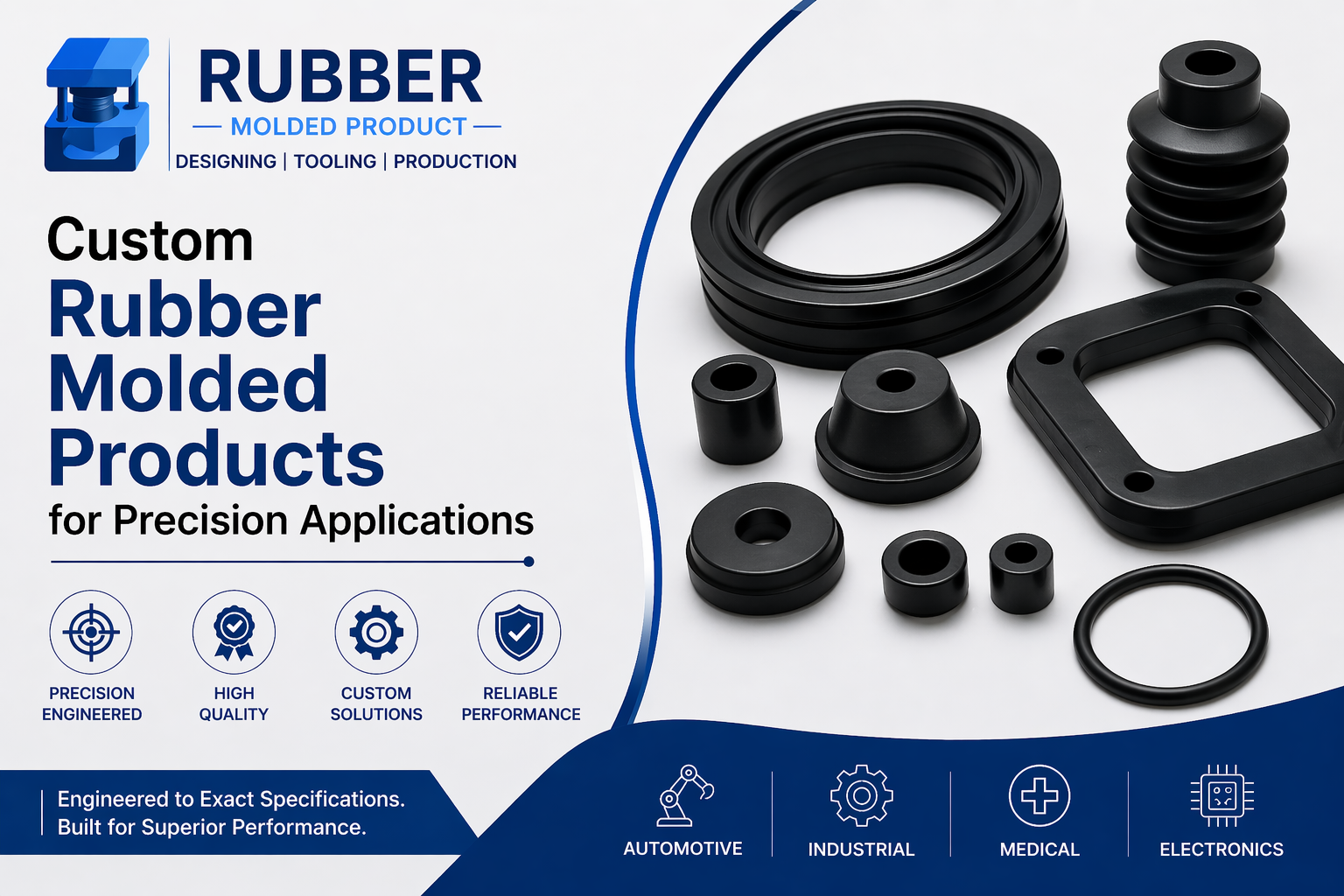
Types of Precision Rubber Molding Processes
Compression Molding
The compression molding is best for thick walled complex shapes. It produces consistent results across low to medium run sizes. The tooling costs remain lower than most other available methods. This process is for rigid and high durometer compounds. Most rubber molding company teams will recommend this for prototypes.
Transfer Molding
The transfer molding delivers extremely fine, intricate details on finished parts. The material flows around thin features and sharp internal corners. It remains the top choice for small to medium volume runs. Many manufacturers use this for seal and gasket production.
Injection Molding
The injection molding delivers the lowest unit cost for high volume runs. The cycle times can drop as low as 15 seconds for small parts. The dimensional consistency remains identical in one hundred thousand parts. Most high volume custom rubber parts are manufactured with this method.
Insert Molding
The insert molding permanently bonds rubber to metal parts. The bond forms during the cure cycle and will not separate over time. This process eliminates almost all failure points in assembled parts. Most rubber molded Company british columbia for automotive use this method.
Liquid Silicone Rubber (LSR) Molding
The liquid silicone rubber molding produces stable and high performance parts. It can hold tighter tolerances than any other rubber process. This is the standard process for medical and food contact parts. The cycle times are fast and consistent across very long production runs.
Flash-free Molding
The flash free molding techniques eliminate all secondary deflashing. The tolerances remain consistent across every part pulled from the tool. This technology has become standard for new precision tool builds.
Material Properties for Precision Manufacturing
The shore hardness ranges run from 10A up to 90A for most compounds. Soft materials absorb vibration while hard materials resist wear and tear. Most custom rubber products can be formulated to any required hardness.
The temperature resistance ranges from -65°F up to 500°F for special compounds. Some materials will remain flexible at temperatures well below zero. Others will hold their shape at very high operating temperatures.
Low compression set values allow parts to return to their original shape. This is the single most important property for seals and gaskets. The poor compression set will lead to premature failure and leakage. All precision custom rubber parts should specify a maximum compression set value.
The tear strength ratings define how well a material resists crack propagation. The high tear strength materials will not split even when nicked or damaged. This property is critical for parts that see dynamic movement and installation.
The FDA and medical grade options are available for almost all compounds. These materials meet strict requirements for food and human contact. Most molded rubber products for healthcare use these special compounds. They also meet all international standards for clean room production.
The conductive rubber compounds dissipate static electricity and electrical charge. These compounds retain all the other physical properties of standard rubber. They have become standard for EMI and RFI shielding applications.
Tolerance Capabilities and Quality Standards
The tolerances can go as tight as ±0.005 inch for well designed custom rubber products. The tolerances will vary based on material and part geometry. The surface finish specs are defined and measured using standard Ra values.
The surface finish can be adjusted by modifying the finish of the mold surface. Most precision parts fall between 0.8 and 3.2 Ra out of the tool.
The parts are measured after cure, after post cure and after ageing. The manufacturers run this testing on every new material and tool design. It prevents expensive field failures much later in the product lifecycle.
ISO 9001 compliance is the base standard for all quality manufacturing. It defines consistent processes and documentation across all operations. The reputable rubber molded parts will have this certification as standard.
AS9100 aerospace standards define additional requirements for aerospace parts. They impose much stricter traceability and documentation requirements.
Medical device regulations follow the ISO 13485 international standard. This standard defines requirements for the production of for healthcare. Automotive production requires full IATF 16949 certification for all suppliers. This is the strictest standard for high volume automotive production.
Critical Design Considerations
The wall thickness uniformity is the single most important design rule. The uneven wall thickness will cause shrinkage, warping and dimensional variation. Most common design mistakes relate directly to uneven wall thickness.
The draft angles should run between 0.5 degrees and 2 degrees for most parts. The draft allows the part to release cleanly from the tool after curing.
The parting line placement will have a huge impact on part cost and quality. A poorly placed parting line will increase flash and secondary operation cost. It can also create cosmetic and functional issues on the finished part.
Undercut elimination will reduce tool cost and complexity. The internal undercut requires an additional action in the mold tool. The manufacturers can remove small undercuts with small changes to part design.
Gate location planning controls the flow of the material inside the mold cavity. A poorly placed gate will cause knit lines, voids and dimensional variation. It can also leave a cosmetic mark on a visible surface of the part. The gate location is one of the most important decisions during tool design.
The venting requirements allow air to escape the cavity as material fills. The insufficient venting will cause voids, burn marks and incomplete fill. Many common part defects trace back to insufficient or poorly placed vents.
Testing and Validation Methods
The durometer hardness testing verifies that the material matches the specified hardness. It is the fastest and most reliable check for correct material formulation. A variation of more than 5 points indicates a problem with the compound.
Tensile strength verification confirms that the material meets the physical properties. This test catches any variation in raw material or cure cycle. A drop in tensile strength indicates a major problem with the process.
The compression set evaluation measures how well a part returns to shape. They are then measured to see how much permanent set they have taken. Most premature seal failures are caused by poor compression set performance.
The temperature cycling tests expose parts to repeated extreme temperature changes. Parts are cycled between high and low temperatures for hundreds of cycles. They are inspected for damage, dimensional change and property loss.
Leak testing protocols verify that seals and gaskets hold pressure correctly. Parts are tested under air or liquid pressure at the rated operating load. It will catch even very small defects.
Conclusion
The right molding method is one of the most important design choices. It will define the long term reliability and performance of your entire system. Any cutting corners on this step will almost always lead to higher costs later.
 Peak Peptides
  Sushant Ramnarine
  Supply Base Solutions