
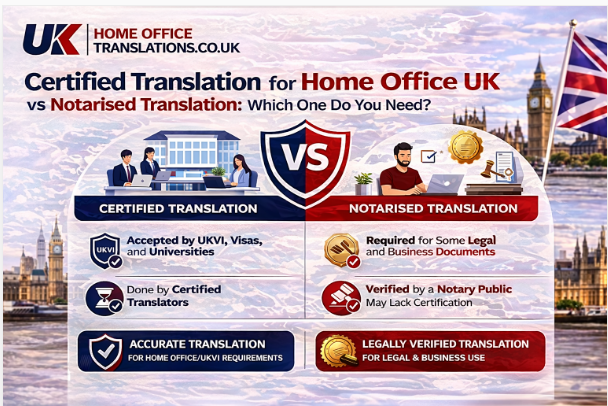
This question gets asked in almost every immigration forum discussion about document translation. And the answers given are frequently wrong — confusing the two, conflating them, or recommending notarisation when certified translation is all that’s needed.
Let me give you a clear, definitive answer — and the framework to apply it to your specific situation.
Key Differences Between Certified and Notarised Translation for UK Home Office Applications
We’ve covered this in earlier articles, but it bears a direct, focused treatment here.
Certified translation: A professional translator produces an accurate English translation of the original document, attaches a signed statement confirming the translation is accurate and complete, and includes their name, contact details, and language pair. This is the translation. The certification is the translator’s declaration.
Notarised translation: Everything in certified translation, plus an additional step: a notary public — a legally appointed independent official — verifies the translator’s identity and signature and attaches their notarial certificate with their official seal.
For UK Home Office immigration applications — the vast majority of cases readers of this article are dealing with — certified translation is the required standard. The Home Office guidance does not routinely require notarised translation for visa applications.
Notarised translation is for legal proceedings, apostille processes, and specific contexts where independent authentication of the translator is required.
Certified translation for Home Office UK meets the standard for standard immigration applications. Notarised document translation UK is available for contexts requiring that higher level of authentication.
When You Should Use Certified Translation vs Notarised Translation in the UK
Always use certified translation for:
- Spouse/partner visa applications
- Skilled Worker visa applications
- Student visa applications
- Visit visa applications
- Settlement (ILR) applications
- Naturalisation applications
- Most standard immigration administrative processes
Use notarised translation when:
- The document is being presented as evidence in a UK court or tribunal
- The document requires an apostille from the FCDO
- A foreign consulate specifically requires notarised translation
- A UK solicitor handling a property transaction or probate requires notarisation
- The authority requesting the document has explicitly specified notarisation
The test: ask the authority that will receive the document what they require. If they say “certified translation,” you have your answer. If they say “Notarised document translation UK” or “notarisation,” you need the higher standard.
Common Misunderstandings About Translation Types in UK Immigration Cases
“The notarised version is always better, so I’ll get that”
Getting notarised translation when certified translation is sufficient wastes money and time — and adds no benefit in the Home Office context.
“My solicitor said I need notarisation”
Solicitors advising on immigration sometimes recommend notarisation out of caution, or because they’re used to legal proceedings contexts. Confirm with UKVI whether notarisation is specifically required for your application before commissioning.
“I need notarisation because the document is a legal document”
“Legal document” covers a huge range — and most legal documents submitted to UKVI as supporting evidence need only certified translation.
“Online services that say ‘notarised translation’ are producing notarised translation” Some online services use the phrase “notarised translation” loosely to mean “certified translation.” True notarisation involves an actual notary public. If the process doesn’t include a physical appointment with a notary, it’s not notarisation.
How to Choose the Right Translation Type Based on Your Visa Requirements
Simple framework:
- Identify which authority will receive the document.
- Check that authority’s stated requirements.
- If the requirement is “certified translation” — commission certified translation.
- If the requirement is “notarised translation” or includes apostille — commission notarised translation.
- If the requirement is unclear — ask the authority directly before commissioning.
Don’t guess. The cost difference between getting it wrong and getting it right is typically the cost of the translation itself — not a trivial amount for what may be an unnecessary upgrade.
The Bottom Line
For the vast majority of UK visa applications, certified translation is what you need. Notarised translation is for legal proceedings and specific authentication contexts. Know which situation you’re in, commission accordingly, and don’t overcomplicate the decision.
 Jhoana Williams
  Petrofast Middle East FZC
  essentialhoodiesusa1