
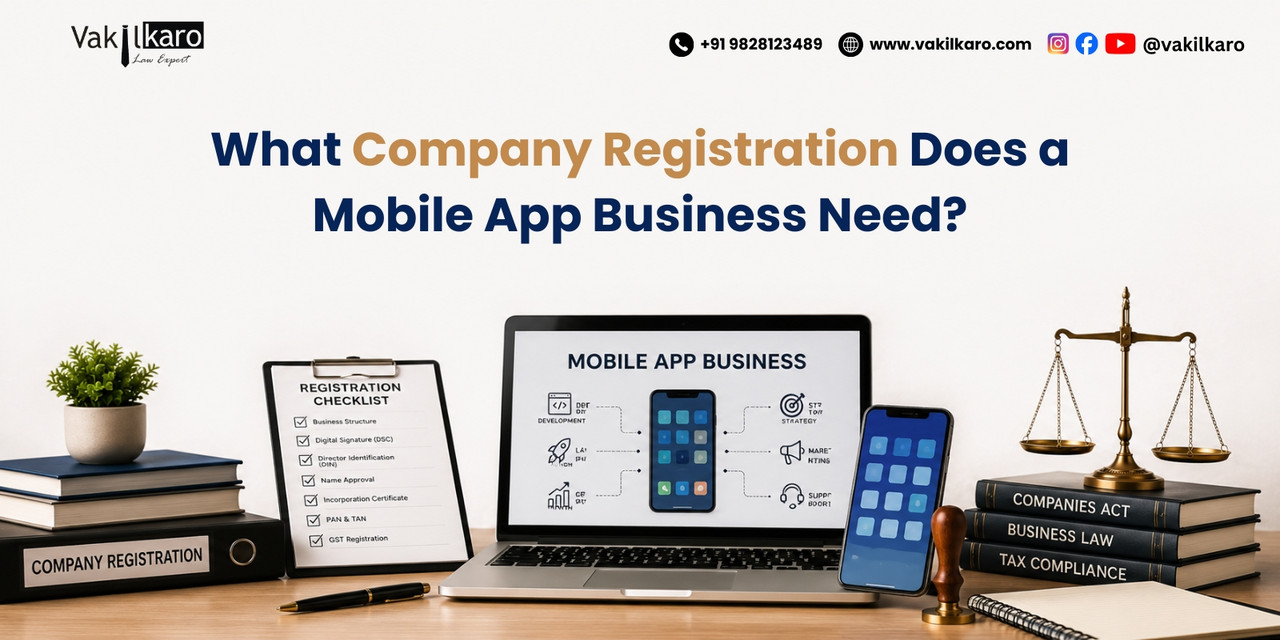
The mobile app sector in India is expanding quite fast, with startups developing apps in different industries like fintech education healthcare, e-commerce, gaming, and productivity. Though many entrepreneurs concentrate a lot on the app development and user acquisition aspects, they still miss an essential question: which Company Registration type is suitable for a mobile app business?
The VakilKaro Brief: Company Registration and Mobile App
The Update
App developers have several choices for business types, but the ideal choice for them must consider factors like their investment plans, how much liability protection they want, ownership needs, and the ability to scale up in the future.
The Impact
Picking the right organizational form early on can cause easier compliance processes, higher investor trust, and a stronger support for business expansion over the years.
The Action
Business owners should consider their funding plans, marketing strategies, and daily operations requirements before they choose the legal form of their company.
Why Company Registration Matters for App Businesses?
Many apps on our phones started as side hobbies of students, freelancers, or people who want to become entrepreneurs. At first, founders are mainly concerned with making the product, attracting users, marketing, and enhancing features. But once the app begins to get users, make money, or work with commercial partners, the importance of having a legal structure rises.
Having a registered business means legal recognition and a formal identity distinct from the people who started it. This can help with getting into agreements, opening business bank accounts, tax management, employee hiring, and building a reputation with clients and partners. Besides that, registration lays down the rules for ownership and governance, which are crucial when the business expands.
Tech startups see Registering a Private limited Company not just as a matter of compliance, but a strategic move that opens them up to fundraising, determines who owns the intellectual property, and sets the stage for future growth.
Can You Launch an App Without Registering a Company?
Well, technically speaking, it is possible for a person to conceptualize and publish an app even without the presence of a company immediately. A lot of app developers first run their apps on their own to check if the market is ready for the product, and only then will they commit to business structures.
But working without formal registration may pose constraints. There is the risk of mixing one’s personal and business money, which can cause accounting and taxation issues. Business deals might have to be made under the founder’s personal name, and personal liability could be higher if there’s a dispute or a legal case.
When the app becomes popular, these problems tend to get in the way Really. This is the reason many business owners decide at some point to adopt a formal business structure after their apps exhibit commercial success.
Common Registration Options for Mobile App Founders
App entrepreneurs in India have multiple options of legal structures available to them, per their goals. To have the simplest structure, easily maintained and appropriate for a local one person or small business, the most common choice is a Sole Proprietorship.
Personal and business assets are not separated though, and there’s limited growth potential. Partnership Firms- An association of 2 or more persons carrying on business as partners and with a view to profit- May be engaged by an enterprise which is unincorporated or incorporated; or for a business with several proprietors; or offer services as an association.
An LLP offers a degree of liability protection and a distinct legal personality while at the same time offering a business, flexible management arrangements. They are most likely to be suitable for service orientated enterprises, and small businesses.
One Person Companies (OPCs) enable one person entrepreneurs to enjoy the advantage of incorporation with sole ownership.
Private Limited Companies continue to be the most preferred legal structure for technology entrepreneurs as they provide the liability advantages of a Limited Company combined with investment readiness and scalability.
Why Private Limited Companies Are the Preferred Choice?
Most app-based startups with big growth plans would usually find a Private Limited Company the best option for their business structure.
When a company is formed through registering a private limited company in india, it gets a separate legal identity which means the business can exist independently of its founders. This disconnection gives the business more stability and continuity First and less personal exposure to business liabilities on the other.
The ownership of Private Limited Companies can be represented by shares, Because of this it’s easier to admit new co-founders investors advisors, and strategic partners. For this reason, quite a few top tech companies start off with pvt ltd company registration even before their launching their products.
This particular business form works well for companies that plan on scaling fast or may need to obtain external funding in the future.
Investors Prefer Private Limited Companies
One of the strongest reasons tech startups opt for pvt ltd firm registration is the investor preference factor, honestly. Angel investors, venture capital firms, and institutional investors generally seem to favor Private Limited Companies, mostly because the setup lets them take equity shares and really join in the company’s development. It also makes it easier to manage investment agreements, clarify shareholder rights, and handle those future fundraising rounds without too much hassle.
Companies working as sole proprietorships or, older style partnerships, often run into more hurdles when trying to pull in professional investors. So, founders who know they will seek capital later typically choose a Private Limited Company right from the beginning, not after things get messy.
Liability Protection Is Crucial
Mobile app businesses can run into multiple risks too, like contractual disagreements, customer complaints, regulatory trouble, and data- related claims. A Private Limited Company typically offers limited liability protection,so shareholders aren’t personally on the hook for the company’s debts beyond what they’ve put into the business. That split, between personal finances and business assets is a real plus, especially for startups in fast changing, or tightly regulated, markets. For founders trying to build long term technology ventures, this kind of cover often turns into a major factor when deciding which registration structure to use.
Intellectual Property Ownership Becomes Simpler
For most app businesses, intellectual property is among the most valuable assets. Like the source code , application designs, trademarks, branding elements, and proprietary technology can really make up a substantial portion of the company’s value.
When intellectual property is owned directly by the company, ownership rights are generally clearer and a bit easier to administer. This matters a lot during fundraising, acquisitions, collaborations, and due diligence type exercises.
Investors and would be acquirers often prefer a business where the key intellectual property assets are formally owned by the company, not by individual founders.
Additional Compliance for Certain App Categories
Not all mobile apps run under exactly the same regulatory frame work, and honestly it can get a bit messy. If the app sits in areas like fintech, lending, insurance, healthcare, payments, or even financial advisory services, then there might be extra licenses, permissions, or compliance steps beyond normal company registration.
For instance, a lending platform may have to look at RBI related requirements, whereas a healthcare app could need to follow specific rules about user data handling and how services are actually delivered.
So, founders really should review the industry specific duties first before they start operations, even if it feels slow at the beginning.
Choosing the Right Structure
The ideal registration setup depends a bit on a bunch of things, like how many founders there are, what the expected revenue model looks like, investment plans, any regulatory needs, and what the team is trying to achieve for growth.
If you’re an entrepreneur building something more of a lifestyle business, or you’re just testing a concept, then sometimes a simpler structure can be enough, especially early on. But if it’s a startup that wants to scale, bring in investors, build intellectual property, and push out nationally or even internationally, then a Private Limited Company usually gives the best base.
That’s basically why private limited company registration in india is still the go to choice among technology entrepreneurs and app founders.
Conclusion
Initially, the launch of a mobile app enterprise is possible without the need for a formal incorporation. Though, the establishment of a legal structure is typically necessary for the continued growth of the business. Issues like liability, intellectual property rights, taxation, and the reputation of the business will become more significant as the app gains popularity, makes money, and looks for funding.
Even though there is different registration options, private limited company registration is considered by many as the most apt option for app-based businesses that want to grow. It not only gives limited liability protection but is also attractive to investors, offers operational flexibility, and lays down a structure that can accommodate further expansion.
It is essential for founders, who are planning to start or grow a mobile app business, to think through their aims and decide on a structure that fits well with both their current requirements and their future growth ambitions.
About Vakilkaro
Vakilkaro is a platform, owned by Jsons Solicitors Private Limited that simplifies access to legal and compliance advice in India. It connects people to registered practitioners such as Advocates, Chartered Accountants and Company Secretaries to handle company registration, documentation, drafting contracts and compliance requirements.
Besides that, the platform offers easy-to-understand explanations and the latest developments in corporate law taxation insolvency, and other areas so that businesses are always well-informed. Vakilkaro is not a law firm, nor does it provide legal advice directly. Instead, it is a medium through which users get connected with professionals, and services are offered both online and offline.
 Ahlawat Associates
  Ahlawat Advisory
  Interlegal International Network