
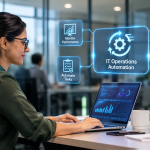
Introduction

Modern enterprise technology environments demand speed, stability, and seamless adaptability. Managing complex infrastructure, hybrid cloud environments, and massive volumes of data requires more than traditional manual oversight. Modern organizations turn to IT operations automation to transform repetitive maintenance, routine provisioning, and system alerts into intelligent, continuous processes.
Implementing IT operations automation bridges the gap between infrastructure management and digital innovation. Beyond resolving basic routine tasks, IT operations automation reduces operational risk, minimizes downtime, and frees technical teams to focus on strategic initiatives. Establishing a sustainable framework for IT operations automation accelerates business agility, optimizes costs, and strengthens institutional resilience in dynamic digital markets.
The Core Pillars of Effective Automation Systems
Building a dependable environment relies on standardizing core workflows before introducing automated scripts or orchestration platforms. Without structured operational workflows, executing IT operations automation simply accelerates existing process inefficiencies. Organizations must map end-to-end procedures, clear communication channels, and ownership responsibilities prior to technical deployment.
Centralized visibility forms the secondary cornerstone of effective operations. Modern infrastructure spans on-premise hardware, public clouds, and edge computing nodes. Connecting IT operations automation across disparate software assets creates a unified monitoring ecosystem where systems continuously report operational metrics and health status. Centralization ensures that automated actions maintain accurate contextual awareness across the enterprise.
Strategic Value of Automated Infrastructure Workflows
Transitioning routine infrastructure management into automated workflows fundamentally improves organizational capacity. System administrators spend countless hours manually managing password resets, server patching, access provisioning, and basic system checks. Implementing IT operations automation handles these high-volume, low-complexity activities instantly with consistent precision.
- Routine password resets and access management
- Server patching and security updates
- Automated alert triage and incident routing
Furthermore, manual intervention inevitably carries risk of human error, particularly during high-stress outages or late-night maintenance windows. Standardizing system adjustments through IT operations automation establishes consistent quality standards. Automated audit logs maintain complete traceability for every executed system modification, simplifying regulatory compliance while enforcing organizational governance.
Proactive Event Triage and Event-Driven Incident Resolution
Traditional IT support models rely heavily on reactive troubleshooting, responding after services experience degradation or failure. Advanced implementations of IT operations automation shift organizations into proactive event detection. Continuous telemetry tools evaluate system parameters, identifying unusual latency patterns, disk capacity limits, or memory leaks before end-users notice performance drop-offs.
Event-driven IT operations automation takes monitoring standard steps further by initiating corrective scripts immediately upon event detection. For instance, if a database container experiences sudden resource saturation, automated policies can automatically scale compute capacity, restart stagnant services, or purge temporary caches. Fast automated response drastically reduces Mean Time to Repair (MTTR), keeping core digital services operational round-the-clock.
Integrating Artificial Intelligence into IT Operations Automation
The convergence of artificial intelligence and automated orchestration marks a pivotal phase in enterprise infrastructure management. Traditional IT operations automation relies on deterministic, rule-based instructions. Incorporating machine learning algorithms empowers systems to analyze vast historical datasets, recognizing subtle anomalies that standard static thresholds miss.
Intelligent IT operations automation predicts potential failure vectors, suggesting optimized resource allocation and executing complex multi-tier root-cause analysis. Intelligent agents dynamically adjust resource allocation based on historical usage peaks, preventing performance bottlenecks before traffic surges occur. Combining predictive AI insight with robust IT operations automation shifts operational paradigms from reactive troubleshooting toward self-healing enterprise systems.
Overcoming Implementation Challenges and Cultural Barriers
Scaling automated operations across enterprise departments requires addressing systemic technical debt and cultural hesitations. Fragmented toolchains across distinct infrastructure teams frequently create operational silos. Leaders embarking on IT operations automation initiatives must establish consolidated governance frameworks and unified orchestration standards across all teams.
Equally important is supporting staff through the operational shift. Team members often harbor concerns that implementing IT operations automation threatens their professional roles. Leadership must communicate clearly that automated workflows eliminate repetitive toil rather than human expertise. Position IT operations automation as an enabling capability that shifts engineering focus toward high-value software architecture, resilience engineering, and strategic digital expansion.
Best Practices for Scaling Automation Maturity
Achieving lasting success with enterprise automation requires a phased, progressive approach to maturity. Attempting to automate highly complex, multi-system legacy workflows immediately increases project risk. Organizations should initially focus IT operations automation on well-documented, repetitive tasks with clear outcomes to build institutional confidence and demonstrate clear return on investment.
Establishing a dedicated Center of Excellence helps standardize automation practices, security guidelines, and reusable code modules across business divisions. Continuous measurement of operational key performance indicators—such as ticket reduction rates, deployment frequency, and service availability—validates the business impact of IT operations automation while guiding future infrastructure investments.
Conclusion
Modern enterprise IT management requires balancing continuous stability with rapid technological adaptation. Adopting IT operations automation provides the structural foundation needed to manage increasingly complex digital ecosystems without proportional increases in overhead or risk. By combining standardized processes, proactive monitoring, intelligent orchestration, and a supportive organizational culture, businesses unlock maximum value from IT operations automation—ensuring resilient, scalable infrastructure capable of supporting long-term digital growth.
 Saransh Agarwal
 judithroyal
 myvirtualteams