
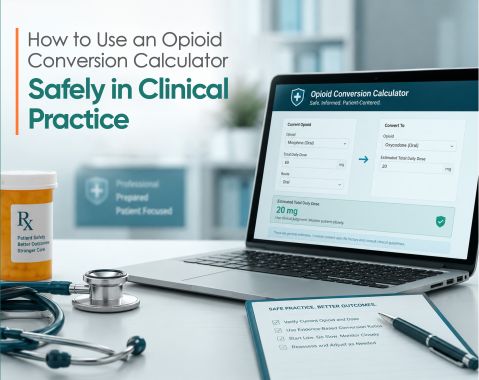
Managing severe acute and chronic pain often requires rotating or switching a patient from one opioid medication to another. Whether due to unmanageable side effects, changing renal function, inadequate pain control, or a transition in administration route (such as oral to intravenous), rotating opioids is a core skill in palliative care, oncology, and acute pain medicine.
However, switching between different analgesic agents is not a simple one-to-one conversion. Because opioids vary widely in potency, receptor affinity, and pharmacokinetic profiles, converting doses incorrectly poses substantial risks of accidental overdose or severe opioid withdrawal. Utilizing standardized Oral Morphine Equivalents (OME) and structured calculation methodologies ensures that dosage adjustments remain safe and clinically sound.
What Is Equianalgesic Potency and Why Does It Matter?
Equianalgesic potency refers to the relative dose of two different opioid analgesics required to achieve an equivalent degree of pain relief. To establish a universal reference point across various medications and routes, clinical medicine relies on the concept of Oral Morphine Milligram Equivalents (OME)—sometimes referred to as Morphine Milligram Equivalents (MME).
Converting all opioid doses to a baseline morphine equivalent allows clinicians to assess total daily opioid burden, evaluate overdose risk, and establish appropriate starting doses when switching agents.
Opioid Rotation Flow:
[Calculate Current Total 24h Dose] ➔ [Convert to Baseline OME] ➔ [Apply Equianalgesic Ratio] ➔ [Reduce for Incomplete Cross-Tolerance (25–50%)] ➔ [Establish Breakthrough Dosing]
Step-by-Step Methodology for Opioid Dose Conversions
When calculating a switch from a primary opioid agent to a secondary agent, clinicians follow a standardized multi-step process:
Step 1: Calculate the Total 24-Hour Dose
Sum all scheduled around-the-clock doses as well as any breakthrough doses consumed over a representative 24-hour period.
- Example: A patient takes oral oxycodone modified-release 20 mg twice daily, plus two breakthrough doses of oral oxycodone immediate-release 5 mg over 24 hours.
- Total 24-Hour Oxycodone: 40 mg + 10 mg = 50 mg oral oxycodone/day.
Step 2: Convert to Oral Morphine Equivalents (OME)
Multiply the total daily dose of the current drug by its specific OME conversion factor.
- Calculation: 50 mg oral oxycodone × 1.5 (conversion factor) = 75 mg OME/day.
Step 3: Convert OME to the New Target Opioid
Divide or multiply the baseline OME by the appropriate equianalgesic ratio of the target drug. If switching to oral hydromorphone (conversion factor 4.0 relative to morphine):
- Calculation: 75 mg OME ÷ 4 = 18.75 mg oral hydromorphone/day.
Step 4: Account for Incomplete Cross-Tolerance (Crucial Safety Step)
When switching from one opioid to another, patients exhibit incomplete cross-tolerance. Because different opioids act subtly differently on mu-opioid receptor subtypes, a patient tolerant to morphine may be unexpectedly sensitive to hydromorphone.
- Standard Practice: Reduce the calculated equianalgesic dose of the new opioid by 25% to 50% to prevent accidental sedation or respiratory depression.
- Applying 30% Safety Reduction: 18.75 mg × (1 – 0.30) = 13.12 mg oral hydromorphone/day.
- Final Regimen: Divide into scheduled doses (e.g., approximately 2 mg oral hydromorphone every 4 hours or 6 mg modified-release twice daily).
Common Pitfalls in Clinical Conversions
Even experienced practitioners can encounter errors when performing manual calculations under time pressure. Key pitfalls include:
- Omitting Breakthrough Doses: Failing to include PRN (as-needed) breakthrough doses taken over the previous 24–48 hours results in under-dosing the new opioid.
- Forgetting Cross-Tolerance Reductions: Directly transferring equianalgesic doses without a 25–50% safety reduction risks serious toxicity.
- Assuming Linear Conversion for Methadone: Methadone’s conversion ratio changes dynamically depending on the baseline OME. At high morphine doses, methadone is vastly more potent than standard tables indicate.
- Ignoring Organ Function: Impaired renal or hepatic clearance significantly prolongs the half-life of active metabolites (e.g., morphine-6-glucuronide or hydromorphone-3-glucuronide), requiring dose adjustments regardless of equianalgesic tables.
To streamline complex multi-step conversions and double-check manual calculations, clinical teams frequently rely on validated digital reference tools. Healthcare professionals can access an interactive opioid conversion calculator on MedTree to double-check OME values and dose reductions across various clinical scenarios.
Setting Up Breakthrough Pain Regimens
Whenever a scheduled around-the-clock opioid is established, a corresponding breakthrough regimen must be prescribed to manage incident pain.
- Dose Calibration: A standard breakthrough dose is generally calculated as 10% to 15% of the total 24-hour OME.
- Frequency: Immediate-release oral formulations are typically dosed every 1 to 2 hours as needed, whereas IV breakthrough doses are administered every 15 to 30 minutes.
- Re-evaluating Baseline Needs: If a patient consistently requires more than 3 to 4 breakthrough doses per day, the total baseline around-the-clock dose should be re-calculated and upwardly adjusted.
Frequently Asked Questions
What is the difference between MME and OME?
Morphine Milligram Equivalents (MME) and Oral Morphine Equivalents (OME) are used interchangeably in clinical literature. Both terms refer to the equivalent milligram dose of oral morphine used as a standard baseline metric for opioid comparison.
Why is the conversion factor different for oral vs. IV morphine?
Oral morphine undergoes significant first-pass metabolism in the liver, resulting in an oral bioavailability of roughly 20% to 40%. Intravenous or subcutaneous morphine bypasses first-pass hepatic metabolism, making parenteral morphine approximately 3 times more potent than oral morphine.
How do you handle opioid conversion in patients with renal impairment?
In renal impairment, active metabolites of morphine and codeine accumulate, increasing the risk of sedation and neurotoxicity. In these patients, clinicians often prefer opioids with less renal metabolite dependence, such as fentanyl or buprenorphine, and apply greater safety reductions during conversions.
Should I reduce the dose for cross-tolerance if the patient has severe uncontrolled pain?
If a patient is switching opioids due to severe, uncontrolled pain rather than side effects, clinicians may apply a smaller cross-tolerance reduction (e.g., 15% to 25%) or convert to 100% of the calculated equianalgesic dose while monitoring the patient closely in a clinical setting.
Summary
Opioid equianalgesic conversion requires a systematic approach: totaling 24-hour intake, converting to baseline oral morphine equivalents, adjusting for target drug ratios, and systematically reducing the final dose by 25–50% to account for incomplete cross-tolerance. Adhering to these clinical principles ensures patient safety while maintaining effective pain management.
 vashupc90
 josephrock9
 costreportcpa