
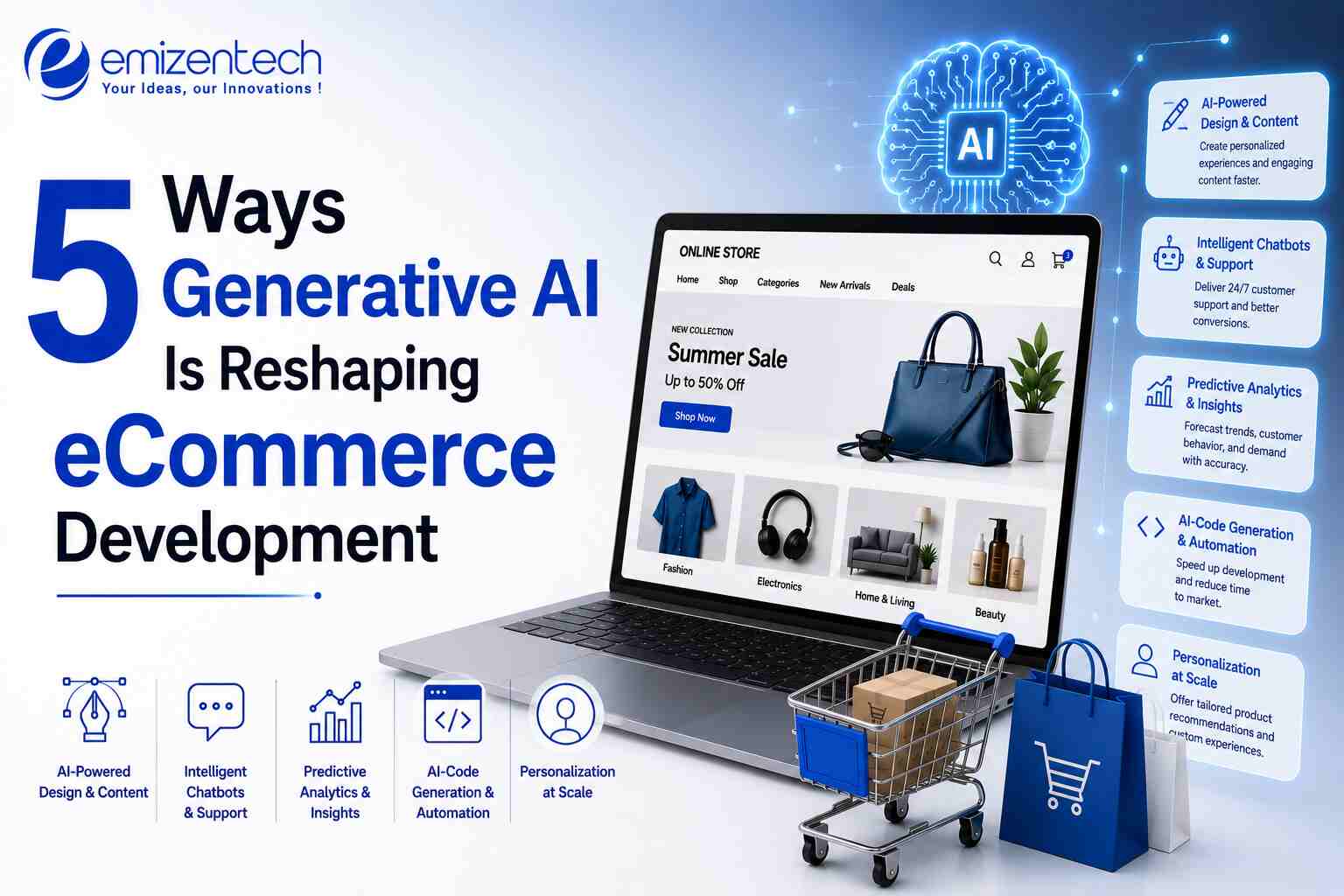
Generative AI adoption in retail has moved fast. What started as a handful of experiments with chatbots and automated emails has turned into a broader shift in how online stores are built, run, and improved. Across digital commerce, businesses are using generative AI not just to answer customer questions but to write product content, personalize shopping journeys, and speed up how new features reach the storefront.
This shift goes well beyond basic automation. Retailers are rethinking how their platforms are developed, tested, and updated, with AI playing a role at almost every stage. This article looks at five ways generative AI is reshaping eCommerce development today, along with the benefits, challenges, and best practices worth knowing before adopting it.
Understanding Generative AI in eCommerce
Generative AI differs from traditional, rule-based AI in one key way: it creates new content rather than just following fixed instructions or sorting data into categories. Traditional AI in eCommerce has typically handled tasks like fraud detection, basic recommendation logic, or inventory forecasting based on historical patterns. Generative AI, built on large language models and similar technologies, can write text, generate images, hold natural conversations, and even assist with code producing original output based on the patterns it has learned.
This capability has made it relevant to nearly every part of an online store, and it’s why many eCommerce development services now build generative AI features directly into the platforms they deliver. Retailers use it to draft product listings, build chat-based shopping assistants, generate marketing copy, and support developers building new storefront features. Because it can handle repetitive, content-heavy tasks at scale, it has become a practical tool for both small stores and large multi-category marketplaces trying to keep pace with growing catalogs and rising customer expectations.
Key Ways Generative AI Is Shaping eCommerce Development
The impact of generative AI on eCommerce isn’t limited to one department. It touches content, personalization, search, customer support, and the development process itself. Here are five areas where the change is most visible.
Transforming Product Content Creation
Writing product descriptions, titles, and specifications for hundreds or thousands of items used to be one of the most time-consuming tasks for eCommerce teams. Generative AI tools can now draft this content directly from product attributes, reducing the manual workload significantly. This is particularly useful for stores with large or frequently changing catalogs, where keeping descriptions accurate and consistent across categories would otherwise require a sizable content team. Tools like Shopify Magic and Jasper are already being used by retailers to generate first-draft product copy, which teams then review and refine rather than write from scratch.
Enabling Smarter Personalization
Generative AI has made personalization more dynamic than older recommendation engines allowed. Instead of showing the same “customers also bought” list to every visitor, AI models can generate product suggestions and even personalized descriptions based on a shopper’s browsing history, purchase patterns, and stated preferences. This extends to personalized email content and tailored landing pages that adjust based on user behavior. Retailers who have adopted this approach often see measurable gains in engagement, since shoppers are shown content that matches their actual interests rather than generic bestseller lists.
Enhancing Search and Product Discovery
Traditional eCommerce search relies heavily on exact keyword matches, which often frustrates shoppers who describe what they want in natural language. Generative AI-powered search can interpret phrases like “a warm jacket for hiking in cold weather” and return relevant results even if none of those exact words appear in the product listing. This also improves merchandising, since AI can group and surface products based on context and intent rather than rigid tags. The result is a shorter, less frustrating path between a shopper’s search query and the product they actually want.
Improving Customer Support and Shopping Assistance
AI-powered virtual shopping assistants have become more capable of handling nuanced conversations, not just scripted FAQ responses. These assistants can answer product questions, offer size or style guidance, and help shoppers compare options in real time. This reduces the volume of repetitive queries reaching human support teams, freeing them to focus on more complex issues. Most retailers using this technology still keep a clear path to human support, recognizing that automation works best for common questions while sensitive or complicated issues still need a person.
Accelerating eCommerce Development and Innovation
Beyond the customer-facing side, generative AI is changing how development teams build and maintain online stores. AI-assisted coding tools help developers prototype features faster, generate boilerplate code, and identify bugs earlier in the testing process. This shortens the time between an idea and a working feature on the storefront. As these AI-driven capabilities continue to evolve, they are helping streamline testing, automate repetitive tasks, manage content updates, and improve overall development efficiency without compromising quality.
Benefits of Using Generative AI in eCommerce Development
Across these five areas, a few consistent benefits stand out for businesses that adopt generative AI thoughtfully.
- Improved operational efficiency, since repetitive tasks like content drafting and basic support are handled faster
- Faster content production, allowing larger catalogs to stay updated and consistent
- Better customer experiences, driven by more relevant search results and personalized recommendations
- Enhanced personalization capabilities that go beyond simple recommendation lists
- Increased scalability, letting growing stores manage more products and customers without a proportional increase in manual work
- Support for data-driven decisions, as AI tools surface patterns in customer behavior that teams can act on
Best Practices for Implementing Generative AI in eCommerce
Getting real value from generative AI depends less on the technology itself and more on how it’s rolled out. A few practices consistently separate successful implementations from disappointing ones.
- Start with high-impact, well-defined use cases rather than trying to automate everything at once
- Use reliable, well-governed data sources so AI outputs reflect accurate product and customer information
- Continuously review AI-generated content and outputs before they reach customers
- Maintain transparency with customers about where AI is being used, particularly in support interactions
- Combine AI capabilities with human expertise rather than treating it as a full replacement
- Measure performance regularly and adjust based on what’s actually working
The Future of Generative AI in eCommerce Development
Looking ahead, several trends are likely to shape how generative AI continues to influence eCommerce development, though the pace of adoption will vary by business size and industry.
- Hyper-personalized shopping experiences, with storefronts that adjust layout, content, and offers dynamically for each visitor
- AI-generated storefront experiences, where pages and product displays adapt in real time rather than relying on static templates
- Conversational commerce evolution, as AI assistants take on more of the shopping journey from discovery through checkout
- Predictive customer engagement, where AI anticipates what a shopper might need before they ask
- Greater automation across commerce operations, extending beyond content and support into areas like inventory and pricing decisions
Conclusion
Generative AI is reshaping eCommerce development in five clear ways: transforming product content creation, enabling smarter personalization, enhancing search and discovery, improving customer support, and accelerating development itself. What ties these together is that AI works best as a tool that enhances human decision-making, not one that replaces it. Teams still need to review outputs, make judgment calls, and stay close to what customers actually need. As these technologies continue to evolve, their influence on digital commerce is becoming increasingly evident, including in how eCommerce solutions are approached at EmizenTech. Businesses that combine AI capabilities with human expertise are likely to achieve the most sustainable long-term results.
FAQs
1. What is Generative AI in eCommerce?
“Generative AI in eCommerce” refers to AI systems that create original content—such as product descriptions, images, or conversational responses—rather than simply following fixed rules or sorting existing data.
2. How does generative AI improve online shopping experiences?
It improves shopping experiences by enabling more accurate search results, personalized product recommendations, and responsive virtual assistants that help customers find what they need faster.
3. Can generative AI help with product content creation?
Yes. It can draft product descriptions, titles, and specifications based on existing product data, which teams then review and refine before publishing.
4. What are the challenges of using generative AI in eCommerce?
Common challenges include maintaining data quality and accuracy, addressing privacy and security concerns, managing AI-generated content responsibly, integrating AI with existing systems, and balancing automation with human oversight.
5. Is generative AI suitable for small and medium-sized eCommerce businesses?
Yes. Many tools are accessible and scalable, allowing smaller businesses to use generative AI for tasks like content creation and customer support without needing large technical teams.
 alberttaylor2019
  Moto catch
  DocuGov AI