
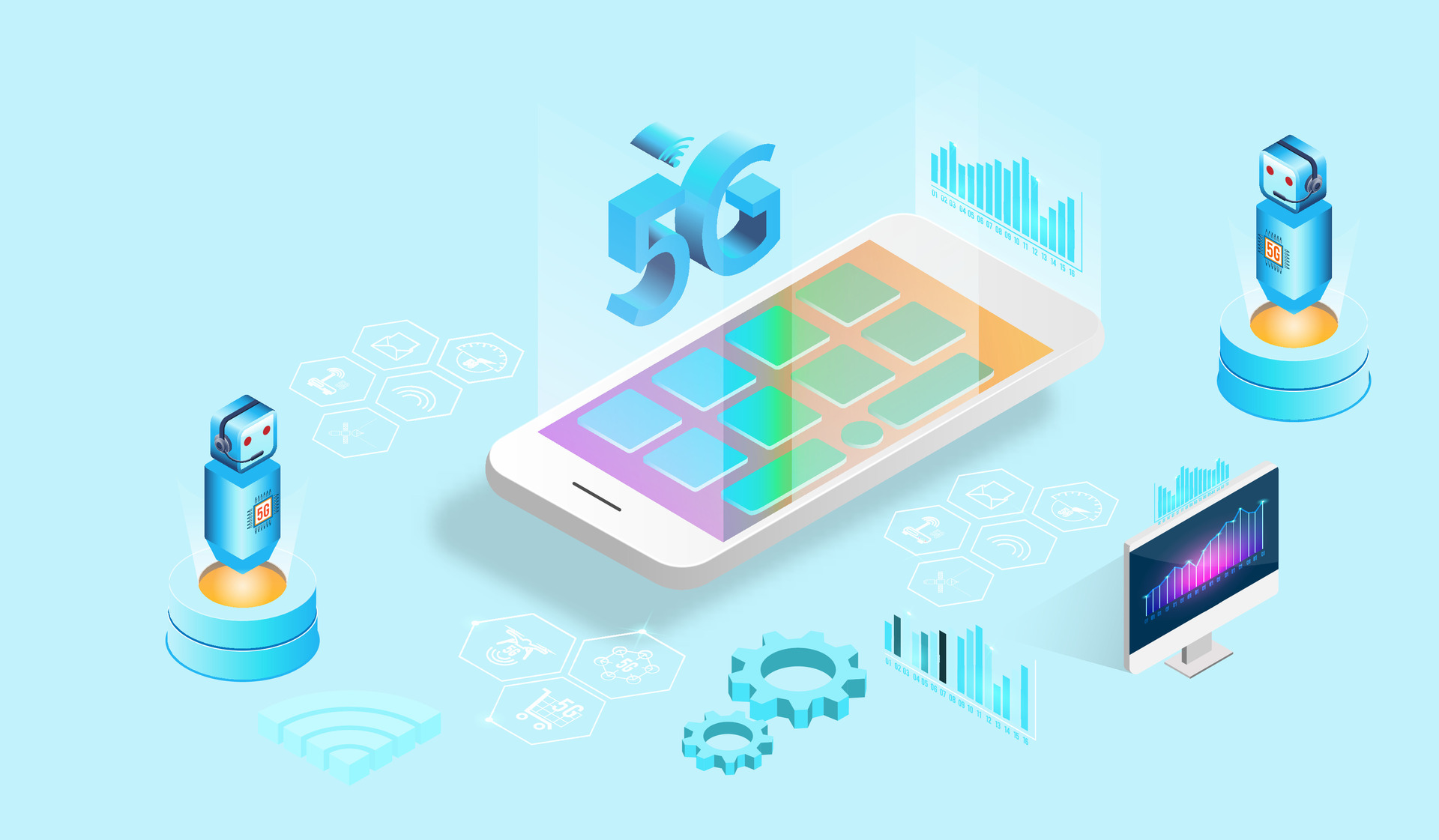
Technology is moving faster than the world has ever witnessed. With all the developments heading our way, one of which definitely deserves its place in the limelight is 5G. The worth of 5G technology is not so much more downloads or streaming. It’s about transforming the way mobile apps are developed, how they work, and how people work with them.
From gaming to healthcare, 5G is transforming the manner in which we engage with digital technology. Today, developers can imagine things that were possible only a few years back. In this blog, I will explain the impact of 5G technology on mobile app development, its intrinsic features, and how it shall transform the future of digital experiences.
What is 5G Technology and How Does It Work
5G is the fifth-generation wireless network technology. It has improved from the past but by an astronomical margin in the form of speed, reliability, and data storage capacity. While the 4G networks provide a top speed of 100 Mbps, 5G provides a top speed of 10 Gbps in ideal conditions. That is, the HD movie downloads in seconds rather than in minutes.
How does it work? 5G employs existing and new technologies combined to attempt to speed up and improve the network.
- Millimeter Waves: They transport vast amounts of information at very high velocities over comparatively short distances.
- Small Cells: Small cell locations placed close to users provide network coverage.
- Massive MIMO (Multiple Input Multiple Output): Use a large array of antennas to transmit and receive data at the same time.
- Beamforming: Channels directly sense to devices to render them critical, and hence data transmission is optimal.
- Network Slicing: Even builds networks over common infrastructure for different purposes.
The configuration makes device-to-device communications quick, secure, and dependable, enabling intelligent apps and smooth digital experiences.
The Evolution of Cellular Technologies
It is useful in attempting to understand the impact of 5G technology on mobile app development to get an idea about the development of the mobile network.
| Generation | Key Advancement | App Experience |
| 1G | Analog voice communication | Only voice calls |
| 2G | Digital voice and SMS | Basic text messaging |
| 3G | Mobile internet access | Early browsing and email apps |
| 4G | High-speed data | Real-time streaming and advanced apps |
| 5G | Ultra-fast, low latency, IoT-ready | Intelligent, immersive apps |
Each generation introduces more connectivity and communications. 5G, however, isn’t just making everything faster. It’s making intelligent, interactive, and highly connected mobile apps possible.
Top 5G Features Enabling Mobile App Innovation
5G is introducing a new era of features propelling mobile app development to a new level.
1. Rapid Data Transfer
5G networks are 100 times faster than 4G. Developers of apps can now make apps that can handle large files, HD video, and more powerful real-time features without any need for sacrifice in performance.
2. Ultra-Low Latency
Latency is the difference in time from receiving to transmitting information. 4G comes closest to 50 milliseconds of it, and 5G does it at 1 millisecond. This near-instant response is required for real-time gaming, video calling, etc.
3. Massive Connectivity
Assured peak of one million devices per square kilometer, which can be networked. It is suitable for Internet of Things (IoT) applications like smart homes, wearables, and industrial automation.
4. Higher Reliability and Energy Efficiency
5G does not just guarantee speed but is also envisioned to use less power for every unit of data sent. That translates to longer-lasting batteries and allows for more eco-friendly usage of technology.
5. Dedicated Use Network Slicing
Network slicing enables developers to allocate a dedicated slice of the 5G network for a particular use. Applications related to health, for instance, can utilize highly secure and low-latency slices, whereas video-oriented applications can utilize speed- and bandwidth-based ones.
The Impact of 5G Technology on Mobile App Development
The influence of 5G technology on mobile application development extends to all aspects of how applications are created and made available.
1. Immersive and Real-Time Experience
Developers can use 5G to make AR and VR apps future-proof. Immersive and realistic experiences such as AR navigation, interactive learning interfaces, and virtual stores can be offered by developers.
2. Gaming on a Whole New Level
The mobile game sector is the biggest gainer of 5G. Multi-player games would be continuously played with no pause and disruptions. Cloud gaming will also gain much as 5G will allow most processing-heavy operations to be pushed off to servers at the far end.
3. Smart Healthcare and Remote Monitoring
The healthcare information can be sent to healthcare applications in real-time on 5G. Physicians can watch patients from afar through facial devices, enhancing diagnosis and response during crises.
4. Internet of Things integration
5G is the platform for the internet of things. It enhances smart thing-to-thing, vehicle-to-vehicle, and factory automation device communications. It motivates developers to create more efficient IoT mobile applications.
5. Cloud-Driven Rise of Mobile Applications
5G optimizes the use of cloud storage and computing and mobile apps. The apps can retrieve data directly from the cloud immediately without lag at faster speeds. This not only preserves local storage space but also the apps become smoother to use.
6. Enabling AI and Smart City Solutions
It’s the effort of 5G that makes that possible, as increasingly more cities go digital. For traffic management to climate monitoring, AI-powered apps can take inputs and respond to real-time data in seconds and with precision.
Business Opportunities in the Era of 5G
The age of 5G heralds the rise of fresh opportunity for incumbents and new entrants together. Retail, education, health, and logistics are finding novel ways of harnessing 5G-capable mobile technology to derive greater value.
For instance, businesses that venture into mobile app development Atlanta or elsewhere in the USA and Canada already have 5G-based applications in the pipeline to offer even more tailored and high-performance user interfaces. The future success of companies will rely on how extensively they embrace such emerging technologies and their advantages.
Challenges Developers Need to Prepare For
While 5G is highly promising, there are also certain risks that have to be considered by the developers:
- Device Support: Devices are not yet entirely 5G-enabled, and hence apps will have to have fallbacks on earlier networks.
- Security Vulnerabilities: There are more things being brought online, and thus more data which can be accessed by hackers, and thus stricter security controls will be needed.
- Increased Development Expenses: Additions of the latest technologies such as AR, VR, and IoT might be costlier initially to develop.
- Testing and Calibration: Apps that will have 5G will require to undergo thorough testing across various devices and network setups.
These can be rectified by proper planning, testing, and intentional rollout of technology.
👉Interesting Read: Software Testing Concepts Every Beginner Should Know
Conclusion
5G technology is used in mobile app development to revolutionize the level of performance, creativity, and engagement. With higher data rates, lower latency, and more connections, 5G is opening up to possibilities never envisaged.
This migration will be under the stewardship of developers who embrace this change. As they develop tomorrow’s next-generation games, health apps, or smart platforms with AI, 5G is the path from today’s cellular era to tomorrow’s intelligent world.
 pdkpatel155
  techcrams.com@gmail.com
  ryancooperseo6@gmail.com