
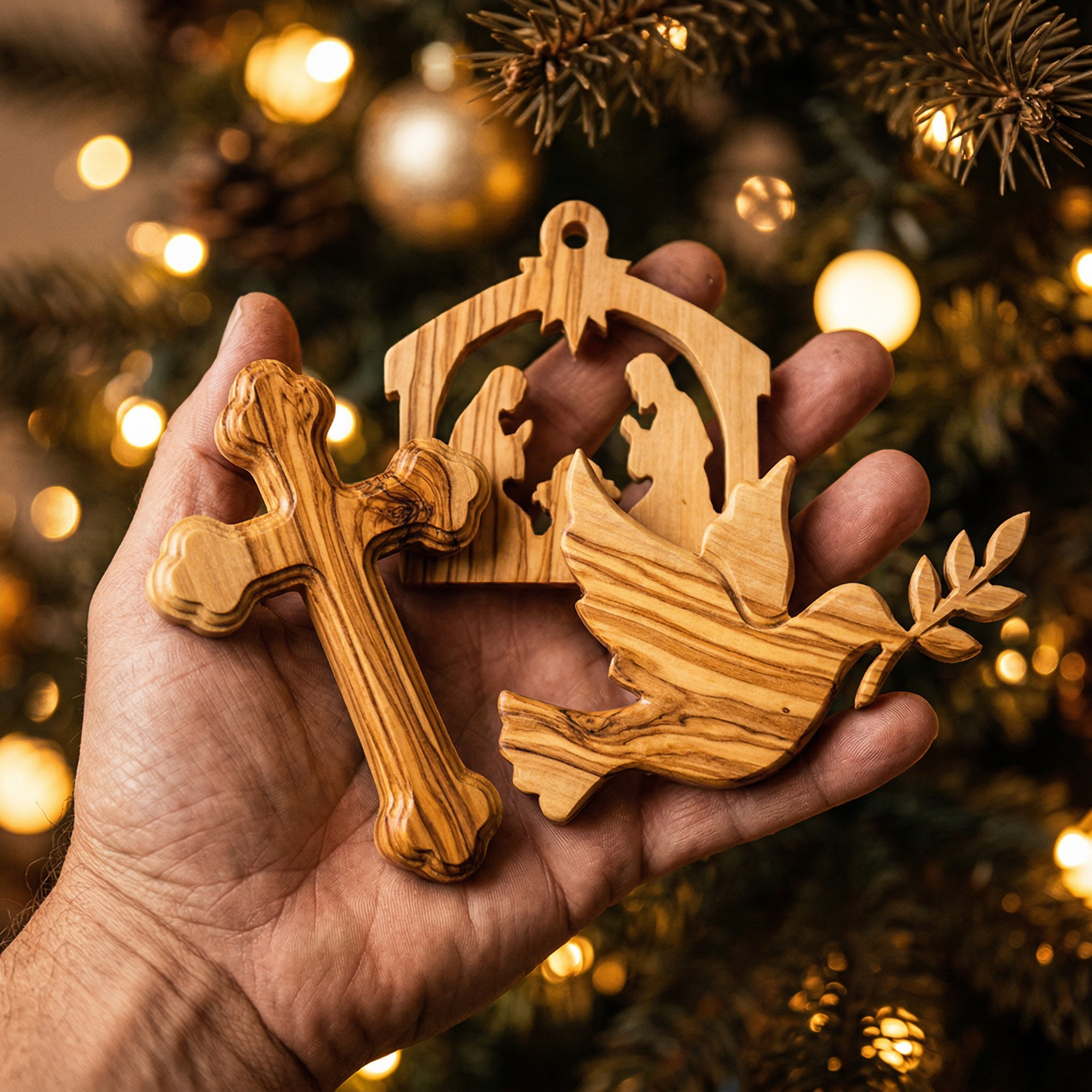
There is a small box in my office that comes out every November.
It has twelve olive wood ornaments in it. I started collecting them the year I made my first visit to Israel. I bought two from a market stall in the Old City and brought them home wrapped in newspaper. The following year a friend who knew I had started collecting brought me one from a workshop in Bethlehem. Then my wife started adding one each year as a Christmas gift until the box held a full set.
What I know now that I did not know when I bought the first two is that not all olive wood ornaments are the same object. Some are made from genuine solid wood with genuine hand-carved detail and will look better in twenty years than they do today. Others are pressed wood or resin with a surface finish that will start to disappoint within a few seasons.
The decisions that separate those two outcomes are not complicated. They just require asking the right questions before ordering.
Before going into each decision, spend a few minutes with these olive wood ornaments carved by craftsmen in the Holy Land. Having a clear visual reference for genuine craftsmanship makes every decision below immediately easier to apply.
Material First: Confirm Solid Olive Wood Before Everything Else
Every other decision in this list depends on the material being right. There is no point choosing a symbol or a size or a carving depth if the wood itself is not what it claims to be.
Genuine olive wood from the Holy Land, specifically from the region around Bethlehem and Jerusalem where the tradition of olive wood carving has been practiced for generations, has specific properties. The grain is tight and fine. The color ranges from pale honey to deep amber with natural darker streaks. The weight is noticeable for a piece of that size. The surface, properly finished, has depth.
No two pieces of genuine olive wood have identical grain, because no two sections of any tree are identical. A set of ornaments from solid olive wood will have variation across the pieces. Some will be lighter in color. Some will have more visible grain contrast. That variation is not inconsistency. It is the signature of the material.
A uniform set where every ornament looks exactly like every other one, same color, same grain pattern, same surface texture, is almost certainly not solid olive wood. Uniformity is the product of machine production using non-wood materials. Variation is the product of genuine wood.
How to verify before buying
Ask the seller specifically whether the ornaments are solid olive wood or a composite. Ask where the wood is sourced. Ask whether the grain varies across individual pieces. A seller who works with genuine materials will confirm all of this readily. A seller who cannot answer specifically is telling you what you need to know.
Choosing the Right Symbol for Your Tree and Your Household
This is the decision most buyers make last, if they make it consciously at all. It should be made first, after confirming the material.
Each symbol on a Holy Land olive wood ornament carries a history. Choosing based on that history rather than just visual preference means you are building a tree with meaning, not just with objects.
|
Symbol |
Biblical and Historical Meaning |
Best For |
|
Cross |
Central symbol of Christian faith |
Any Christian household, most universal |
|
Fish (Ichthys) |
Early Christian symbol, Sea of Galilee connection |
Hebrew roots faith, New Testament focus |
|
Dove |
Holy Spirit, peace, Noah and the flood covenant |
Peace-oriented, interfaith households |
|
Olive branch |
Peace and covenant throughout the Hebrew Bible |
Any household, most historically rooted symbol |
|
Pomegranate |
Righteousness, abundance, seven species of Israel |
Jewish households, Hebrew roots tradition |
|
Menorah |
Temple worship, light, Hanukkah |
Jewish households, Messianic congregations |
|
Star of David |
Jewish identity and covenant |
Jewish households, Hebrew roots believers |
|
Nativity silhouette |
The Bethlehem scene, incarnation |
Christmas-focused households, gift for new parents |
For a household that observes both Jewish and Christian traditions in a Messianic context, a set that combines the olive branch, the fish, the Star of David, and the menorah creates a tree that holds the full theological breadth of that identity in physical form.
Carving Quality: The Detail That Determines Longevity
A well-carved olive wood ornament looks better with age. A poorly carved one does not improve.
The carving quality is what you are actually paying for when the material is already confirmed as genuine. Two pieces of identical olive wood from the same workshop will read completely differently depending on the depth and precision of the carving. The one carved with greater depth will catch light better on the tree, read more clearly from a distance, and retain its character after decades of handling.
When evaluating carving quality in a listing, look for photos taken at an angle rather than straight-on. A photograph taken from slightly to the side of an ornament will show whether the symbol has genuine depth or is a surface marking. If the seller provides only straight-on product photos, ask specifically for an angled close-up of the main symbol.
For ornaments in the three-to-five-centimeter range, the carving needs to be deeper relative to the size of the piece to read clearly. Smaller ornaments with shallow carving become indistinct at tree-hanging distance. Larger ornaments have more surface area to work with and the detail can be more gradual while still reading well.
Size and How Ornaments Work Together on a Tree
According to Encyclopaedia Britannica on the history of Christmas tree traditions, the practice of decorating trees with meaningful objects has roots going back centuries, with the specific objects chosen carrying symbolic significance within the household that displays them. An olive wood ornament from the Holy Land is the kind of object with enough history behind it to anchor that tradition in something deeper than seasonal decoration.
For individual ornaments on a standard tree, pieces between four and eight centimeters in their longest dimension hang well and read clearly at normal tree-viewing distance. Under four centimeters, olive wood ornaments tend to get lost visually among other decorations. Over eight centimeters, they can feel heavy on thinner branches.
If you are buying a set of multiple ornaments, keeping them in a similar size range creates visual coherence on the tree. A set where some pieces are three centimeters and others are nine centimeters will look unbalanced regardless of how good each individual piece is.
Buying as a Gift: The Note That Completes the Gift
An olive wood ornament set from the Holy Land is one of the most distinctive Christmas gifts available. It is also one of the easiest to give without the context that makes it genuinely meaningful rather than simply beautiful.
For a family receiving a first home together, a set of olive wood ornaments with a note about the craftsmen who made them, the land the wood comes from, and what each symbol represents on the tree creates a set of heirlooms rather than a set of decorations.
For a child receiving their first personal ornament, a single hand-carved fish or dove with a short note about the symbol and where it was made is a gift they can carry with them when they have their own tree someday.
For a couple who has everything, a set of symbols chosen specifically for the meanings most relevant to their shared faith or their household tradition is a gift that requires knowing them well enough to choose with intention. That specificity is itself the gift.
Write the note. Every time. It takes three minutes and it is the difference between giving an ornament and giving the story that makes the ornament worth keeping forever.
Conclusion
The twelve ornaments in my November box have been on a tree every year for fourteen years.
They will be on a tree for another forty if I take care of them. Some of them have darkened slightly from oil and handling. The carving on the oldest ones has settled into the wood in a way that makes them look more defined now than when I first hung them.
That outcome came from one set of good decisions made fourteen years ago. The material was confirmed as solid olive wood. The symbols were chosen with their meanings in mind. The carving depth was checked before ordering. The size range was consistent across the set.
Those decisions take ten minutes. The ornaments they produce last a lifetime.
Frequently Asked Questions
How many olive wood ornaments do I need to make a cohesive set?
There is no required number. A set of three to five ornaments of different symbols creates a meaningful thematic presence on any tree without dominating it. A set of eight to twelve can become the primary decorative element of the tree if that is the intention. Many collectors build their sets gradually over years, adding one or two pieces annually, which makes each addition feel intentional rather than a bulk purchase.
Can I mix olive wood ornaments with other tree decorations?
Yes. Olive wood ornaments tend to work well with natural, warm-toned tree decorations because the material itself is warm and natural. They sit less comfortably alongside very bright or highly reflective ornaments that compete with the subtlety of the wood. Many people who collect olive wood ornaments gradually shift their other decorations toward natural materials, dried citrus, linen ribbon, simple glass, to create a tree that lets the wood read clearly.
Are there olive wood ornaments appropriate for Hanukkah or year-round display?
Yes. Ornaments with the menorah, Star of David, pomegranate, or olive branch motif are not specifically Christmas objects and can be displayed year-round or during Hanukkah. A menorah-motif olive wood ornament hung in a window or on a dedicated display branch during the eight days of Hanukkah carries the same material connection to the Holy Land that it does on a Christmas tree.
What is the best way to store olive wood ornaments between seasons?
Store individually in soft cloth or acid-free tissue paper. Do not pack loosely in a box where pieces knock against each other. Keep in a dry location away from temperature extremes. A wooden box or a fabric-lined case is ideal. Avoid plastic bags or sealed containers, which trap moisture and can cause the wood to develop an unpleasant smell over time. A small piece of cedar in the storage box helps deter insects and adds a pleasant scent.
Do olive wood ornaments change in appearance over time?
Yes, and in the right direction. Genuine solid olive wood deepens in color over years of handling and seasonal display. The grain becomes more pronounced as the wood oxidizes slightly. The carved symbols settle into a clearer reading as the surface develops its natural patina. A set of olive wood ornaments that has been handled and displayed for twenty years typically looks richer and more beautiful than the same set looked when it was new.
Is there a way to tell the age of olive wood used in ornaments?
Not precisely, but older olive wood from larger, slower-growing trees tends to have finer and tighter grain than wood from younger trees. The very dense, fine-grained pieces with high contrast between the light and dark sections of the grain typically come from older trees. This is considered the premium end of the material. If grain tightness matters to you, ask the seller whether they can confirm the age range of the trees used in their pieces.
 admin
admin  sheikhomaralsaleh