
By Drake Miller – Academic Strategy Consultant & Career Readiness Advocate
For many high school and university students across the United States, a 2,000-word research paper feels like a relic. In an era of 15-second clips and AI-generated summaries, it’s often dismissed as a “checkbox” for graduation.
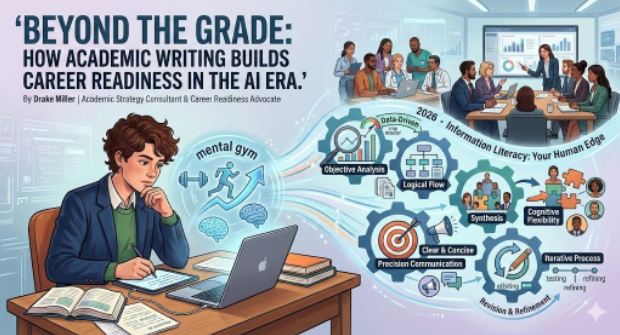
However, as we navigate the 2026 job market, a pattern has emerged among successful professionals: the highest earners aren’t those who memorized the most facts, but those who used academic writing as a “mental gym” to build durable skills. In fact, NACE (National Association of Colleges and Employers) now lists “Communication” and “Critical Thinking” as the top two competencies for career readiness.
1. The Professional “Crap Detector”: Objective Analysis
A thesis statement isn’t just a sentence; it’s an exercise in data-driven decision making. By reviewing thesis statement examples , students can see how a singular, focused argument acts as the foundation for complex analysis. In your future career—whether as a marketing manager or a healthcare admin—you won’t make choices based on a whim. You will analyze market trends and consumer data. By learning to scrutinize sources now, you develop an internal ‘crap detector’ that helps you identify algorithmic bias and ‘hallucinated’ AI results in the workplace.
2. Structured Problem Solving and Logical Flow
Academic writing requires a rigid, logical hierarchy: a problem (intro), evidence (body), and resolution (conclusion). This structure is the exact blueprint used for writing legal briefs, medical reports, or executive summaries.
For students who feel overwhelmed, seeking professional thesis help at Myassignmenthelp.com to write my thesis can actually be a strategic move—if used as a “learning scaffold.” Seeing a high-quality model of a structured argument helps students internalize the logic required to break down complex corporate problems into digestible steps.
3. Synthesizing Stakeholder Perspectives
One of the hardest parts of college-level writing is synthesis—taking conflicting views and weaving them into a new conclusion. This is the definition of “cognitive flexibility.” In your career, you will rarely work in a vacuum; you’ll be balancing the needs of a budget, a diverse team, and client expectations. The synthesis you practice in a sociology paper is the same mental process used to manage a multi-department project.
4. Precision Communication: Killing the “Fluff”
In the high-stakes US workplace, miscommunication costs businesses billions annually. Academic writing teaches you to eliminate ambiguity and choose the “right” terminology. If you can communicate a complex idea clearly and concisely, you become an indispensable asset to any C-suite or leadership team.
5. The Iterative Process: Embracing Revision
No great paper is a first draft. The discipline of proofreading and editing builds intellectual humility. Tech giants like Google thrive on “iteration”—testing, failing, and refining. Learning to look at your own work critically separates entry-level employees from industry experts.
6. Information Literacy: Your Human Edge
While Generative AI can generate text, it cannot provide strategic verification. Academic writing teaches you the “why” behind a conclusion. In a world where AI can write the email, the person who can verify the facts and strategize the implementation is the one who gets promoted.
Frequently Asked Questions
Q.1 How does writing help if my career is technical (e.g., Coding or Engineering)?
Even “Software Engineers” must present cases for new features, defend technical decisions, and write documentation. This is “Strategic Communication,” and it’s how you get your projects funded.
Q.2 Can I use AI for my assignments in 2026?
Use AI as a brainstorming partner, but never let it do the “thinking.” If you let a machine do the heavy lifting, your analytical muscles will atrophy, leaving you unprepared for high-level professional roles.
Q.3 What should I do if I am struggling to meet writing standards?
Break the task into “micro-goals.” Don’t be afraid to use educational scaffolds. Whether it’s a university writing center or a professional service, studying a well-structured model of an assignment can provide the clarity you need to succeed.
About the Author: Drake Miller
Drake Miller is a Texas-based career strategist with 15+ years of experience bridging the gap between academic theory and professional practice. He holds an M.A. in Rhetoric and specializes in helping students develop the persuasive writing skills required for the modern US workforce.
 London Rug Company
  norenjackson
  threedtekinc